
In high-throughput AI training pipelines, traditional data paths copy files from NVMe storage into host CPU memory (sysmem) before routing them to the GPU. How does NVIDIA GPUDirect Storage (GDS) optimize this data flow to reduce latency and host CPU overhead?
Select an answer to reveal the explanation.
Short Explanation and Infographic
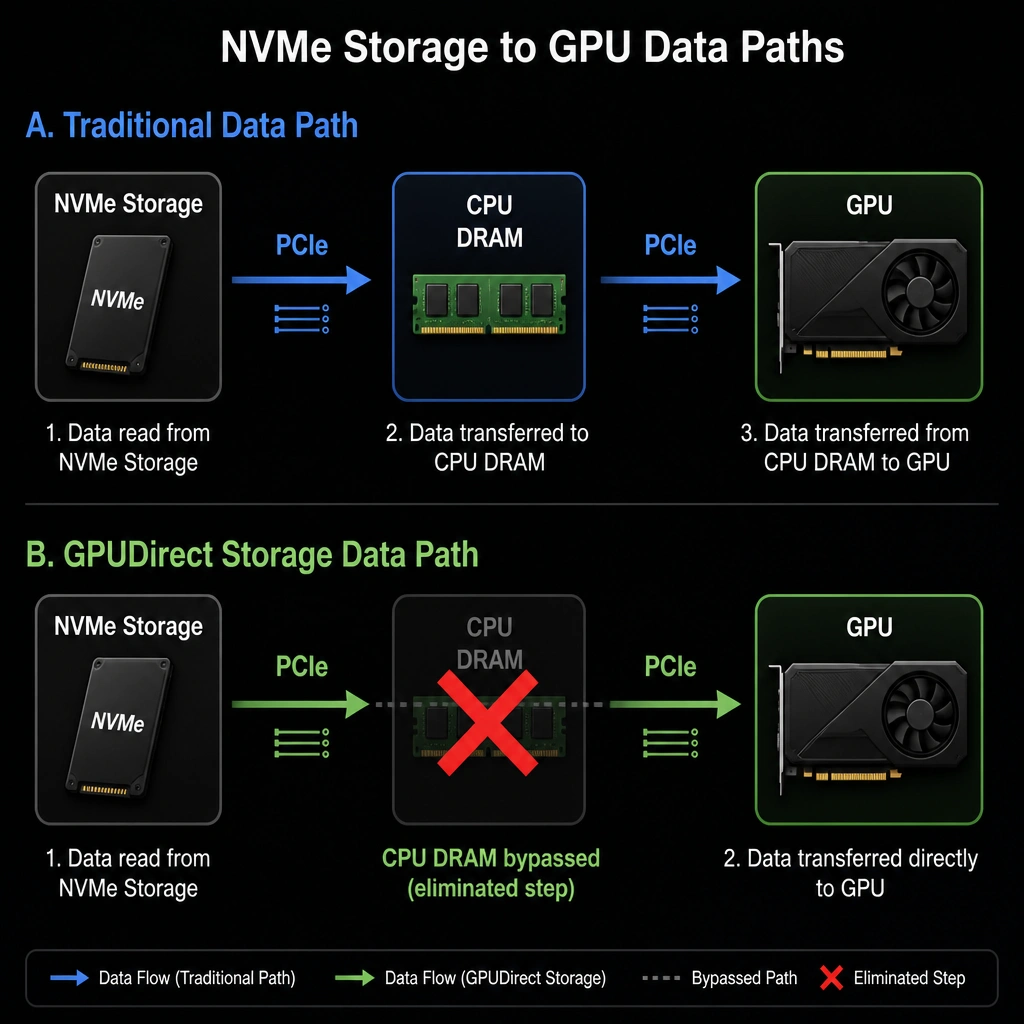
Check this out: in a normal network, when your GPU needs data from an NVMe drive, the data has to take a long, exhausting detour. It goes from the storage drive, travels over the PCIe bus, lands in the host CPU's memory (DRAM), and then the CPU copies it right back over PCIe to the GPU memory. Talk about a bottleneck! GPUDirect Storage (GDS) fixes this by establishing a direct DMA highway between your NVMe storage and your GPU memory. The CPU doesn't have to touch it, and system memory is bypassed. This drops latency and frees up your host CPU to do actual processing. Trust me on this, when you're feeding hungry GPUs, keeping the CPU out of the I/O path is a game-changer.
Full explanation below image
Full Explanation
NVIDIA GPUDirect Storage (GDS) is a technology designed to optimize the data path between local or remote storage (such as NVMe or NVMe over Fabrics) and GPU memory (HBM). In traditional storage access methods, data must first be read into system memory (DRAM) bounce buffers managed by the CPU, and then copied to GPU memory. This indirect path introduces significant latency, limits throughput to system memory bus speeds, and creates CPU bottlenecks during intensive deep learning training runs.
GDS bypasses the CPU and system memory by creating a direct memory access (DMA) path between storage and GPU memory via PCIe switches. This reduces latency, increases end-to-end bandwidth, and frees up CPU cores and system DRAM for other tasks.
Let's address why the incorrect options are wrong: - GDS does not perform real-time data compression or decompression; it is strictly a hardware routing and direct memory access protocol. - GDS does not cache data in system DRAM; in fact, bypassing system DRAM is a core feature to prevent memory bandwidth starvation. - GDS is not responsible for data validation or error correction; those functions are handled at the filesystem or application levels, not by the direct I/O data path.