
A research university needs to acquire enterprise-grade GPUs to train complex 3D computer vision models for medical scan analysis. The team requires high-bandwidth memory (HBM) and data center reliability for multi-day training runs but is constrained by a moderate budget that cannot support flagship Hopper-architecture GPUs. Which GPU provides the most cost-effective solution for their server cluster?
Select an answer to reveal the explanation.
Short Explanation and Infographic
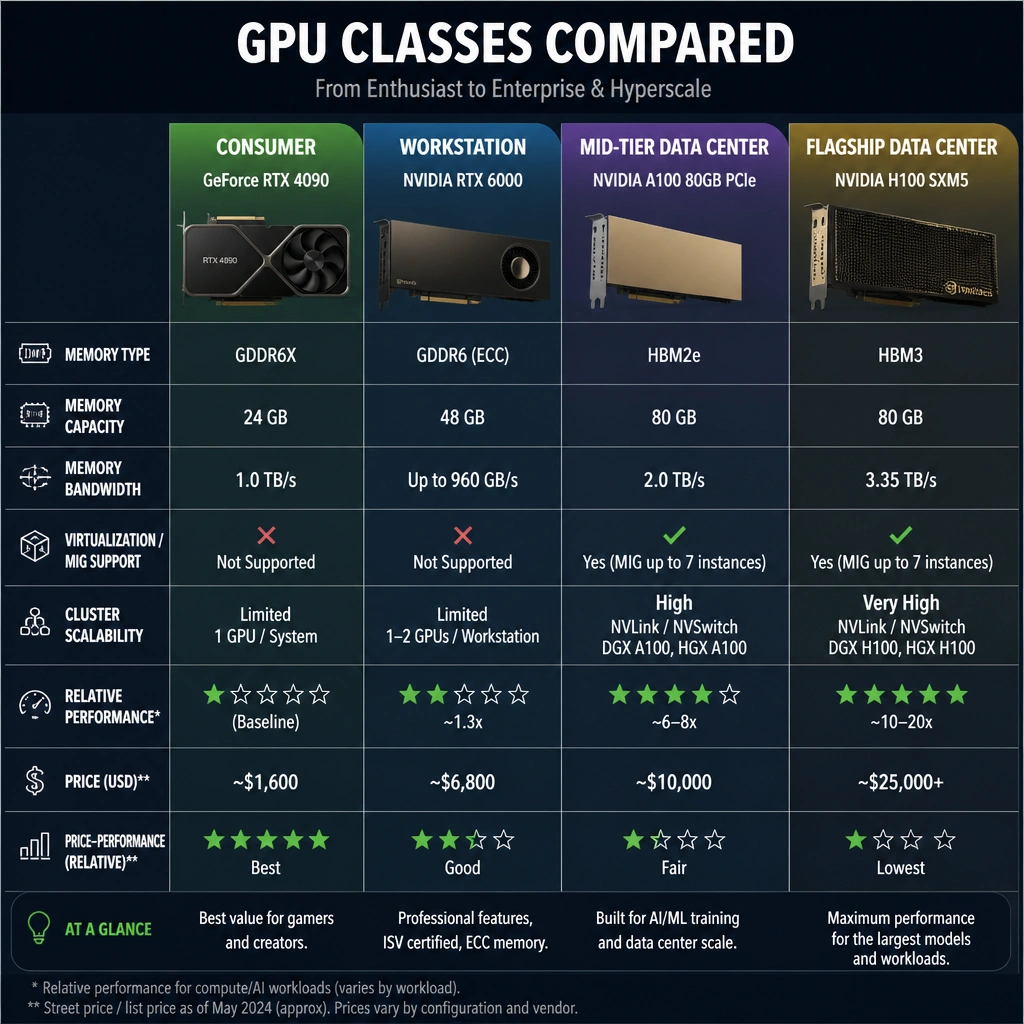
Alright, let's look at this from a budget-versus-performance angle. If you've got an open checkbook, you buy the flagship H100. But in the real world, research labs have strict budgets. You need enterprise stability—meaning ECC memory and proper cooling—and you need massive memory bandwidth to handle those heavy 3D medical scans. The NVIDIA A100 Tensor Core GPU is your goldilocks choice. It gives you enterprise data center features like Multi-Instance GPU (MIG) and high-bandwidth memory (HBM2) without the massive price tag of the Hopper series. Sure, consumer cards like the RTX 4090 are fast, but they aren't built for enterprise clusters, and workstation cards like the RTX 6000 are designed for rendering, not high-scale deep learning training. The A100 is the sweet spot.
Full explanation below image
Full Explanation
Selecting GPUs for deep learning workloads requires balancing computational capacity, memory bandwidth, enterprise reliability, and budget. Training medical imaging models involving large 3D arrays requires high-bandwidth memory (HBM) and support for multi-GPU communication technologies like NVLink.
The NVIDIA A100 Tensor Core GPU is the most cost-effective choice for this scenario. It provides data-center-class reliability, high-bandwidth memory (up to 80GB HBM2e), and enterprise virtualization features like Multi-Instance GPU (MIG) at a much lower price point than the flagship H100 (Hopper) GPU.
Analyzing the distractors: - The NVIDIA H100 offers superior performance but carries a premium price that exceeds the constraints of a mid-tier research budget. - The NVIDIA RTX 6000 (Ada Generation) is a workstation GPU optimized for professional graphics and design. While it has 48GB of GDDR6 memory, it lacks HBM and is not designed for scale-out server deployment. - The GeForce RTX 4090 is a consumer gaming GPU. It lacks ECC memory, does not support enterprise scale-out clusters, and is prohibited from data center use under NVIDIA's licensing terms.