
A systems engineer is designing a low-latency network cluster for high-performance computing (HPC) and needs a technology that enables servers to read or write directly to each other's memory spaces. The solution must achieve near-zero copy data transfer and avoid involving the host operating system or CPU in the transfer path. Which technology should they implement?
Select an answer to reveal the explanation.
Short Explanation and Infographic
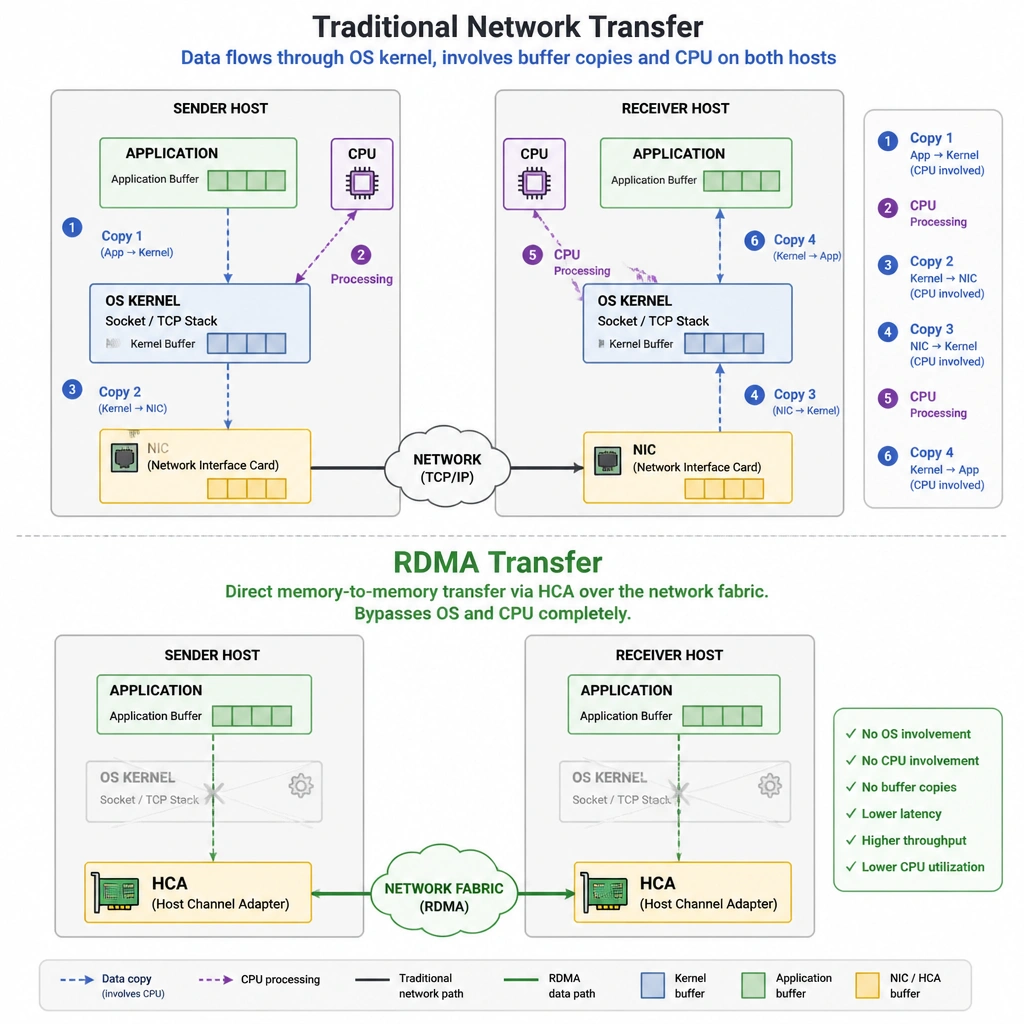
Here's the deal: if you want to run high-performance AI workloads, you can't have your CPU sitting around copying data back and forth between system buffers. That's a massive performance killer! Remote Direct Memory Access (RDMA) is the technology you need. Think of it like a VIP direct pass. Instead of sending data up and down the operating system's networking stack on both ends, RDMA lets one server write directly into the memory of another server over the network. Zero-copy, no CPU overhead, and microsecond latency. Pretty cool, right? Always remember this for the exam: if you need near-zero copy and low CPU overhead in HPC, RDMA is your answer.
Full explanation below image
Full Explanation
Remote Direct Memory Access (RDMA) is a high-performance networking technology that allows computers in a network to exchange data directly from their main memory without involving the operating system, cache, or CPU of either host. By bypassing the kernel stack and eliminating the need for data buffering or copying between host operating system memory and application memory (zero-copy), RDMA reduces latency to microseconds and significantly lowers CPU utilization. This makes it vital for clustered database systems, distributed machine learning, and high-performance computing (HPC) fabrics.
Let's look at the other options: - TCP/IP Offload Engine (TOE) offloads the processing of the TCP/IP stack to the network interface card (NIC), which reduces CPU overhead, but it still relies on traditional kernel-level data copying and does not support true zero-copy direct memory access. - Quality of Service (QoS) manages network resources by prioritizing specific types of traffic (e.g., voice or high-priority control packets), but it does not change how data is transferred between system memory and the network card. - Virtual Local Area Networks (VLANs) segment a physical network into logical broadcast domains at Layer 2 to improve security and traffic isolation, which has no effect on memory copy overhead or host CPU processing.