
What is the primary operational advantage of deploying a dedicated Out-of-Band Management (OOBM) network for the hardware infrastructure in an AI data center?
Select an answer to reveal the explanation.
Short Explanation and Infographic
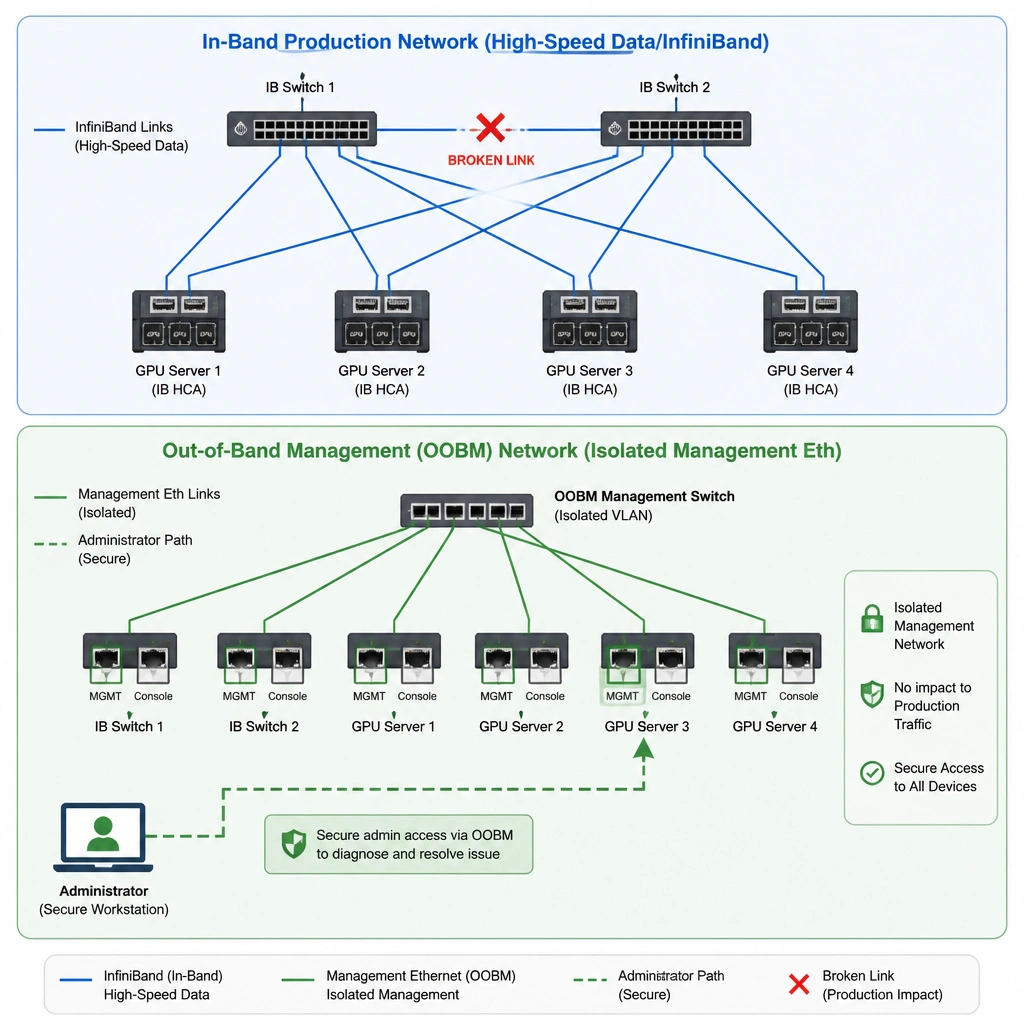
Here's the deal: imagine you're modifying a core switch config on your AI network, you hit enter, and suddenly the screen goes dead. You just cut your own connection! If you were relying on 'In-Band' management—meaning you manage the device over the same network that carries the data traffic—you are now officially locked out. You'd have to drive to the data center with a console cable. Trust me, nobody wants to do that at 2:00 AM! Out-of-Band Management (OOBM) gives you a dedicated, completely separate network path to your switches and server BMCs (like IPMI or iLO). Even if the main production network is completely crashed, congested, or misconfigured, you can still log in, reboot the gear, revert the config, and save the day. It's an absolute lifesaver. Got it? Sweet.
Full explanation below image
Full Explanation
Out-of-Band Management (OOBM) refers to a network management architecture that establishes a dedicated, independent communication path to network switches, routers, firewalls, and server management processors (such as Baseboard Management Controllers - BMCs). This stands in contrast to 'In-Band Management,' where administrative traffic travels alongside production data traffic on the same physical and logical network links.
The primary objective of OOBM is to ensure high availability and disaster recovery capabilities for infrastructure administrators. If a primary network switch fails, suffers a misconfiguration, or is saturated by a massive AI training workload or DDoS attack, standard in-band management channels (like SSH over the production network) become unresponsive. With an OOBM network in place—typically consisting of a separate low-speed Ethernet network connected to console ports or management interfaces (such as IPMI, iDRAC, or ILO)—administrators can access the device's console interface to run diagnostics, reboot the system, or restore working configuration files.
Let's examine why the other choices are incorrect: - Option A: Prioritizing traffic based on application needs (like AI inference latency) is a function of Quality of Service (QoS) configurations on the production network, not the management plane. - Option C: Dynamic adjustment of cooling or environment parameters based on storage traffic is a function of data center facility automation and telemetry systems, which is outside the scope of OOBM. - Option D: Rescheduling workloads due to packet loss is handled by cluster management and scheduling software (like Kubernetes or Slurm) acting on resource metrics, not the OOBM interface. - Therefore, the correct answer is B.