
Within an AI cluster orchestrator, which component performs the algorithmic task of assigning incoming workloads to specific nodes by evaluating real-time GPU availability, system memory capacity, and user job priority?
Select an answer to reveal the explanation.
Short Explanation and Infographic
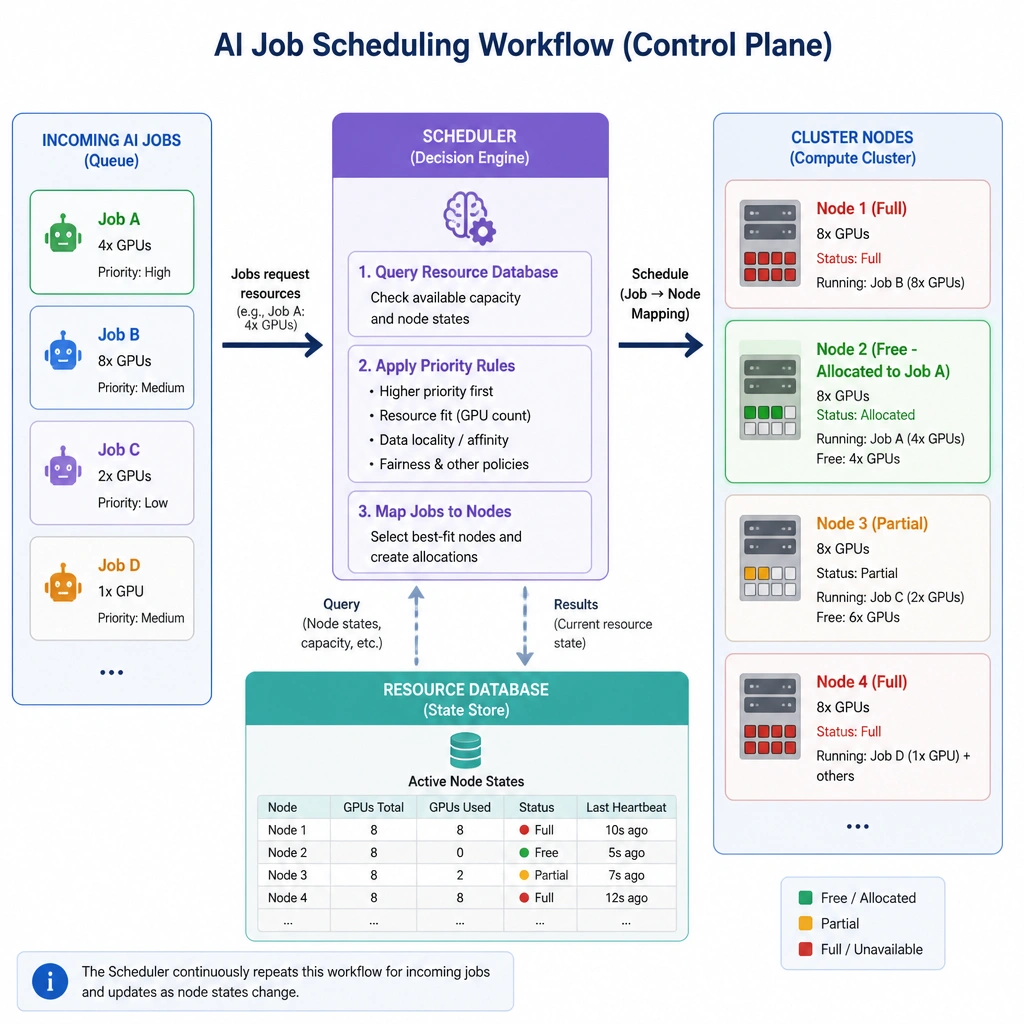
Let's dive in. Think of an AI cluster like a busy airport. You've got planes (your AI training jobs) constantly arriving, and they all need specific gates (GPU nodes) that can handle their size, fuel capacity, and priority. The component acting as the air traffic controller, making the final decision on where and when each plane lands, is the Scheduler. The scheduler looks at the job's resource requests—like 'I need 8 NVIDIA H100 GPUs and 512GB of system RAM'—scans the cluster to see which nodes are open, and schedules the job onto the best host. Don't confuse it with the Resource Manager, which just catalogs the available assets, or the Controller, which handles repairs and keeps things running. Got it? Sweet.
Full explanation below image
Full Explanation
In cluster orchestration frameworks (such as Kubernetes, Slurm, or Nomad), responsibilities are split among distinct control plane components to ensure scalable and reliable operations. The component responsible for making placement decisions—matching pending workloads to execution hosts—is the Scheduler.
When a workload is submitted, the Scheduler evaluates the job's constraints and requirements against the current state of the cluster nodes. These constraints include: - Hardware Requirements: Number of GPUs, GPU model types, CPU cores, and system memory. - Affinity and Anti-affinity Rules: Directives specifying that certain containers must run together or must be separated on different physical hosts. - Job Priority and Preemption: Determining whether a high-priority job should displace an active low-priority job. Once a suitable node is selected, the scheduler binds the workload to that node, passing execution control to the node-level agent (such as the Kubelet in Kubernetes).
Let's evaluate the incorrect options: - Service Discovery (Option B): This component enables different services and containers within the cluster to locate and communicate with each other dynamically via DNS or internal routing, but it has no role in workload placement. - Resource Manager (Option C): This component tracks the allocation and inventory of physical assets (like registered GPUs or CPU cores) across the cluster. While the scheduler queries the resource manager to get current status, the resource manager itself does not make placement decisions. - Controller (Option D): The controller (or controller manager) continuously monitors the cluster's state, comparing the actual state with the desired state and performing actions (like restarting failed pods or scaling replica sets) to resolve differences. - Therefore, the correct answer is A.