
A systems administrator is configuring a Slurm cluster to run containerized deep learning workloads. Which set of container runtime environments can be natively integrated with Slurm to execute these tasks?
Select an answer to reveal the explanation.
Short Explanation and Infographic
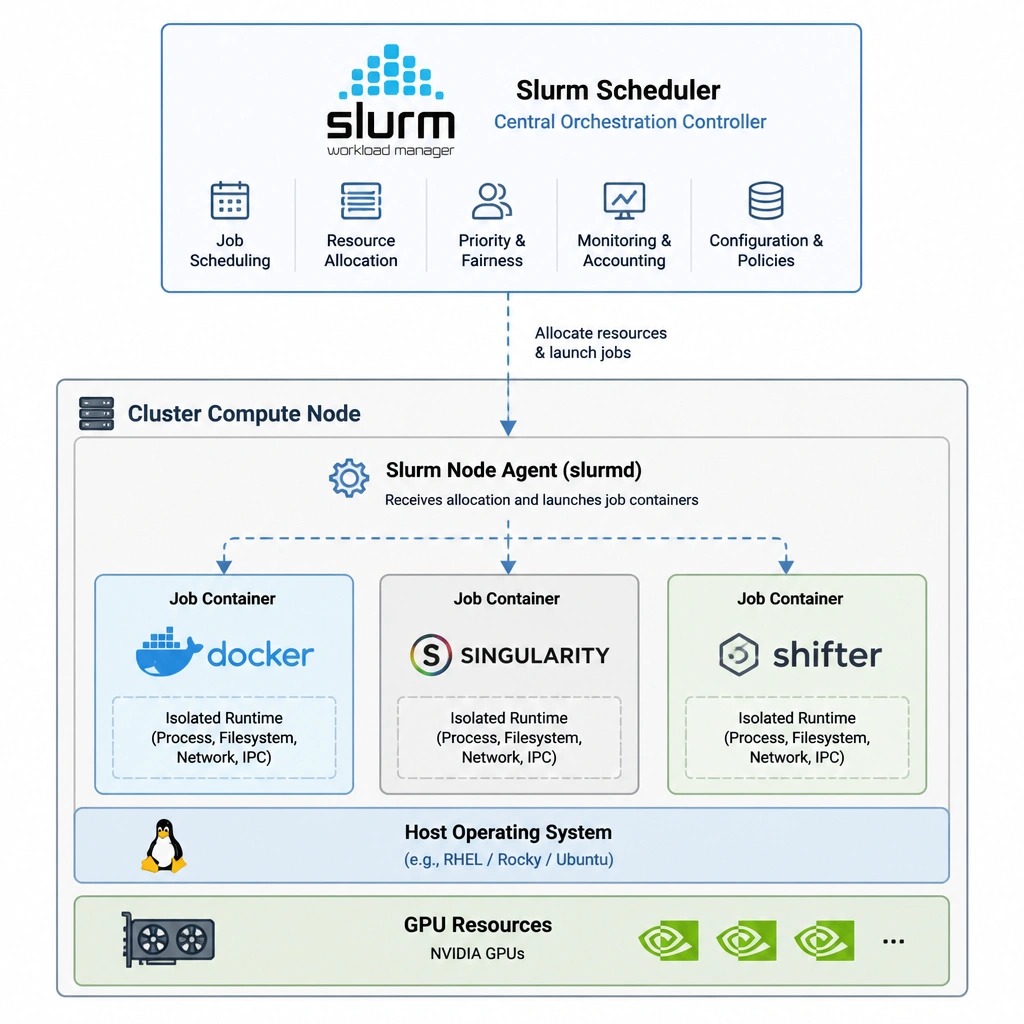
Here's the deal: in the high-performance computing (HPC) world, Slurm is the undisputed king of job scheduling. But when researchers want to run their deep learning models, they don't want to install dependencies directly on the cluster nodes. They want to use containers. So, what containers can you run inside a Slurm job? Many people think it's just Docker, but trust me on this, that's a huge misconception! In HPC, Docker can be a security risk because it runs as root. That's why Slurm natively supports Docker, Singularity (which is super popular in HPC because it runs with user privileges), and Shifter (which is built for supercomputing platforms). Together, these runtimes let you run containerized workloads cleanly and securely. Got it? Let's keep rolling.
Full explanation below image
Full Explanation
Slurm (Simple Linux Utility for Resource Management) is a widely used open-source cluster management and job scheduling system for Linux clusters. In modern AI and HPC environments, containerization is essential to package complex dependency stacks (such as PyTorch, TensorFlow, CUDA libraries, and python dependencies) and ensure portability across different cluster nodes.
Slurm natively supports multiple container runtime technologies through built-in integrations and plugins (such as SPANK plugins): - Docker: While widely used in enterprise development, standard Docker containers require a background daemon running with root privileges, which can present security concerns in shared multi-tenant HPC environments. - Singularity (now Apptainer): Specifically designed for HPC environments. Singularity allows users to run containers using their own user privileges without requiring root access, making it highly secure and compatible with existing cluster file systems (like Lustre or GPFS). - Shifter: Developed by NERSC, Shifter converts Docker images into a format optimized for execution on supercomputing architectures, integrating with high-performance interconnects and parallel file systems.
Let's evaluate the incorrect choices: - Option A is incorrect because Slurm is not restricted to running only Docker; it natively integrates with other runtimes. - Option B is incorrect because Kubernetes is a separate orchestrator. While Slurm and Kubernetes can co-exist, Slurm does not natively orchestrate Kubernetes pods; it schedules jobs directly on cluster nodes. - Option D is incorrect because Slurm manages job execution on bare-metal operating systems or containers, and is not designed to run workloads exclusively in virtual machines managed by hypervisors like VMware ESXi. - Therefore, the correct answer is C.