
A bank is designing an AI-driven, real-time transaction screening engine that must achieve single-digit millisecond response times while adhering to strict PCI-DSS data privacy standards. Why would an on-premises private AI cloud be preferred over a public cloud environment for this deployment?
Select an answer to reveal the explanation.
Short Explanation and Infographic
Imagine your boss walks in and says, 'We need to deploy a real-time fraud detection system. Every transaction needs to be scanned in less than 5 milliseconds, and if we leak any cardholder data, we're in major regulatory trouble.' Here's the deal: if you host this model in the public cloud, every single swipe has to travel over the internet, hit the cloud server, run the model, and travel all the way back. That WAN latency will kill your response time! Plus, regulatory compliance like PCI-DSS gets way more complicated when data leaves your physical building. By keeping your GPU cluster on-premises, right next to your transactional database, you get blazing-fast, single-digit millisecond speeds and you keep total control over your security boundaries. The cloud has its place, but for low latency and high compliance, on-premises wins hands down. Got it? Let's keep rolling.
Full explanation below image
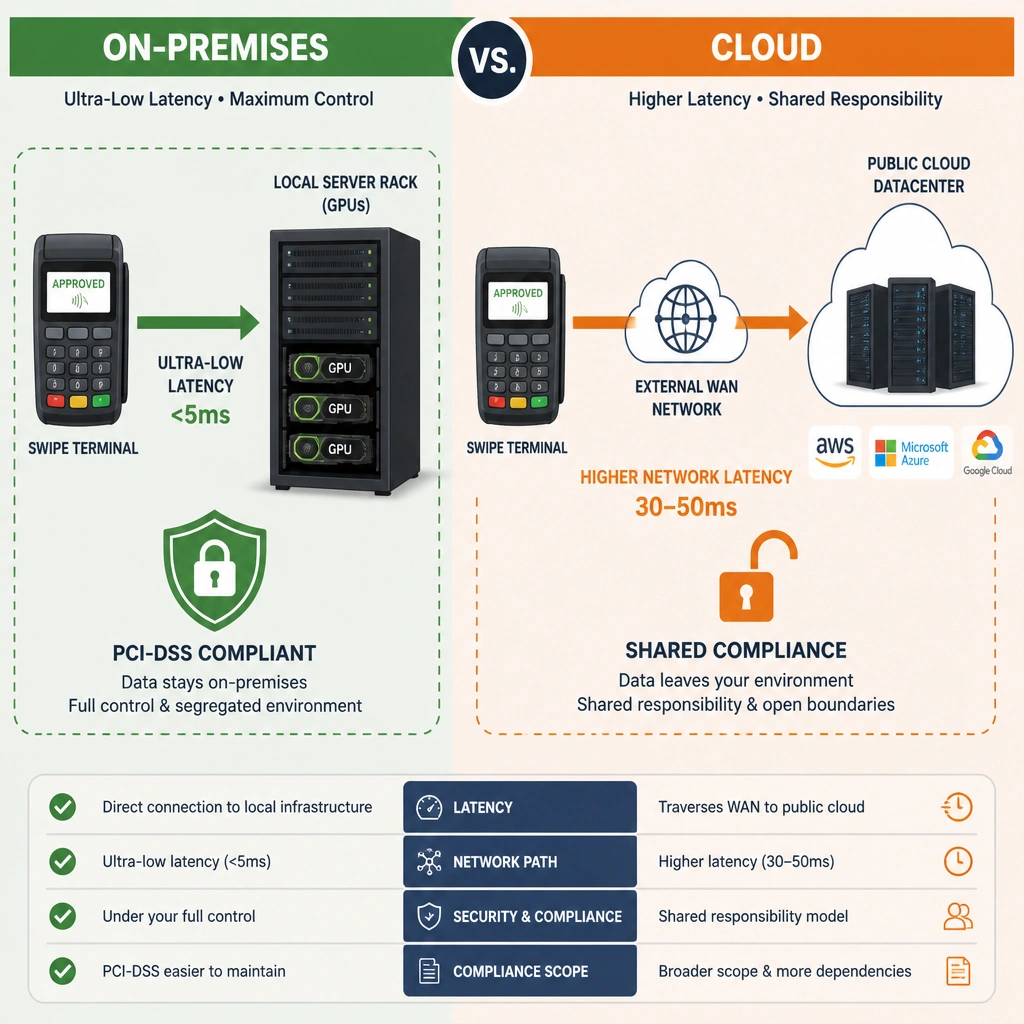
Full Explanation
When deciding between on-premises and public cloud infrastructure for AI deployment, organizations must weigh factors such as capital investment, scalability, latency, and compliance. For a real-time fraud detection system in a financial institution, two variables dominate the decision: latency requirements and regulatory compliance.
1. Ultra-Low Latency: Real-time transaction processing typically requires decision-making within milliseconds. Utilizing public cloud infrastructure introduces WAN transit delays as transaction requests travel over the internet or dedicated leased lines to remote cloud data centers. Hosting the inference engines on-premises, directly adjacent to core transactional databases, minimizes network hops and ensures predictable, sub-millisecond network latency. 2. Regulatory Compliance and Data Control: Standards such as the Payment Card Industry Data Security Standard (PCI-DSS) impose rigid requirements on how sensitive cardholder data is handled, stored, and transmitted. On-premises deployments give the organization absolute control over physical security, network partitioning, data encryption keys, and system logging. This simplifies compliance audits compared to public cloud environments, where data boundaries are shared and cloud provider compliance maps must be audited.
Let's evaluate the incorrect choices: - Option A is incorrect because simplified management and automatic software updates are major benefits of cloud-based environments (Software/Infrastructure as a Service), not on-premises setups, which require local administrative overhead. - Option B is incorrect because automatic and instant elastic scaling is a hallmark benefit of the public cloud's vast, on-demand resource pool. On-premises scaling is constrained by physical hardware acquisition and provisioning lead times. - Option C is incorrect because public clouds reduce initial capital expenditure (CapEx) by using a pay-as-you-go operating expense (OpEx) model, whereas on-premises deployments require significant upfront capital to buy GPUs and server infrastructure. - Therefore, the correct answer is D.