
Which key characteristics and architectural features make InfiniBand the standard networking choice for high-performance computing (HPC) and multi-node AI training clusters? (Select all that apply)
Select all correct answers, then click Submit.
Short Explanation and Infographic
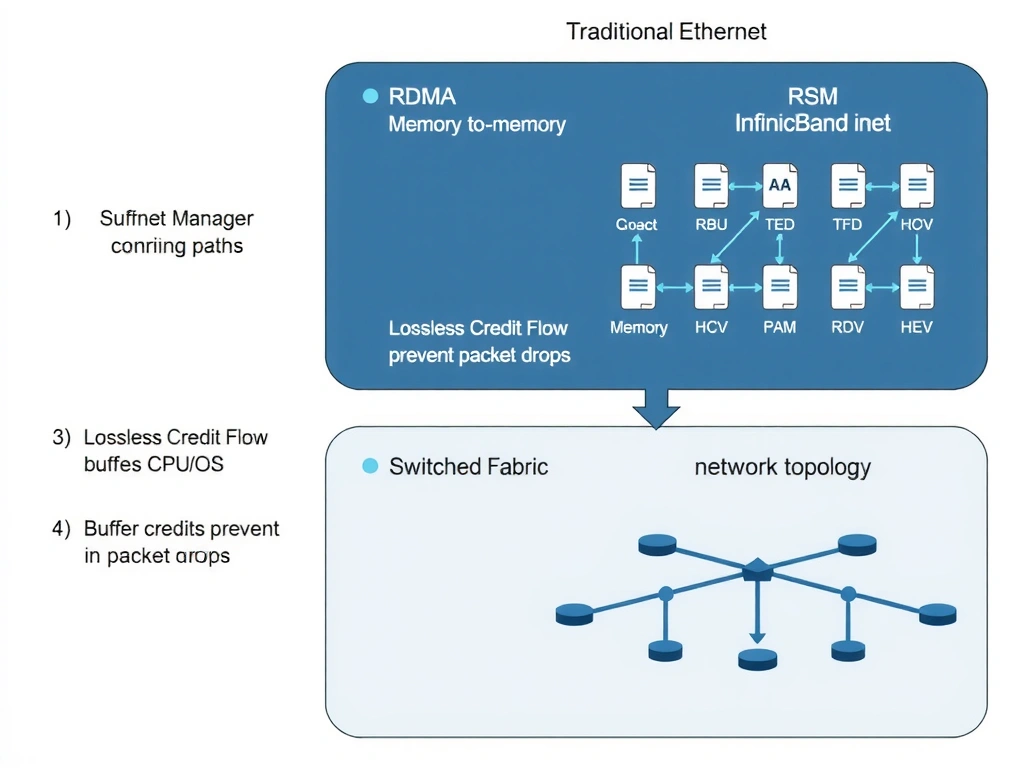
Now, here's where it gets interesting for you if you're building high-performance AI clusters. Standard Ethernet is great for general office traffic or web surfing, but it's terrible for clustering GPUs. Why? Because Ethernet is 'best-effort'—it drops packets when it gets busy and relies on TCP to retransmit them. That's a huge latency killer. InfiniBand, on the other hand, is a totally different beast. First, it uses a switched fabric architecture to give you massive scalability with point-to-point connections. Second, it's a lossless fabric that uses hardware-based credit flow control so it never drops packets. Third, it has native RDMA, allowing one server to write directly into another server's memory without bugging the CPU. And finally, a Subnet Manager centrally handles routing and topology. Make sure you know these for the exam! Got it? Sweet.
Full explanation below image
Full Explanation
InfiniBand is the industry-standard interconnect technology for high-performance computing (HPC) and deep learning clusters due to its specialized features designed for high throughput, extremely low latency, and low CPU overhead.
Let's analyze the correct technical characteristics of InfiniBand: - Switched Fabric Topology (Option A): Unlike shared-medium networks, a switched fabric topology allows multiple point-to-point connections to occur simultaneously. This provides scalable aggregate bandwidth and predictable, low-latency communication. - Subnet Management (Option B): InfiniBand networks rely on a centralized software agent called the Subnet Manager (SM). The SM discovers the physical topology, assigns local identifiers (LIDs), configures routing tables, and manages paths, which guarantees efficient fabric routing and quick recovery from link failures. - Lossless Fabric via Credit-based Flow Control (Option C): To prevent packet loss, InfiniBand employs a link-level, credit-based flow control mechanism. A sending port can only transmit a packet if the receiving buffer at the other end has enough 'credits' (space) to store it. This prevents buffer overflows and eliminates packet loss due to congestion. - Native RDMA (Option E): Remote Direct Memory Access allows a network adapter to transfer data directly from the memory of one host to the memory of another. This transfer bypasses the operating system kernel, the TCP/IP stack, and the host CPU on both ends, reducing latency from milliseconds to microseconds and freeing up CPU cycles for computational tasks.
Let's evaluate the incorrect choices: - Option D (Shared bus-based media) is incorrect because bus architectures suffer from severe scalability bottlenecks and collision domains, whereas InfiniBand uses high-speed switched fabrics. - Option F (Best-effort delivery) is incorrect because best-effort delivery allows packets to be dropped during congestion, requiring slow retransmissions. InfiniBand is strictly lossless to ensure deterministic high-speed performance. - Therefore, the correct answers are A, B, C, and E.