
A networking architect is evaluating interconnect options for a new supercomputing cluster. Which of the following technical features distinguish InfiniBand as the preferred technology over traditional Ethernet for large-scale HPC fabrics? (Select all that apply)
Select all correct answers, then click Submit.
Short Explanation and Infographic
Here's the deal: standard Ethernet is great for general office traffic, but it's terrible for clustering supercomputers. Ethernet uses a best-effort delivery model where packet drops are normal and TCP has to clean up the mess. That's a huge latency killer! InfiniBand, on the other hand, is a switched fabric that uses point-to-point paths instead of a shared bus. It's strictly lossless, using credit-based flow control to prevent packet loss entirely. Add in native RDMA for direct memory transfers and a centralized Subnet Manager to handle routing and configuration, and you've got the ultimate supercomputing recipe. Remember: it's switched fabric, not bus-based, and it's lossless, not best-effort!
Full explanation below image
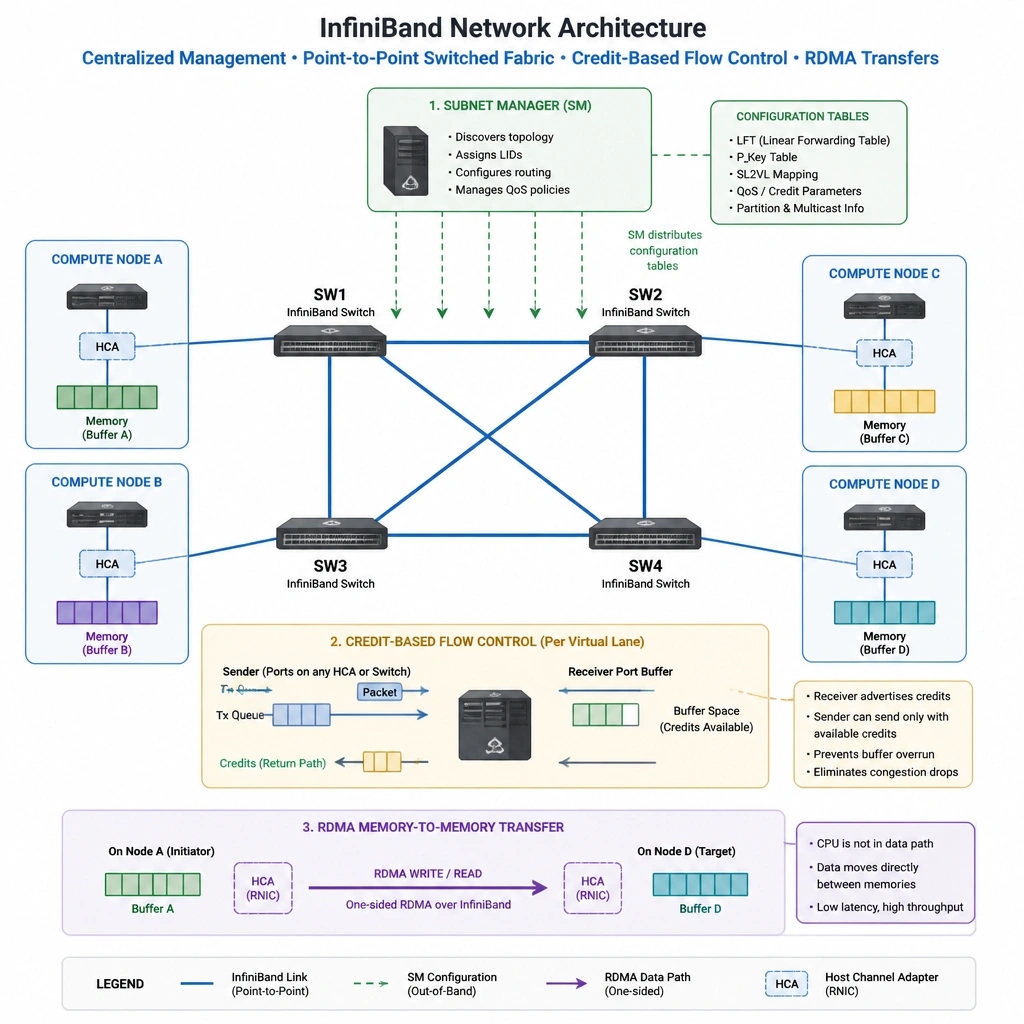
Full Explanation
InfiniBand is designed from the ground up to support the extreme performance, low-latency, and high-throughput requirements of supercomputing and HPC environments. Its distinguishing features include: - Subnet Management: InfiniBand networks are managed centrally by a Subnet Manager (SM). The SM discovers the physical topology, assigns Local Identifiers (LIDs), configures routing tables, and manages paths, ensuring deterministic routing and rapid failover. - Native RDMA: Remote Direct Memory Access allows direct data transfers between the memory spaces of compute nodes without kernel or CPU intervention, resulting in microsecond-level latency. - Switched Fabric Architecture: Unlike legacy shared-bus architectures, InfiniBand employs a switched fabric where endpoints communicate via dedicated, simultaneous point-to-point links. - Lossless Fabric: A credit-based flow control mechanism prevents buffer overflows at the link level, ensuring that packets are never dropped due to congestion.
Let's examine why the incorrect options fail: - Best-effort delivery (D) is typical of Ethernet networks where packets can be dropped and must be retransmitted. InfiniBand is deterministic and lossless. - Bus-based architecture (E) sharing a single medium among devices is a legacy topology that creates massive collisions and limits bandwidth scaling, whereas InfiniBand uses switched fabric.