
When migrating massive datasets for deep learning projects from local storage arrays to cloud object storage, which method ensures the highest level of assurance that no data corruption or structure loss occurred during transit?
Select an answer to reveal the explanation.
Short Explanation and Infographic
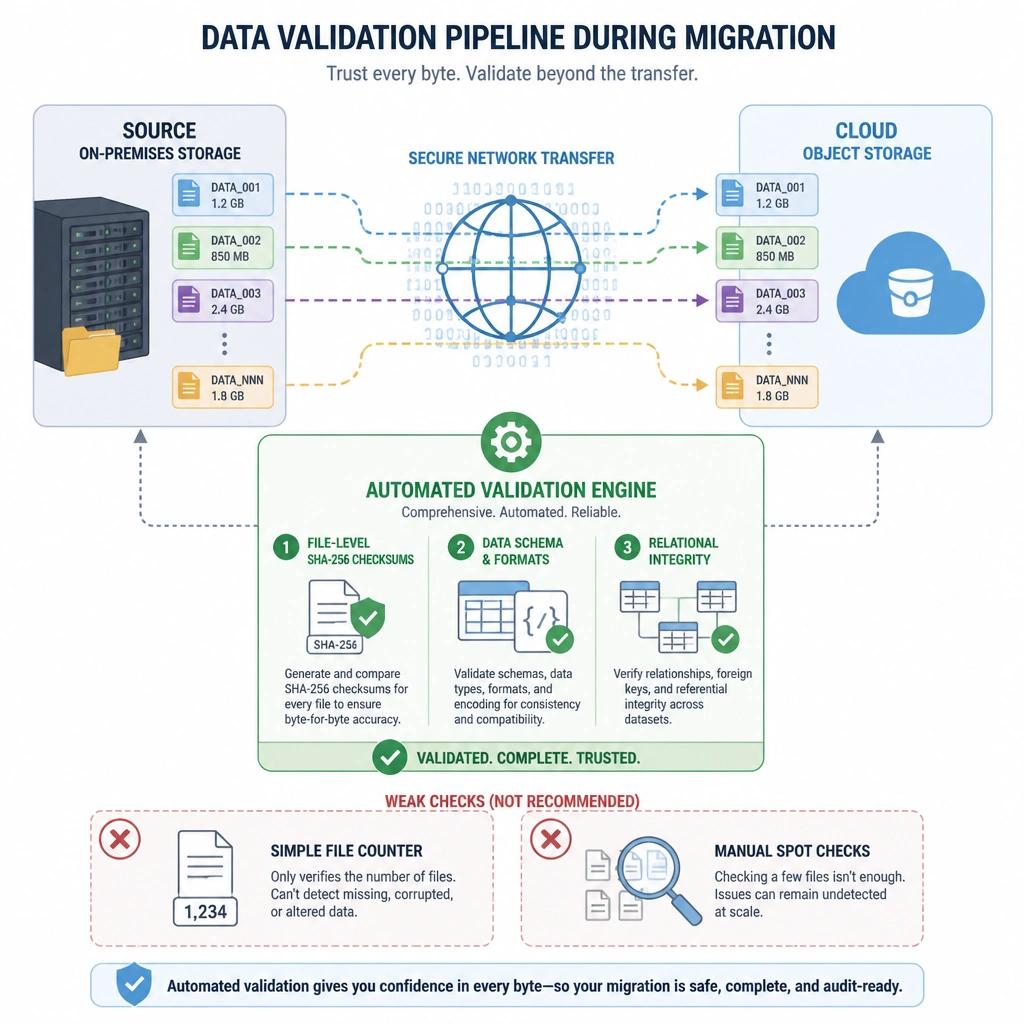
Here's the deal: migrating massive datasets to the cloud is stressful. I remember when we moved a huge training set and thought everything was perfect because the file counts matched. Guess what? Several files were corrupted during the upload, and our model training crashed three days later! Trust me, simply comparing file sizes or counting files isn't enough. And don't just rely on the cloud provider's migration logs—they only tell you the transfer tool didn't crash. To sleep well at night, you need to run automated end-to-end consistency checks. This means comparing cryptographic hashes (like MD5 or SHA-256) of every single file, checking the formats, and verifying relationships in your data. It's the only way to be absolutely sure your training data is pristine. Got it? Sweet.
Full explanation below image
Full Explanation
Data integrity is critical when migrating large datasets for machine learning workflows. Even minor data corruption or format changes can cause training jobs to fail or, worse, introduce silent biases and errors during training that are difficult to debug. Therefore, a robust validation process must go beyond superficial checks.
Let's evaluate the options to understand why automated end-to-end consistency verification is the best practice: - Cryptographic Checksums and Values: Generating hash values (e.g., SHA-256 or MD5) for each file on the source system and comparing them to hashes generated on the destination system ensures that not a single bit has changed during transit. - Format and Schema Validation: Verifying that data structures, database relationships, and file encodings remain identical is crucial, as some cloud migration tools may convert line endings or alter metadata. - Automation: Given the scale of AI datasets (often millions of files), this process must be fully automated to be practical and error-free.
Let's look at why the other options are insufficient: - Option A (comparing file counts and storage size) is vulnerable to silent data corruption, where a file's size remains identical but internal bits are modified, or where multiple files have errors that cancel out size differences. - Option B (relying on provider logs) only validates that the migration service completed its network operations without throwing system exceptions. It does not perform content-level verification. - Option D (manual spot-checking of a sample) is statistically inadequate for large datasets. A 10% sample leaves 90% of the data unchecked, meaning corrupted files are highly likely to go unnoticed. - Therefore, the correct answer is C.