
In the lifecycle of a deep learning model, which stage consumes the greatest amount of GPU VRAM due to the need to store activations, gradients, and optimizer states simultaneously?
Select an answer to reveal the explanation.
Short Explanation and Infographic
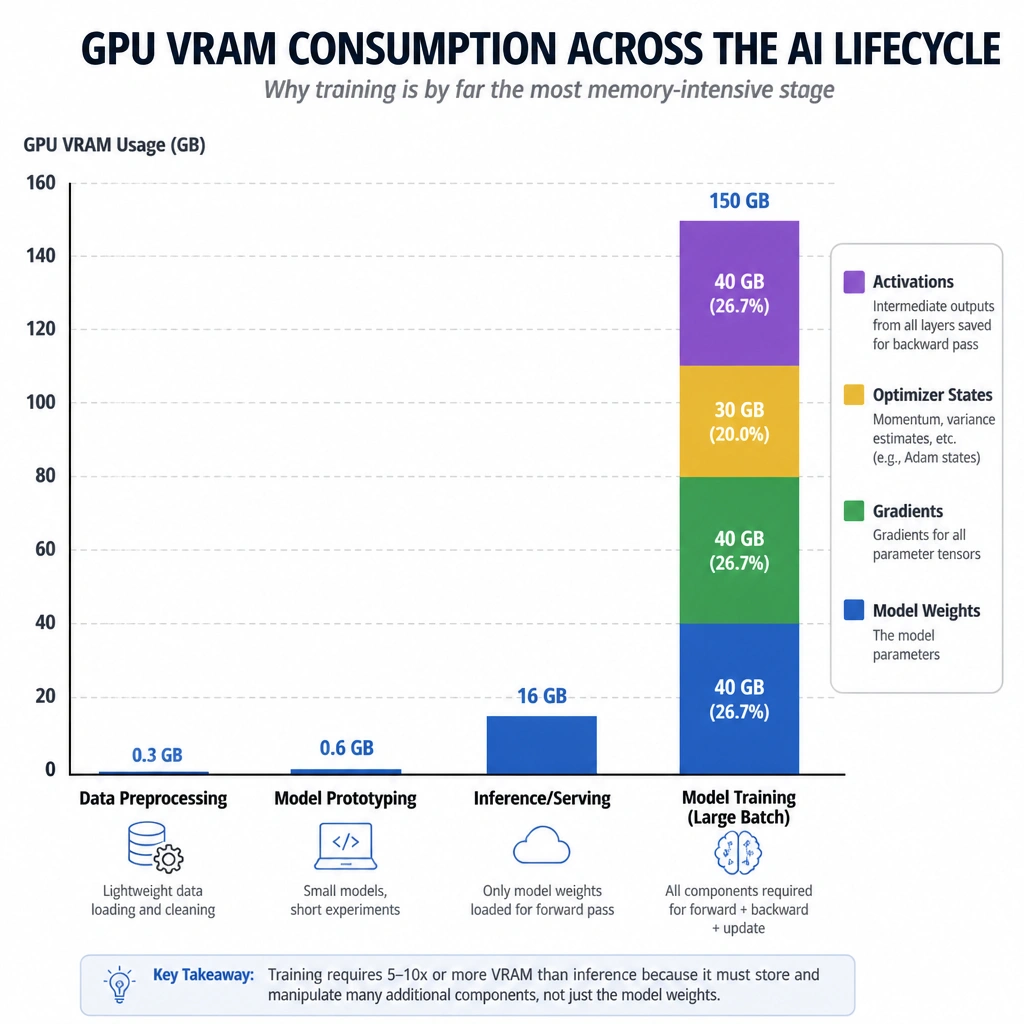
Okay, check this out: why does deep learning require those beastly GPUs with 80GB of VRAM or more? Here's the deal. When you are just running inference—meaning you're deploying a model to make predictions—the GPU only needs to hold the model weights and a tiny bit of temporary memory to process the input. But when you are training that same model, especially with big batch sizes, the story changes completely. The GPU has to store the weights, the gradients, the optimizer states (which are huge for algorithms like Adam), and the activations for every single layer so it can do backpropagation. If you try to run training on a card without enough VRAM, you'll hit that dreaded 'Out of Memory' error instantly. So, training is definitely the memory hog here. Got it? Let's keep rolling.
Full explanation below image
Full Explanation
The GPU memory footprint varies significantly across the different phases of a machine learning workflow. The model training phase, particularly when utilizing large batch sizes, is by far the most demanding in terms of Video RAM (VRAM) consumption.
During model training, the GPU must allocate memory for several large components: 1. Model Parameters (Weights): The actual parameters of the neural network. 2. Gradients: The calculated derivatives for each parameter, used to update the weights during optimization. 3. Optimizer States: Modern optimizers like Adam or AdamW maintain running averages of gradients and their squares, which can require up to twice or three times the memory of the model weights themselves. 4. Activations: The intermediate outputs of each layer during the forward pass. These must be stored in memory because they are required to compute the gradients during the backward pass (backpropagation). Larger batch sizes multiply the memory footprint of these activations.
In contrast, the other phases have much lower GPU memory requirements: - Model Deployment and Serving (Inference): Only requires memory for the model weights and small activation buffers for the current batch (often a batch size of 1 or small batches for real-time services). Gradients and optimizer states are not used. - Data Preprocessing and Feature Engineering: Typically runs on host CPU memory and system RAM rather than GPU VRAM, as it involves ETL operations, text tokenization, or image resizing before feeding data to the model. - Model Architecture Design and Validation: Prototyping and checking code structures is a configuration phase that does not involve loading full-scale datasets or executing heavy training loops. - Therefore, the correct answer is B.