
How does NVIDIA NIM (NVIDIA Inference Microservice) streamline the deployment of AI models across enterprise environments?
Select an answer to reveal the explanation.
Short Explanation and Infographic
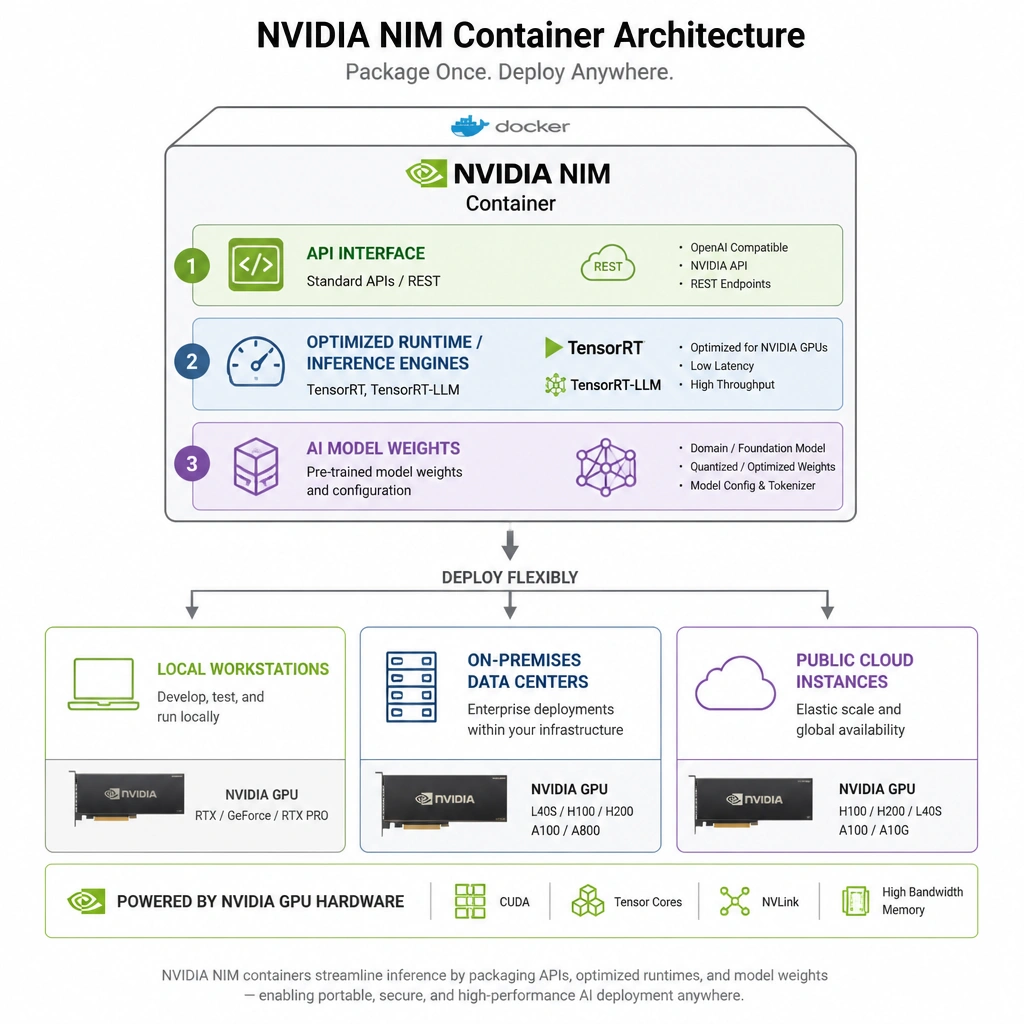
Here's the deal: getting an AI model from development into a real production network is usually a massive headache. You've got to worry about CUDA versions, driver compatibility, API endpoints, and making sure the model actually runs fast on your GPUs. That's where NVIDIA NIM comes to the rescue! Think of it as a complete software package in a box. Instead of making you build and optimize the inference stack from scratch, NVIDIA packages the model, the optimized runtime engine (like TensorRT), and industry-standard APIs into clean, ready-to-deploy Docker containers and Helm charts. You just pull the container, spin it up, and you're good to go—whether you're running on a workstation, in your data center, or out at the edge. It's fast, it's consistent, and it saves you from dependency hell. Got it? Sweet.
Full explanation below image
Full Explanation
NVIDIA NIM (NVIDIA Inference Microservice) is designed to solve the complex operational challenge of deploying artificial intelligence models at scale. In a traditional workflow, deploying a large language model (LLM) or a computer vision model requires assembling a complex stack: the model weights, an inference runtime (such as Triton Inference Server or vLLM), system libraries (like CUDA and cuDNN), and an API layer. NIM simplifies this process by containerizing the entire stack into a single, cohesive unit.
Specifically, NIM delivers OCI-compliant (Open Container Initiative) Docker images and Helm charts. Inside these containers, NVIDIA pre-packages the AI models alongside optimized inference engines (e.g., TensorRT and TensorRT-LLM) that are fine-tuned for NVIDIA GPUs. They expose standard, industry-compatible APIs (such as OpenAI-compliant REST APIs), allowing developers to integrate AI features into their applications with minimal code changes. This containerized approach ensures that the model runs with identical behavior and optimal performance across any supported environment—whether it is an on-premises data center, a hybrid cloud, a local workstation, or an edge device.
Let's evaluate the incorrect choices: - Option A is incorrect because NIM is a software packaging and deployment solution, not a tool for compiling code into hardware ASIC firmware. - Option B is incorrect because NIM is designed for multi-cloud, on-premises, and hybrid deployments, and does not require or rely on cloud provider APIs to operate. - Option D is incorrect because NIM is an enterprise software product focusing on optimized deployment, not a raw community-driven repository like Hugging Face or GitHub. - Therefore, the correct answer is C.