
You are tasking your network engineering team with setting up RDMA over Converged Ethernet (RoCE) across a multi-subnet data center fabric to connect your AI training nodes. Which version of RoCE must be selected, and what architectural capability makes it necessary?
Select an answer to reveal the explanation.
Short Explanation and Infographic
Here's the deal on RoCE: if you're running RDMA over Ethernet, you've got two versions to choose from. RoCE version 1 is basically stuck in its own local neighborhood (Layer 2). It can't cross a router, meaning it's useless if your AI cluster spans different subnets. But RoCE version 2 wraps those RDMA packets inside standard UDP/IP packets. That's the secret sauce! Because it lives at Layer 3, your routers can forward those packets across different subnets throughout the whole data center. Trust me, for any modern multi-rack AI cluster, RoCE v2 is the only way to go.
Full explanation below image
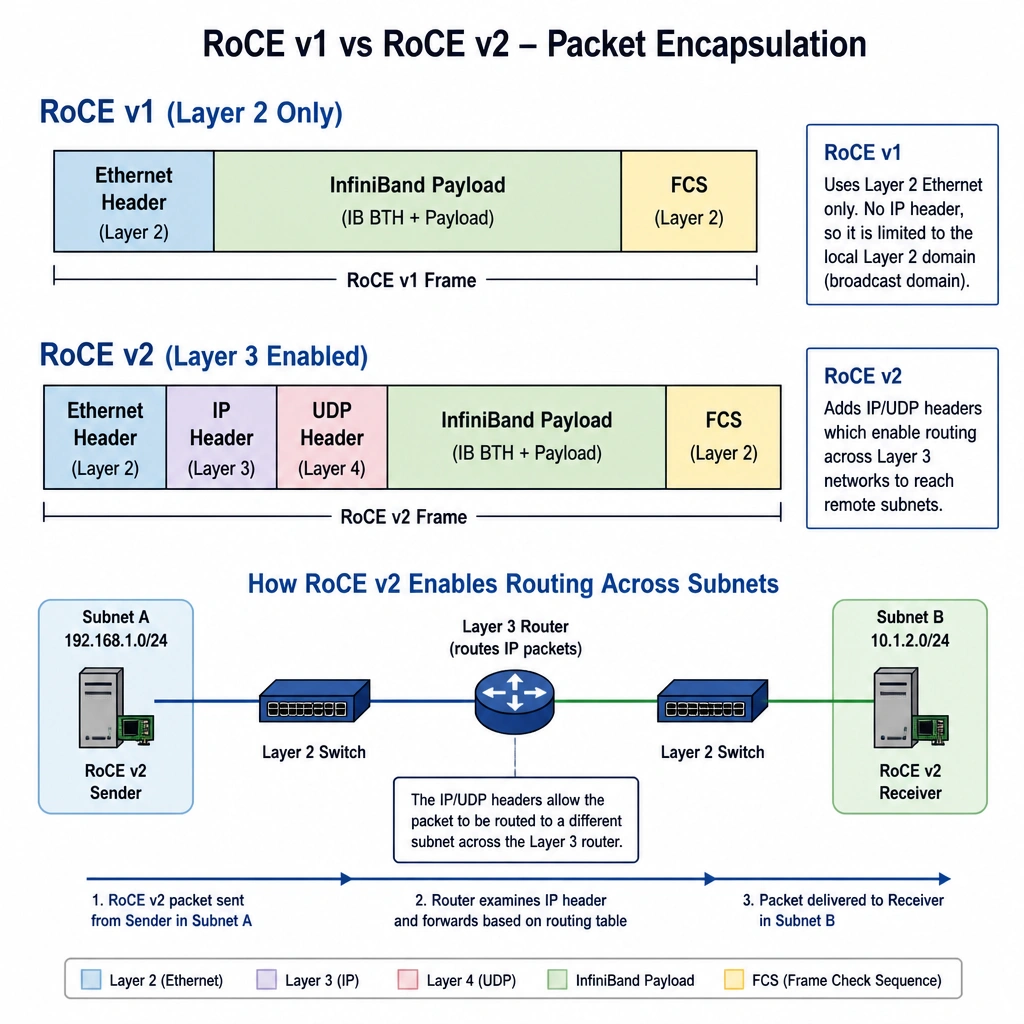
Full Explanation
RDMA over Converged Ethernet (RoCE) allows remote direct memory access over standard Ethernet infrastructure. However, the two versions of RoCE operate at different layers of the OSI model, which dictates how they can be deployed in a data center network.
Understanding the difference between RoCE v1 and RoCE v2: - RoCE v1 (Layer 2 Link Layer): RoCE v1 encapsulates RDMA packets within standard Ethernet frames. Because it does not contain an IP header, it cannot be routed by Layer 3 devices (routers). This restricts RoCE v1 traffic to a single broadcast domain or subnet. It is unsuitable for large-scale enterprise data centers where AI clusters are distributed across multiple racks and subnets. - RoCE v2 (Layer 3 Internet Layer - Correct Answer B): RoCE v2 resolves the routing limitation of v1 by encapsulating the RDMA payload inside standard UDP and IP headers (specifically using UDP destination port 4791). This allows standard IP routers to route RoCE v2 packets across subnet boundaries, enabling large-scale, multi-subnet clusters. - Distractors A and D are incorrect because both RoCE v1 and RoCE v2 utilize the same hardware offload engines, resulting in nearly identical raw bandwidth performance and CPU utilization. RoCE v2 does not introduce software compression or separate bandwidth profiles; its advantage is purely routing compatibility. - Distractor C is incorrect because while RoCE v1 has slightly less encapsulation overhead, the difference in latency is negligible and does not justify the loss of routing capability in a multi-subnet network.