
Which class of enterprise computing workloads is the primary catalyst for pushing data center rack power densities from legacy limits of 2-4 kW up to modern demands of 35-45 kW or more?
Select an answer to reveal the explanation.
Short Explanation and Infographic
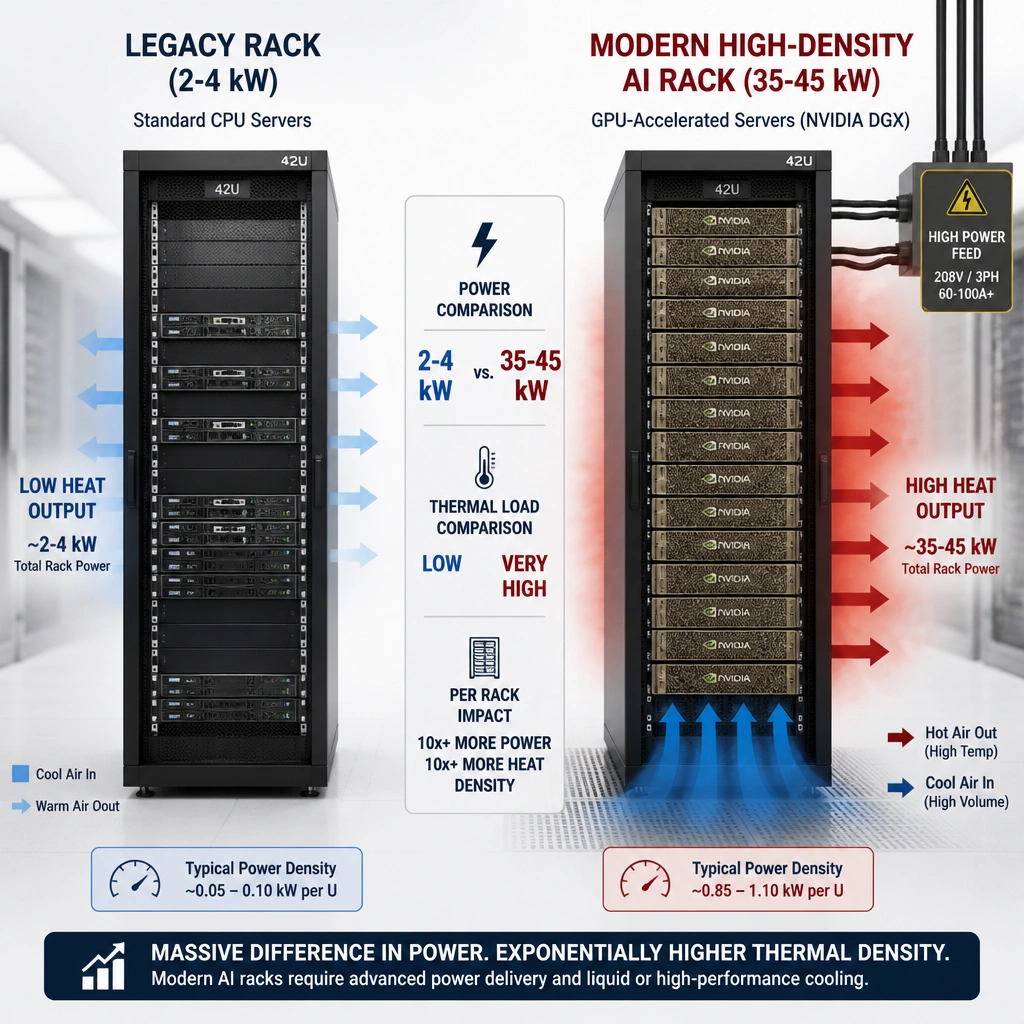
Imagine your boss walks in and says, 'Hey, we're planning to install three racks of GPU servers for our new AI project, but our facility manager says we don't have enough power.' Trust me on this, this happens all the time now! Traditional servers running web sites, emails, or file storage are pretty lightweight—they only pull about 2 to 4 kilowatts per rack. But when you start packing racks full of high-performance GPUs for deep learning training, AI inference, and HPC workloads, those GPUs run hot and demand massive amounts of electricity. We are talking 35 to 45 kilowatts per rack, and sometimes even higher! This massive jump in power consumption completely changes how we design and cool modern data centers. Legacy workloads just don't need this kind of juice.
Full explanation below image
Full Explanation
The rapid rise of artificial intelligence, machine learning, and high-performance computing (HPC) has fundamentally changed data center infrastructure requirements. In legacy data centers, racks typically housed standard CPU-based servers running standard applications, web services, and file storage. These systems operated with a relatively low power density, averaging between 2 kW and 5 kW per rack. Standard air cooling and traditional power distribution units (PDUs) were more than sufficient to support these environments.
However, deep learning workloads—especially the training of large language models and massive machine learning inference tasks—rely on dense clusters of graphics processing units (GPUs) and specialized accelerators (such as tensor cores). These accelerators perform parallel mathematical operations continuously, drawing hundreds of watts per processor. When multiple multi-GPU servers (such as NVIDIA DGX systems) are packed into a single cabinet, the power demand escalates dramatically to 35-45 kW, and in some cutting-edge deployments, over 100 kW per rack. This shift requires specialized high-density power delivery, backup power systems (UPS), and advanced cooling methods, such as direct-to-chip liquid cooling or rear-door heat exchangers, to manage the thermal output.
Let's look at why the other options are incorrect: - Option B is incorrect because file storage, backups, and CDNs are primarily I/O and storage-bound rather than compute-bound. They use low-power disk drives and network interfaces. - Option C is incorrect because hosting standard web, email, and relational databases requires minimal compute compared to heavy matrix multiplication workloads. - Option D is incorrect because standard virtualization (like typical VMs running corporate applications) spreads moderate CPU workloads across physical servers, resulting in much lower rack power densities. - Therefore, the correct answer is A.