
When analyzing the memory architectures of high-performance compute nodes, why do GPUs consistently achieve significantly higher memory bandwidth than enterprise CPUs?
Select an answer to reveal the explanation.
Short Explanation and Infographic
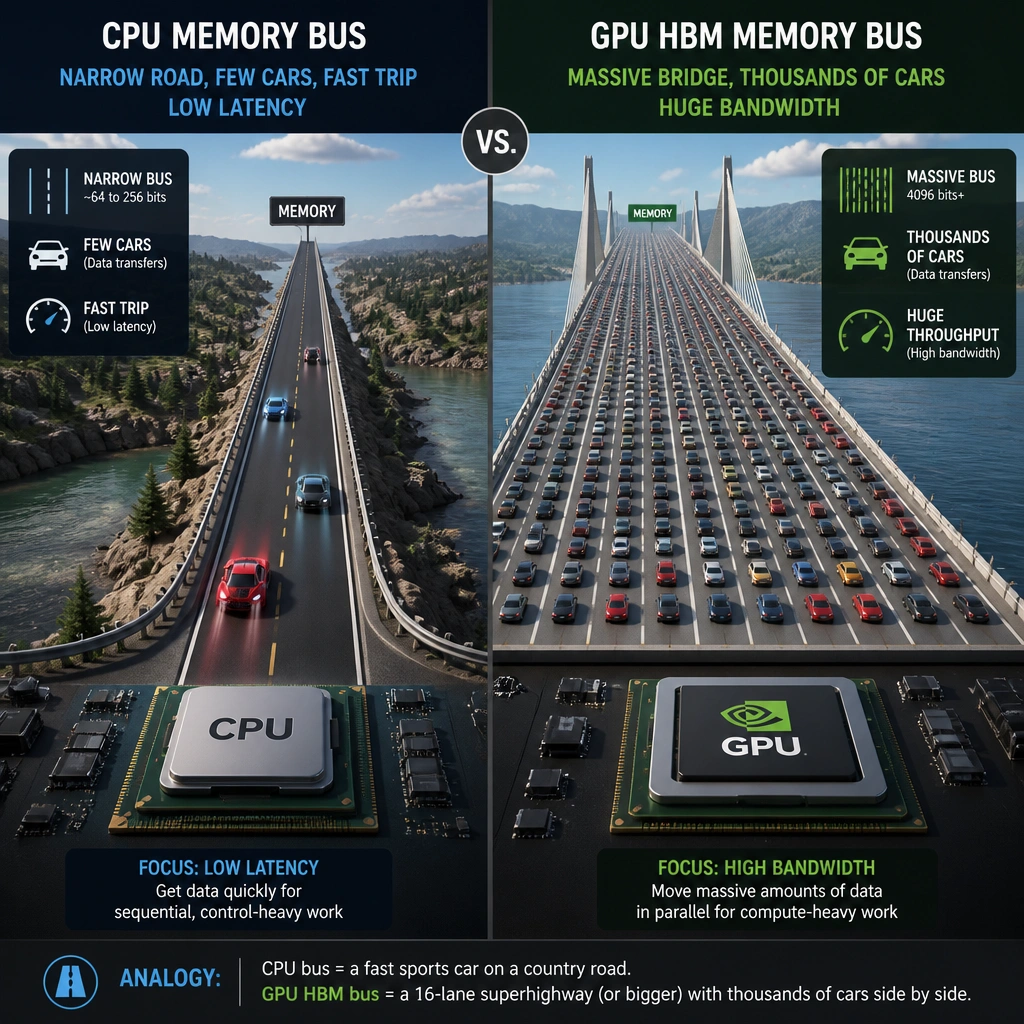
Imagine you're trying to empty a swimming pool. A CPU is like a high-speed bucket brigade—super fast reaction times, but you can only move so much water at once. A GPU, on the other hand, is like a massive fire hose. It uses a super wide memory bus (especially with High Bandwidth Memory, or HBM) to dump massive amounts of data all at once. Sure, the CPU has lower latency (it reacts faster), but when you're moving gigabytes of data for AI model training, you need that raw, brute-force bandwidth that only the GPU's wide bus and high speed can deliver.
Full explanation below image
Full Explanation
The fundamental difference between CPU and GPU architectures stems from their design goals: CPUs are optimized for low-latency execution of sequential tasks, while GPUs are designed for high-throughput execution of massively parallel workloads.
Memory bandwidth—the rate at which data can be read from or written to memory by the processor—is a key differentiator: - Correct Answer (B): Modern GPUs achieve memory bandwidths exceeding several terabytes per second (TB/s) by utilizing extremely wide bus interfaces and specialized memory technologies. For example, GPUs equipped with High Bandwidth Memory (HBM3) stack memory dies vertically and use a silicon interposer to create memory buses that are thousands of bits wide (e.g., 4096-bit or 8192-bit) operating at high speeds. In contrast, standard CPU DDR5 memory architectures typically utilize narrow 64-bit channels (even with 8 channels, the aggregate width is only 512 bits). - Distractor A is incorrect because a deeply nested cache hierarchy prioritizes minimizing latency for small, random memory accesses, which is a hallmark of CPU design rather than the source of high GPU bandwidth. - Distractor C is incorrect because GPUs typically access their own local memory (VRAM or HBM) directly on-board, while CPU-to-GPU data transfers across the PCIe bus are actually a major performance bottleneck, not the reverse. - Distractor D is incorrect because the difference is a physical hardware architectural capability, not a software compression technique.