
While monitoring telemetry for a high-density AI compute node, you observe the GPU power utilization metric fluctuating during a deep learning training cycle. What is this specific percentage metric indicating?
Select an answer to reveal the explanation.
Short Explanation and Infographic
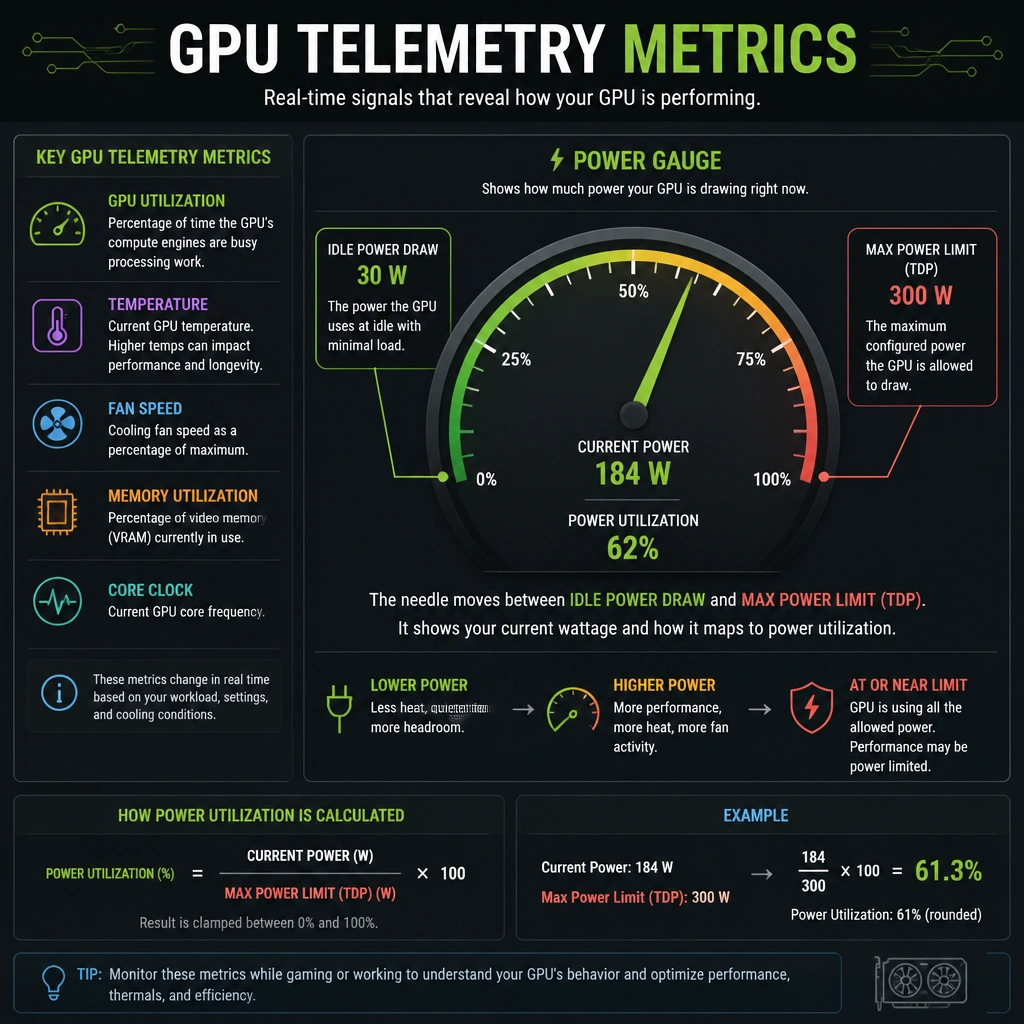
Check this out: when you see your GPU power utilization percentage spiking up to 90% or more, that's not the power of your entire server chassis or just the memory chips. It's showing you exactly how much of that specific GPU's maximum power budget is being consumed right now. Think of it like a gas pedal—the harder those CUDA cores are working, the more juice they draw, pushing that percentage closer to the device's maximum power limit. It's one of the best proxy metrics we have for checking if a workload is actually pushing the hardware to its absolute limit.
Full explanation below image
Full Explanation
GPU power utilization is a critical metric used by infrastructure administrators to monitor efficiency, thermal headroom, and workload scaling in AI clusters. This metric measures the current power draw of the GPU board expressed as a percentage of its maximum configured power limit (often associated with the Thermal Design Power or TDP, which can be modified via utilities like nvidia-smi).
Here is a breakdown of why the options are structured this way: - Correct Answer (B): This metric reflects the dynamic electrical draw of the entire GPU device (including memory, logic, and cooling components on the board) relative to its maximum allowable limit. For instance, if an H100 GPU has a power limit of 700 watts and is consuming 350 watts, the power utilization percentage will read 50%. This serves as an excellent operational proxy for compute saturation because active CUDA and Tensor cores draw substantially more current than idle components. - Distractor A is incorrect because it refers to the host motherboard PCIe slot power draw (which is limited to 75W) rather than the overall GPU board consumption, which typically utilizes auxiliary EPS/12VHPWR power connectors. - Distractor C is incorrect because total system power includes CPUs, system memory, fans, and storage, which are external to the GPU board telemetry. - Distractor D is incorrect because it describes thermal headroom or throttling threshold, which is measured in degrees Celsius rather than power units (watts/percentage).