
A medical research hospital is designing an AI-driven diagnostics platform that processes real-time telemetry from intensive care units alongside high-resolution MRI scans. Which requirement would be the primary driver for choosing a dedicated on-premises GPU infrastructure rather than a public cloud deployment?
Select an answer to reveal the explanation.
Short Explanation and Infographic
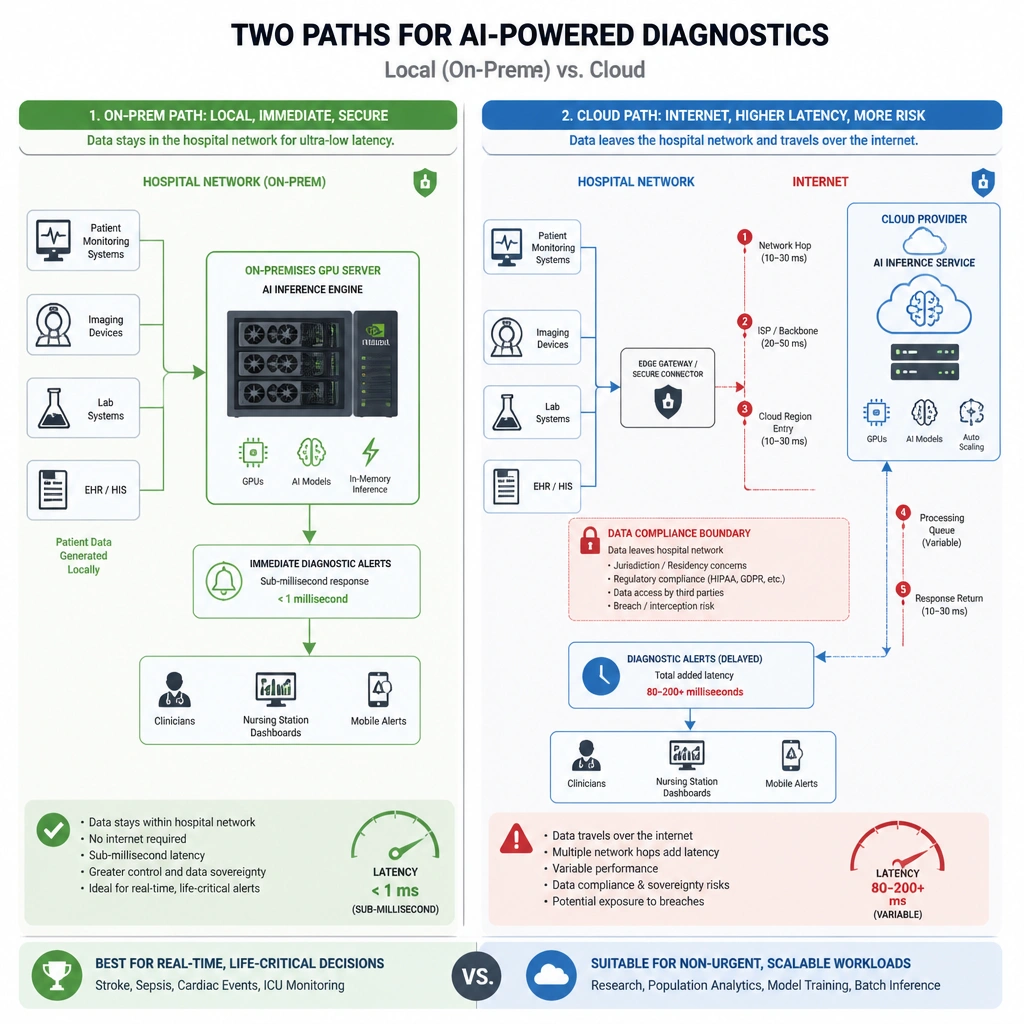
Think about this: if a patient's heart rate spikes, you can't afford to wait for that vital data to travel up to a public cloud, wait in a queue for inference, and travel all the way back to the hospital. Even a few hundred milliseconds could be a matter of life and death! Add in the legal nightmare of sending sensitive medical data over public networks, and an on-premises setup becomes a no-brainer. Sure, the cloud is great for saving on upfront hardware costs (CapEx) or sharing files globally, but when you need extreme low latency and airtight regulatory control, you keep the hardware in your own data center.
Full explanation below image
Full Explanation
When architecting AI infrastructure, organizations must weigh the trade-offs between public cloud services and on-premises deployments. This decision is driven by factors such as latency, security, regulatory compliance, cost structures, and operational control.
Let's analyze why the requirements point to an on-premises deployment: - Regulatory Compliance and Data Residency (Correct Answer B): In healthcare, regulations like HIPAA (Health Insurance Portability and Accountability Act) impose strict rules on protected health information (PHI). Moving this data to a public cloud requires extensive auditing, business associate agreements (BAAs), and configuration to ensure data does not leave designated geographic boundaries. Keeping the infrastructure on-premises simplifies compliance by keeping the data entirely within the hospital's physical security perimeter. - Ultra-low Latency: Real-time patient alerts demand sub-millisecond or single-digit millisecond response times. Round-trip network latency to cloud data centers (including WAN jitter and routing hops) is unpredictable and too slow for safety-critical real-time applications. Processing data on local edge GPU servers eliminates network transit latency. - Distractors A, C, and D represent scenarios that strongly favor cloud-based solutions: - Global collaboration tools (D) are natively supported by cloud ecosystems. - Minimizing CapEx in favor of pay-as-you-go pricing (C) is the primary economic driver for public cloud adoption. - Using pre-built SaaS models and managed ML platforms (D) reduces operational overhead, which is a cloud advantage.