
You are managing a multi-GPU training node and need a command-line interface tool that does more than just print static hardware statistics. Specifically, you need interactive process management (like killing hung training runs directly from the terminal), a dynamic layout that fits any terminal size, and a built-in Python API to automate metric collection. Which tool should you use?
Select an answer to reveal the explanation.
Short Explanation and Infographic
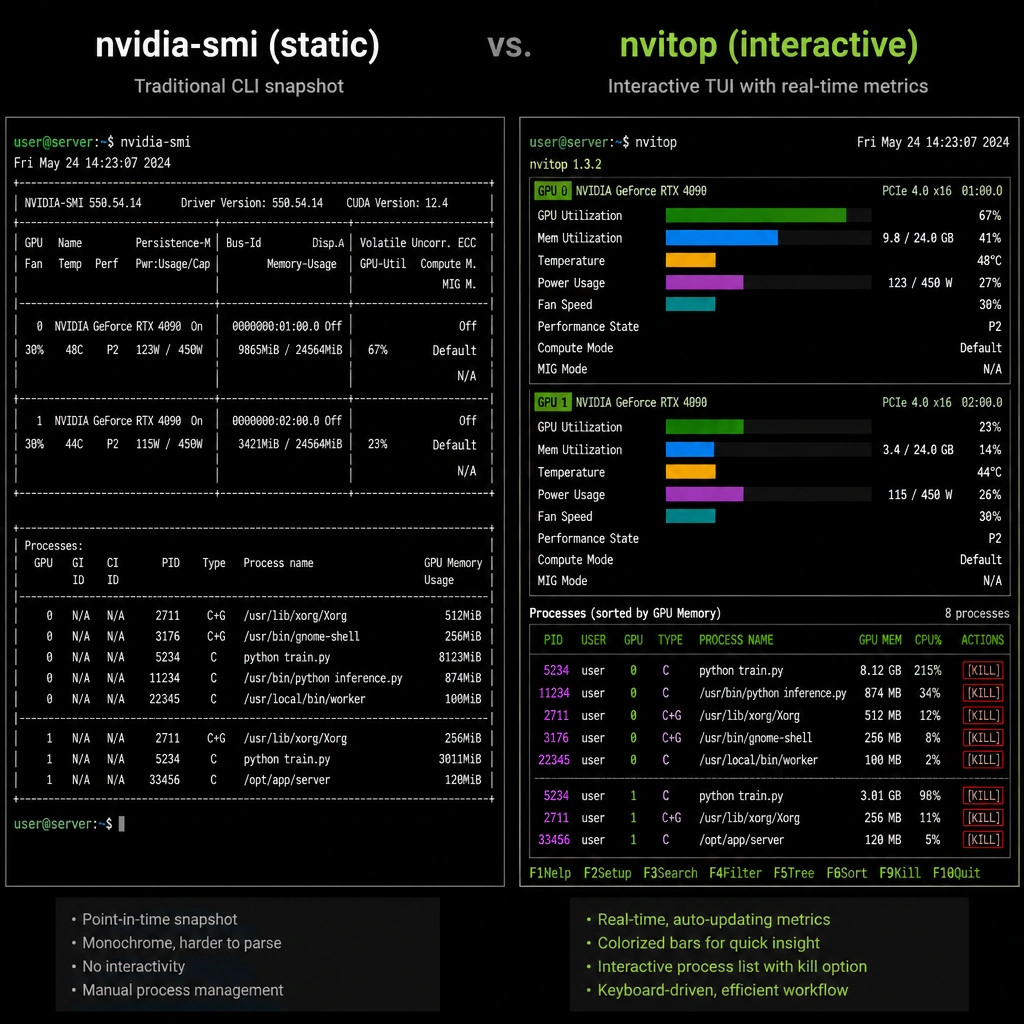
Here's the deal: if you've spent any time working with GPUs, you probably know nvidia-smi inside out. It's the classic go-to, but let's face it—it's static and lacks real interactivity. What if you need to kill a runaway PyTorch process, view pretty graphs that resize with your terminal, and write custom Python monitoring scripts? That's where nvitop shines. Think of it like htop but supercharged specifically for your GPUs. Trust me on this one, once you start using it to manage active processes on a busy node, you'll never want to go back to typing nvidia-smi every two seconds.
Full explanation below image
Full Explanation
Managing GPU-accelerated clusters requires monitoring utilities that go beyond static snapshot tools. For interactive, real-time node management, nvitop is the industry-standard tool that provides an interactive CLI interface specifically designed for GPU status and process tracking. Key advantages of nvitop include: - Interactive Process Management: It allows administrators to filter processes, view specific resource consumption per PID, and issue signals (like SIGKILL or SIGTERM) directly from the interface, similar to the Linux htop tool. - Terminal Adaptation: The text-based user interface dynamically adjusts its layout and graphs to fit the size of the user's terminal window. - Python Integration: nvitop can be imported directly into Python applications, enabling developers to programmatically access real-time GPU telemetry (utilization, memory, temperature) within training scripts.
Let's look at why the other options don't fit: - nvidia-smi (System Management Interface) is a command-line tool bundled with NVIDIA drivers. While it is excellent for query scripts and simple checks, it lacks interactive process termination controls, does not adjust dynamically like a GUI/TUI, and does not natively expose a clean Python API without parsing stdout or utilizing NVML bindings directly. - Data Center GPU Manager (DCGM) is designed for cluster-level management, orchestration integrations (like Kubernetes and Prometheus), and health checks, rather than local interactive process management. - GPU-Z and HWiNFO are GUI-based diagnostic utilities primarily designed for Windows client systems, making them unsuitable for headless Linux AI servers.