
According to industry blueprints for high-performance AI cluster design, a complete end-to-end AI infrastructure stack is built upon how many core architectural pillars?
Select an answer to reveal the explanation.
Short Explanation and Infographic
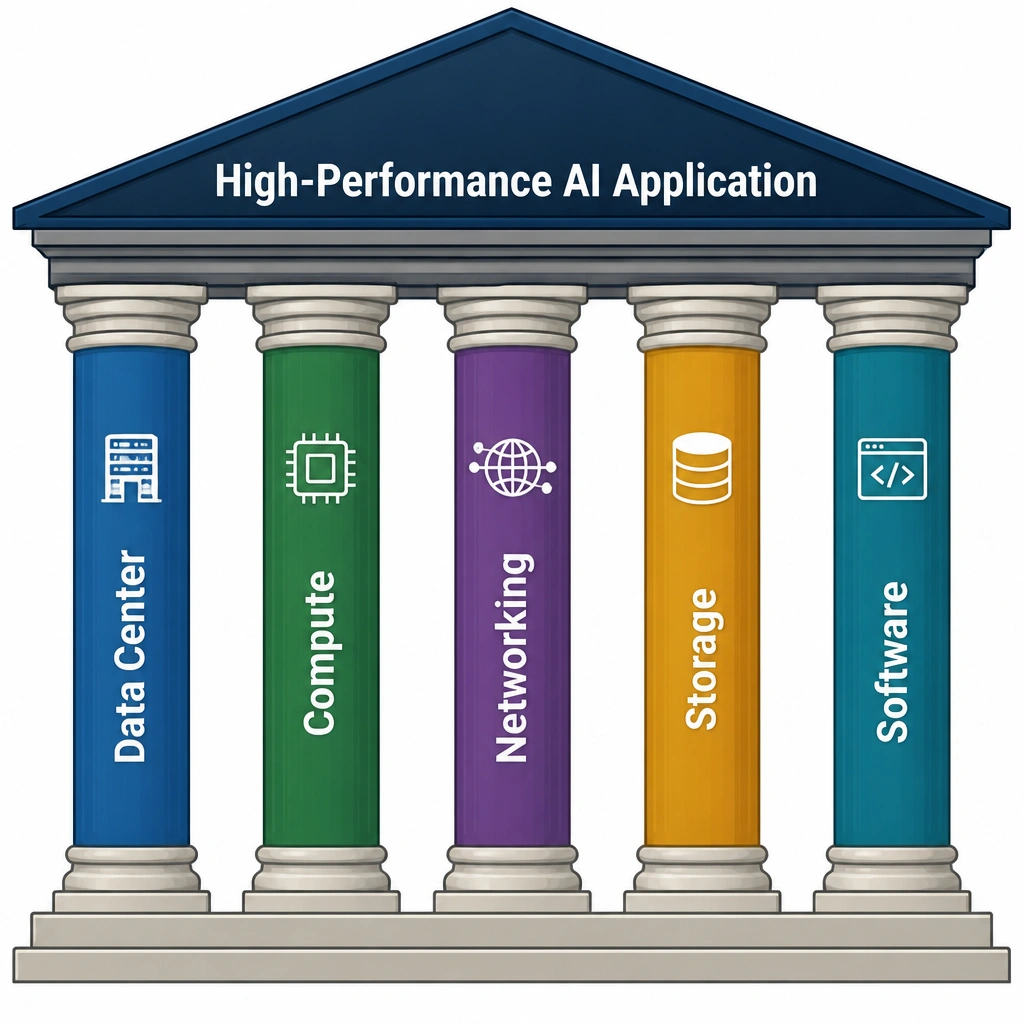
When you're building out an AI cluster, you can't just think about the GPUs. You've got to look at the whole picture. There are exactly five core architectural pillars that make up high-performance AI infrastructure. If you miss even one, your whole project will fall apart. These five are: the physical Data Center facility (power and cooling), the Compute layer (servers and GPUs), the Network fabric (like InfiniBand and Ethernet), the Storage subsystem (fast NVMe and object storage), and the Software stack (orchestrators and frameworks). Remember this number for the exam!
Full explanation below image
Full Explanation
Modern enterprise AI clusters are complex environments requiring a holistically designed stack to prevent performance bottlenecks. Industry blueprints define five core architectural components that serve as the foundational building blocks for high-performance AI deployments: 1. Data Center Infrastructure: The physical facility providing high-density power delivery (often 40kW+ per rack), advanced cooling (such as direct-to-chip liquid cooling), and physical space. 2. Compute Resources: The server nodes containing high-performance CPU architectures, specialized accelerators (GPUs, TPUs), and high-bandwidth interconnects (like NVLink) within the node. 3. Networking Fabrics: Multiple dedicated networks, including a low-latency, high-bandwidth compute fabric (e.g., InfiniBand or RoCE) for GPU-to-GPU communications, and separate networks for storage, management, and client access. 4. Storage Systems: A multi-tier storage architecture capable of delivering high read throughput for training data (often utilizing object storage with local NVMe caching) and fast write capabilities for model checkpoints. 5. Software Stack: The management, orchestration, and scheduling layer (such as Kubernetes, Slurm, or NVIDIA AI Enterprise) that handles job scheduling, container runtime execution, and resource allocation. Understanding these five pillars is essential for designing balanced systems where compute units are not left idling due to network latency, storage bottlenecks, or power constraints. Leaving out any one of these pillars leads to inefficient operations, high tail latencies, or outright hardware failure. Therefore, the infrastructure blueprint is structured around exactly five core areas.