
Throughout the lifecycle of a deep learning workflow, which stage is characterized by highly parallelizable matrix operations and backpropagation, resulting in the most dramatic speedups when moving from CPU-only compute to GPU acceleration?
Select an answer to reveal the explanation.
Short Explanation and Infographic
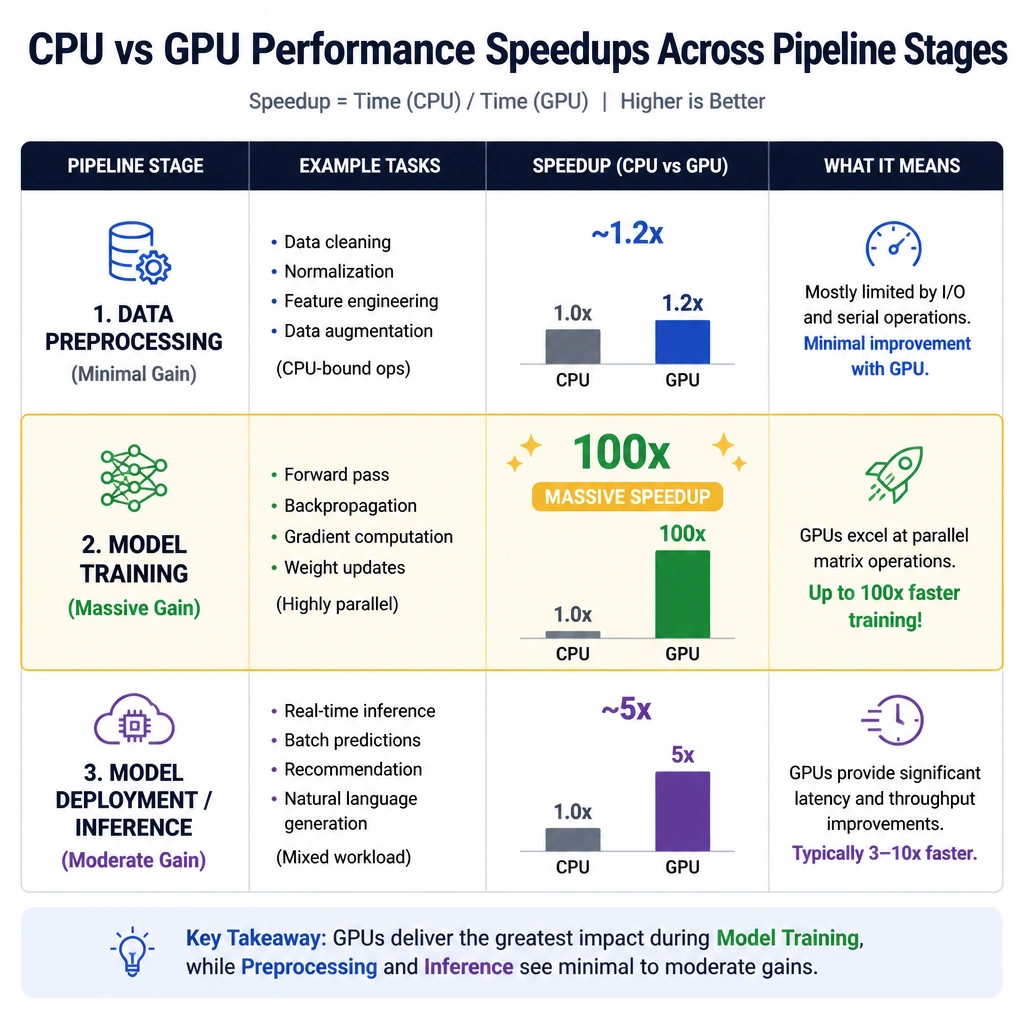
Let's dive in: why did we all start buying GPUs in the first place? It's because of the heavy math. During the Model Training and Optimization phase, your systems are running millions of matrix multiplications and backpropagation steps simultaneously. CPUs have a few super-fast cores, but GPUs have thousands of smaller cores that are built specifically to handle these parallel calculations. While you'll see some speed improvements in preprocessing or deployment, nothing compares to the massive 10x or 100x speedup you get during training.
Full explanation below image
Full Explanation
Deep learning workflows consist of several distinct phases, each with varying computational characteristics. The Model Training and Optimization phase is uniquely suited for GPU acceleration. During training, neural networks process large batches of data, requiring millions of dense matrix operations (such as matrix-matrix multiplications) to compute layer activations (forward pass) and gradients (backward pass/backpropagation). These calculations are highly parallelizable because the operations on individual weight parameters can be computed independently across thousands of GPU cores. Consequently, executing training on GPUs typically yields a 10x to 100x performance improvement over CPU-only processing. In contrast, other lifecycle phases show more modest improvements under GPU acceleration. Data Preprocessing and Feature Engineering often involve operations like text parsing, regex matching, or tabular data manipulation, which are highly serial or branch-heavy, making them better suited for CPUs (though tools like RAPIDS can accelerate some preprocessing steps). Model Deployment and Serving (inference) involves processing smaller, often single-item requests in real-time, where latency is dominated by host-to-device transfers and serial request handling rather than massive parallel computation. Model Evaluation and Validation is similar to inference and occupies a tiny fraction of the overall compute budget compared to the training phase. Therefore, model training stands out as the phase with the most significant performance optimization.