
When engineering a high-performance network fabric for massive-scale distributed deep learning training, why is InfiniBand typically selected over traditional Ethernet for the primary inter-GPU communication interconnect?
Select an answer to reveal the explanation.
Short Explanation and Infographic
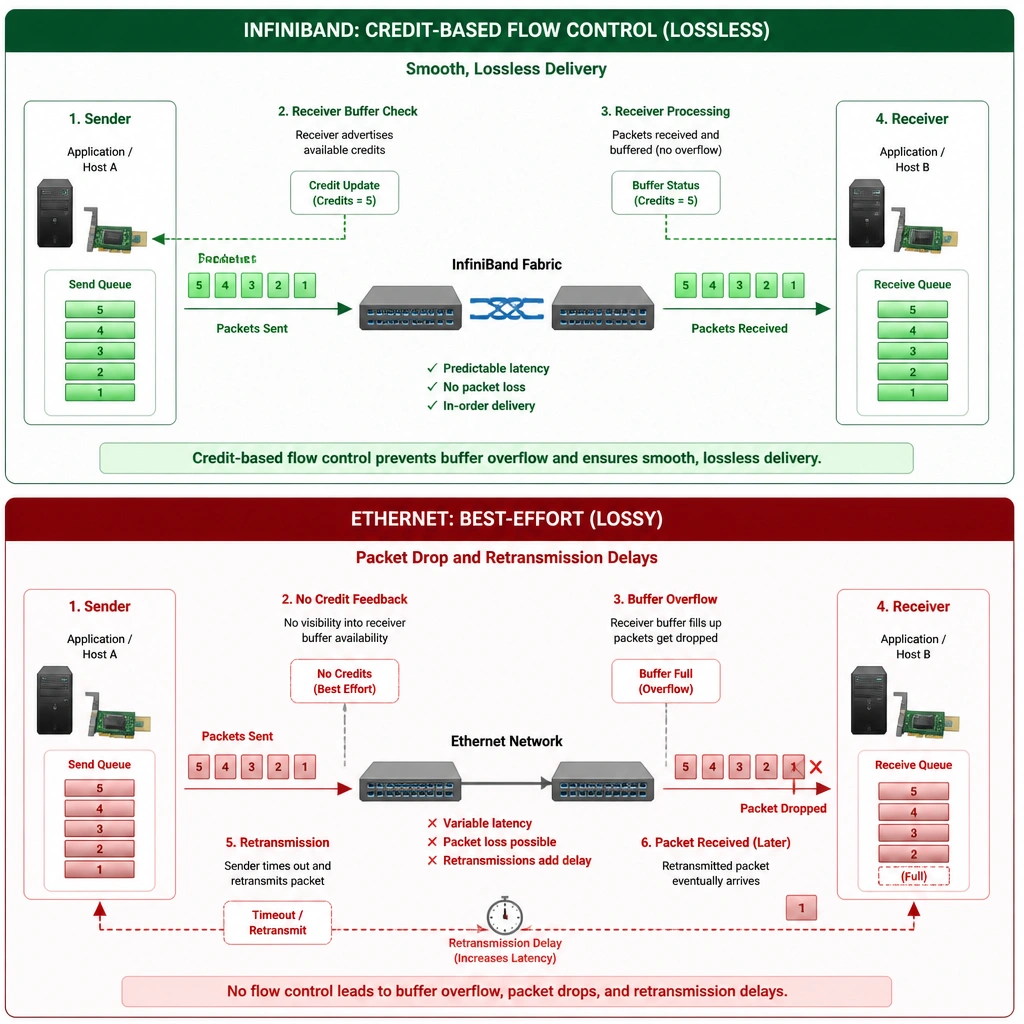
If you've ever dealt with traditional Ethernet, you know it's a "best-effort" network. If congestion hits, packets get dropped, and the sender has to retransmit. In a standard network, that's fine. But in a massive AI training cluster where thousands of GPUs are syncing weights, a single dropped packet causes everyone to sit around waiting. Not very efficient! InfiniBand uses credit-based flow control to guarantee lossless packet delivery. That means zero packet drops due to congestion, and no retransmission delays. Trust me, that lossless delivery is the secret sauce that keeps your training throughput high and predictable.
Full explanation below image
Full Explanation
Distributed deep learning training at scale involves collective communication patterns (such as AllReduce or AlltoAll) where thousands of GPUs continuously exchange model gradients and weights. In these environments, communication latency directly dictates overall training efficiency. InfiniBand is the industry-standard fabric for AI clusters primarily because of its lossless transmission nature. InfiniBand implements a hardware-based credit-based flow control mechanism. A sending port will only transmit packet data when the receiving port has advertised sufficient buffer space (credits) to accept it. This prevents buffer overflows and guarantees that packets are never dropped due to network congestion, eliminating the latency overhead of TCP/IP packet retransmissions. Traditional Ethernet, by contrast, operates on a best-effort packet delivery model. When network buffers overflow on Ethernet switches during heavy synchronization periods, packets are dropped, triggering TCP retransmission timers and causing significant latency spikes. While technologies like RoCE (RDMA over Converged Ethernet) and Priority Flow Control (PFC) attempt to bring lossless qualities to Ethernet, they require complex configuration and are prone to congestion issues like head-of-line blocking and PFC storms. Topologies, media types, and encryption are not the primary differentiators: Ethernet actually supports a wider array of topologies than InfiniBand, both can run over fiber or copper media, and neither fabric relies on hardware encryption as a baseline architectural differentiator for AI throughput. Lossless delivery is the primary feature that guarantees predictability.