
A financial institution is deploying an AI-driven fraud detection inference system that handles sensitive transaction data. The system must process transactions in real-time with latency strictly under 8 milliseconds, the traffic volume is highly predictable and steady, and compliance laws demand complete control over data residency and physical access. Which infrastructure model best aligns with these needs?
Select an answer to reveal the explanation.
Short Explanation and Infographic
Here's the deal: if you need sub-10ms response times and you're dealing with strict data privacy laws, sending your data back and forth to the public cloud is a recipe for disaster. The network latency alone will eat up your budget and blow past your 8ms limit, and your security team will have a fit about data compliance. An on-premises deployment with dedicated hardware gives you total physical control over your data and eliminates the overhead of public internet hops. Auto-scaling in the cloud is great for unpredictable spikes, but since your traffic is steady and predictable, dedicated local hardware is the way to go.
Full explanation below image
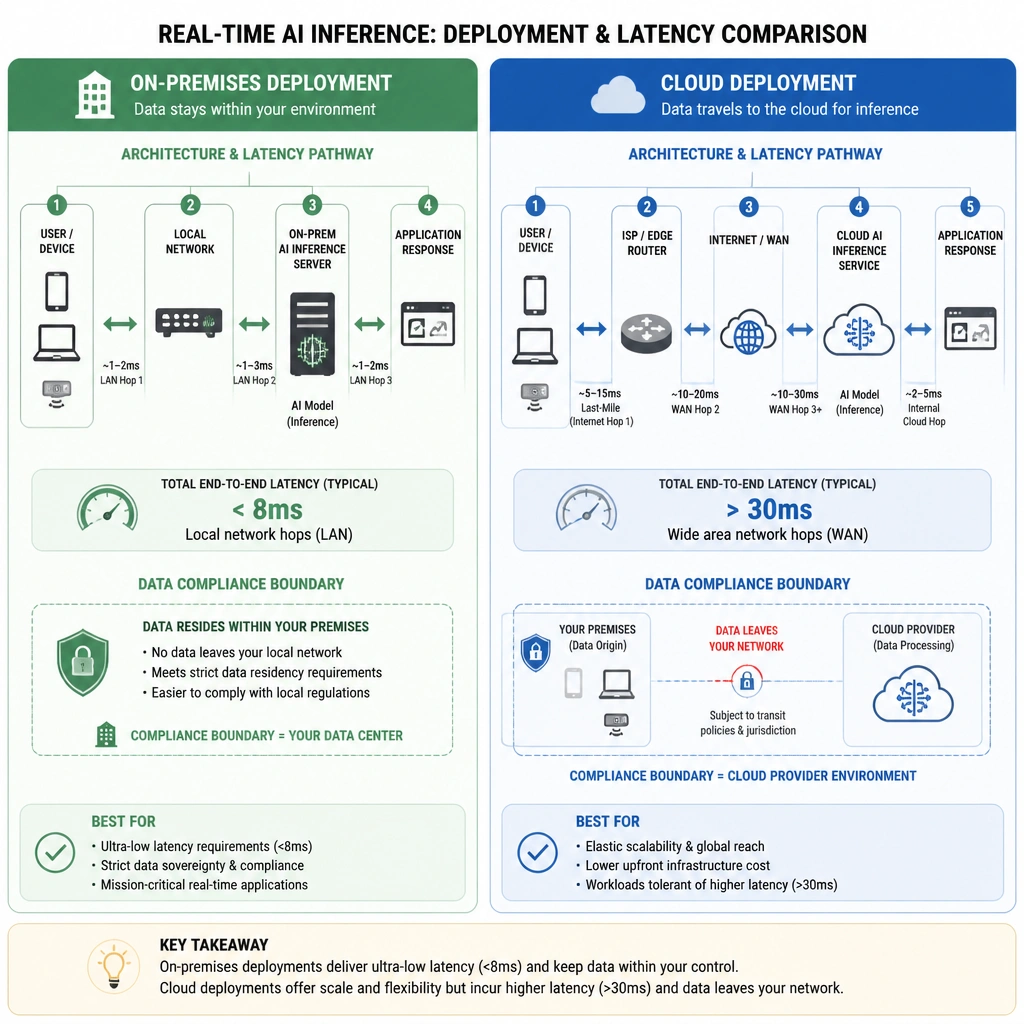
Full Explanation
Selecting the appropriate infrastructure deployment model for AI workloads requires evaluating latency, predictability, and compliance requirements. For applications with strict, ultra-low latency requirements (such as real-time financial fraud detection needing sub-10ms response times), localizing the compute resources close to the data source is vital. On-premises infrastructure with dedicated hardware avoids the network latency associated with transmitting data over the WAN or public internet to cloud data centers. Furthermore, because the workload is predictable and steady, the capital expenditure of dedicated hardware is often more cost-effective over time than paying for continuous cloud compute resources. Finally, for organizations bound by stringent data privacy regulations (e.g., GDPR, HIPAA, or financial sovereignty laws), an on-premises deployment ensures that data stays within a physically controlled boundary, resolving compliance and data residency issues. Alternative deployment models introduce unnecessary complexity or latency. Cloud-based infrastructure with auto-scaling is excellent for variable or bursty workloads, but does not guarantee the lowest network latency and raises data sovereignty concerns. Multi-cloud deployments spread data across different cloud providers, which increases complexity, security overhead, and inter-cloud data transit latency. A hybrid cloud approach with burst capabilities is designed for workloads that occasionally exceed local capacity; however, bursting sensitive data to the public cloud during spikes violates the requirement for strict data location control and predictable latency boundaries. Therefore, the combination of sub-10ms latency limits, stable demand, and strict data sovereignty makes dedicated on-premises infrastructure the optimal solution.