
As AI data architectures evolve, storage strategies for training large language models (LLMs) are changing. What is the current industry consensus regarding the best storage system for handling the massive, write-once, read-many dataset characteristics typical of LLM training?
Select an answer to reveal the explanation.
Short Explanation and Infographic
Check this out: training an LLM is all about reading huge amounts of data over and over again, and writing checkpoints occasionally. It's classic write-once, read-many. In the old days, everyone thought you had to have super-expensive parallel file systems. But here's the deal: object storage is now the go-to. Why? Because it's way cheaper at scale, and it matches those big sequential read patterns perfectly. NFS can't handle the scale, block storage is too expensive and hard to share, and relying purely on local NVMe without a shared backend means you'll have a massive headache syncing datasets across hundreds of nodes.
Full explanation below image
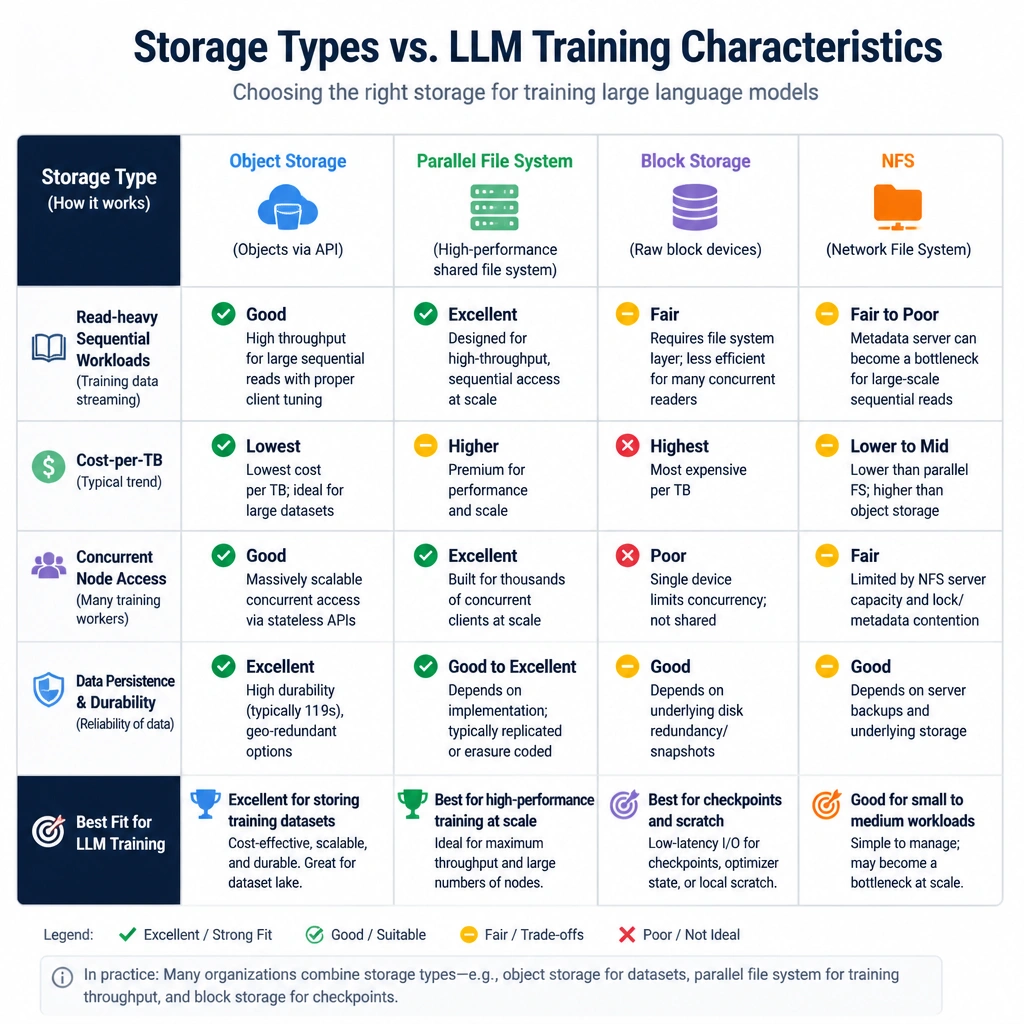
Full Explanation
The storage architecture for large language model (LLM) training has transitioned from traditional high-performance computing (HPC) file systems to cloud-native storage patterns. LLM training workloads are characterized by reading massive text corpus datasets (often terabytes or petabytes in size) in a sequential, read-intensive pattern, combined with periodic writes of model checkpoints. This alignment with write-once, read-many (WORM) behavior has led to the widespread adoption of object storage (such as Amazon S3, Google Cloud Storage, or on-premises MinIO/Ceph). Object storage offers high horizontal throughput, near-infinite scalability, and significant cost savings compared to traditional file or block storage. Large-scale training setups typically stream data directly from object storage into local node memory or NVMe caches during training epochs. Other storage types have limitations at this scale. Network File Systems (NFS) struggle with concurrent access from thousands of GPU nodes, leading to performance bottlenecks and locking issues. Block storage is highly performant for random read/write operations (like database engines) but is expensive, difficult to share concurrently across thousands of nodes, and lacks the global namespace of object storage. Local NVMe storage is highly beneficial as a fast local cache on each compute node to speed up training steps, but it cannot act as the primary repository for the global dataset because it lacks shared access and data persistence across the cluster nodes. Hence, object storage has emerged as the preferred primary storage tier due to its economy and compatibility with sequential I/O.