
In a Kubernetes-managed AI cluster, a deep learning job is submitted that requires four NVIDIA H100 GPUs and 64 GB of system RAM. Which component of the orchestration control plane is tasked with evaluating the resource requests, assessing the available nodes, and deciding exactly which node will host the containerized workload?
Select an answer to reveal the explanation.
Short Explanation and Infographic
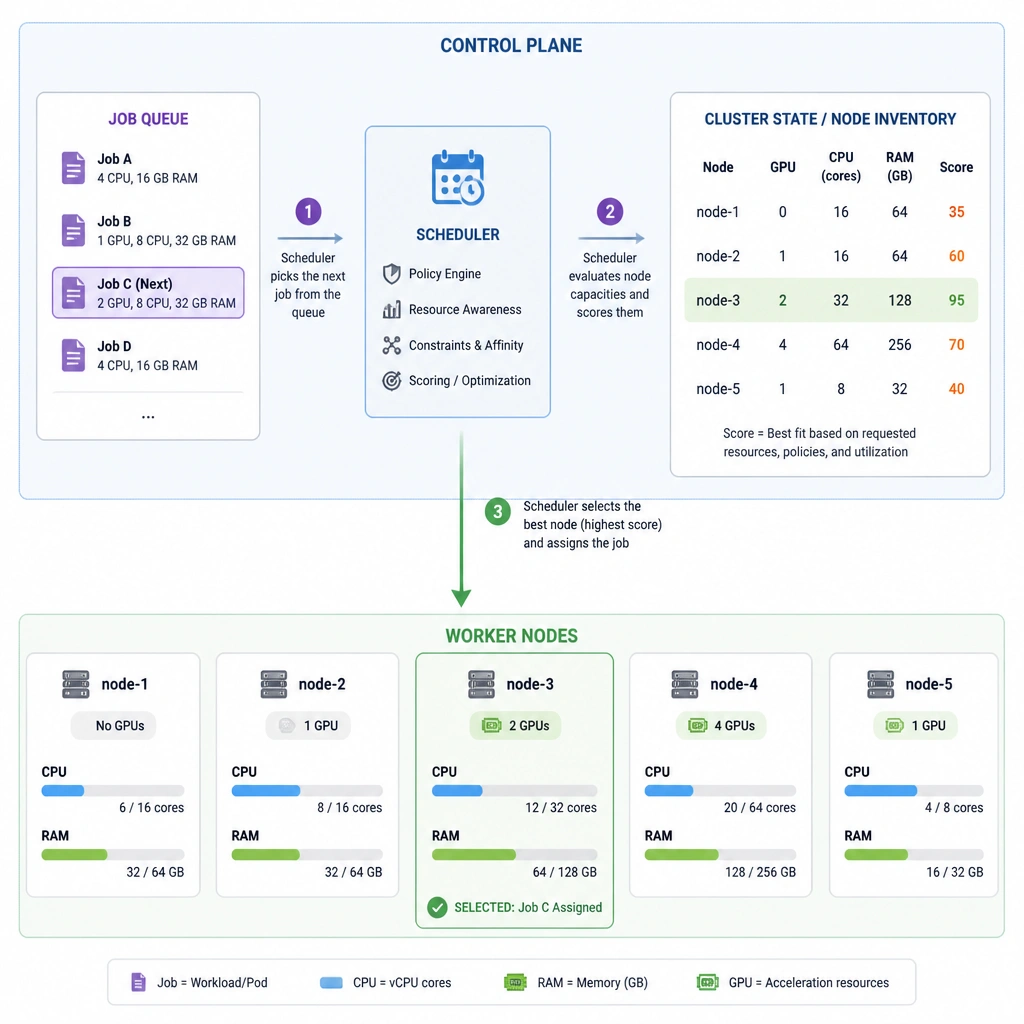
Think of this like a traffic controller at a busy airport. When a job shows up needing four high-end GPUs, you can't just let it land on any random server. You need the Scheduler. Its entire job is to look at the resource requests—like GPU count, RAM, and priority—match that up with what's free on the cluster nodes, and decide where the job goes. The Resource Manager tracks what resources are available, the Controller makes sure your running state matches your desired state, and Service Discovery helps containers talk to each other. But the actual matchmaking? That's all on the Scheduler.
Full explanation below image
Full Explanation
In container orchestration platforms like Kubernetes or Slurm, managing high-performance AI workloads requires precise allocation of specialized hardware resources. When a containerized machine learning job is submitted, it defines specific resource requirements, such as the number of GPUs, CPU cores, system memory, and storage. The Scheduler is the control plane component responsible for determining the optimal placement of this job. It filters nodes based on whether they meet the pod's constraints (e.g., GPU availability, node affinity, taints/tolerations) and then scores the remaining nodes to find the best fit, taking topology into account (like placing multi-GPU jobs on nodes where the GPUs are linked via high-speed NVLink rather than PCIe). The other components perform distinct tasks. The Resource Manager (or kubelet on individual nodes) tracks and reports node capacity and allocates the actual hardware resources once a job has been assigned. The Controller (or Controller Manager) is responsible for maintaining the desired state of the system, handling failovers, and scaling pods. Service Discovery (such as CoreDNS) enables containers to locate and communicate with each other across the network cluster. None of these components are responsible for the initial node scheduling and placement decisions. A key concept here is that the Scheduler acts as the decision-maker for job placement, whereas the Controller manages lifecycle states, the Resource Manager handles local hardware interactions, and Service Discovery resolves network endpoints.