
Your organization is planning to train a massive, multi-billion parameter large language model (LLM) from scratch in your new data center. You need to select a GPU infrastructure that provides the highest memory capacity per node, optimal training throughput, and the most efficient floating-point operations for transformer workloads. Which architecture represents the state-of-the-art solution for this level of enterprise AI training?
Select an answer to reveal the explanation.
Short Explanation and Infographic
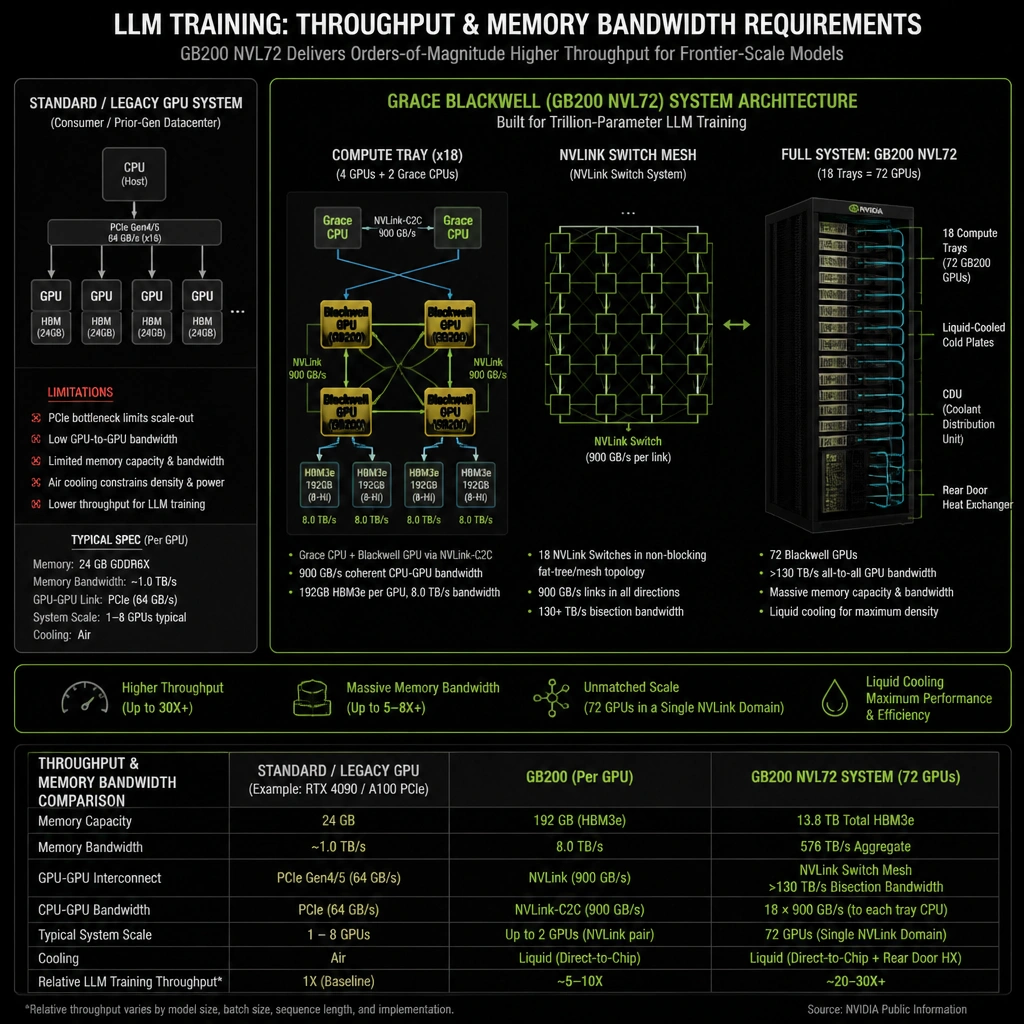
If your boss walks in and says we're training a model with hundreds of billions of parameters, you can't just toss standard gaming GPUs or legacy hardware at it. Trust me, you'll run out of memory before you even start the first epoch! The NVIDIA Blackwell architecture, specifically the GB200 NVL72, is the absolute beast designed for this scale. It packs a second-generation Transformer Engine and insane memory throughput to keep those massive tensor calculations moving without hitting bottlenecks. Don't even think about using V100s—they're way too old—or consumer cards like the RTX 4090 or 2080 Ti, which lack the enterprise interconnects and memory capacity to link up thousands of chips together.
Full explanation below image
Full Explanation
Training large language models (LLMs) with billions or trillions of parameters requires massive computational capability, high-speed interconnects, and substantial high-bandwidth memory (HBM). The NVIDIA Blackwell architecture, particularly configurations like the GB200 NVL72 (which connects 72 Blackwell GPUs and 36 Grace CPUs via NVLink), is custom-built for this scale of workload. It incorporates a second-generation Transformer Engine that supports micro-tensor scaling and advanced numerical formats (such as FP4), enabling massive throughput and computational efficiency for transformer models. Additionally, the NVLink interconnect provides up to 1.8 TB/s of bidirectional bandwidth per GPU, which is critical for reducing communication bottlenecks during distributed training. In contrast, older architectures and consumer-grade hardware fall short in several areas. The NVIDIA Tesla V100, while a pioneering enterprise GPU in its day (Volta architecture), lacks the memory capacity, modern Tensor Cores, and high-speed NVLink generations required to efficiently train modern LLMs. Consumer GPUs, such as the GeForce RTX 2080 Ti (Turing) and the RTX 4090 (Ada Lovelace), are constrained by limited onboard memory (typically 11GB to 24GB), lack support for enterprise multi-GPU scaling protocols like NVLink, and do not offer enterprise-grade reliability and cooling capabilities suitable for high-density data center deployments. Furthermore, consumer driver license agreements (EULAs) restrict their use in enterprise data centers. For billion-parameter training, the combined factors of HBM3e memory capacity, NVLink bandwidth, and specialized Transformer Engines make Blackwell the correct choice.