
Imagine your boss walks in and asks you to set up a dashboard that displays real-time GPU health and performance metrics for a Kubernetes cluster running deep learning jobs. You need a tool that can query the NVIDIA Data Center GPU Manager (DCGM) and present those metrics specifically in a format that your Prometheus server can scrape. Which component should you deploy to get this done?
Select an answer to reveal the explanation.
Short Explanation and Infographic
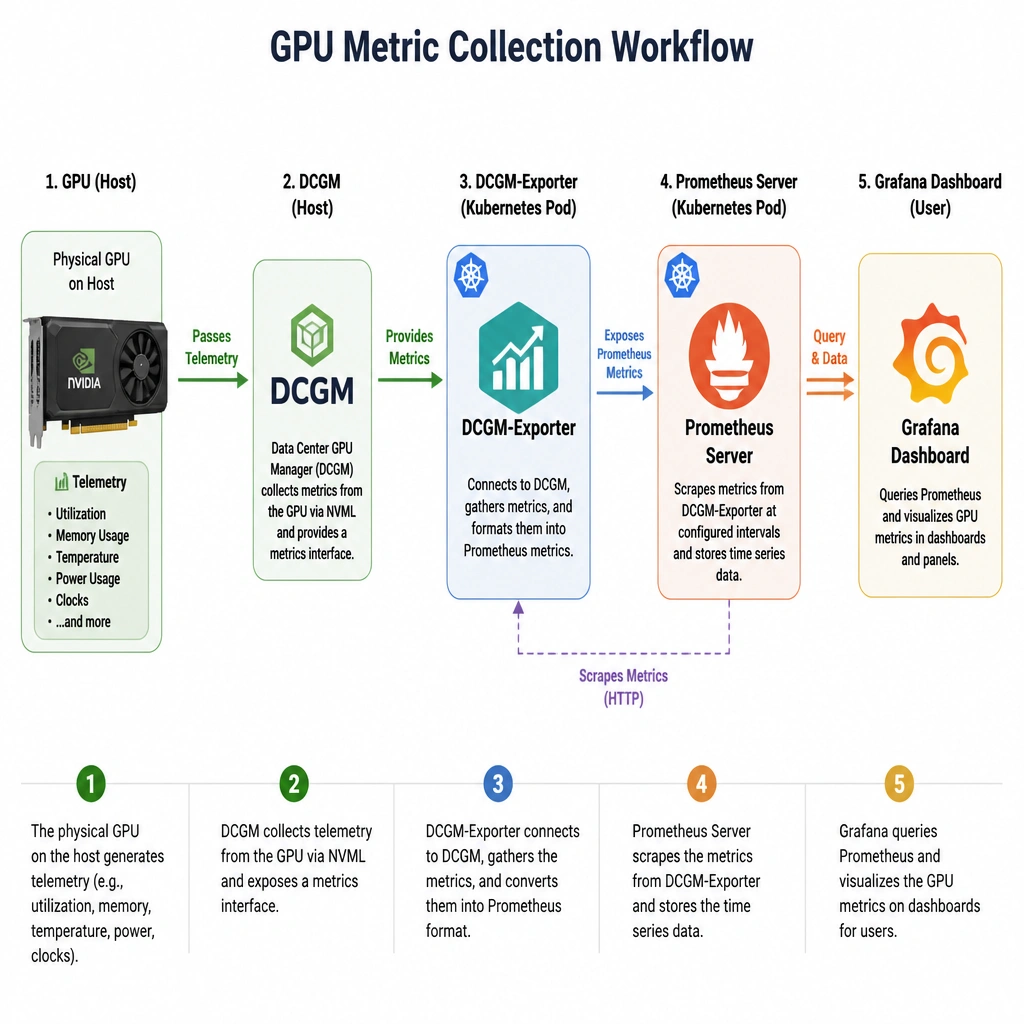
Here's the deal: when you're running GPUs in a containerized environment like Kubernetes, you've got to know how those cards are holding up under heavy loads. That's where DCGM (Data Center GPU Manager) comes in. But how do you get those raw metrics into your monitoring setup? You use the NVIDIA DCGM-Exporter. It queries DCGM and formats the telemetry so Prometheus can scrape it and feed it right into your Grafana dashboards. The other tools are awesome, but they have different jobs. The GPU Operator sets up the whole driver stack, the Container Toolkit lets containers talk to the hardware, and the Device Plugin exposes the GPUs to the K8s scheduler. So for metric scraping, DCGM-Exporter is your go-to!
Full explanation below image
Full Explanation
In modern containerized AI and high-performance computing (HPC) clusters, monitoring GPU health, utilization, and temperature is critical for maintaining system reliability and optimizing workload distribution. NVIDIA Data Center GPU Manager (DCGM) is a suite of tools designed to manage and monitor NVIDIA Tesla, Ampere, Hopper, and Blackwell GPUs in cluster environments. To integrate this telemetry into cloud-native monitoring pipelines, the NVIDIA DCGM-Exporter is deployed. It gathers low-level metrics from DCGM and exposes them via an HTTP endpoint in the standard Prometheus exposition format. This allows Prometheus to periodically scrape the metrics and store them for visualization in tools like Grafana. The exporter runs as a daemonset in the Kubernetes cluster, ensuring that every GPU-enabled node has a local metrics exporter. The other components mentioned serve distinct purposes in the NVIDIA container stack and do not export metrics. The NVIDIA GPU Operator automates the lifecycle management of all NVIDIA software components needed to run GPU-accelerated applications in Kubernetes, including drivers, container runtimes, device plugins, and even the DCGM-Exporter itself, but the Operator is an orchestrator rather than the exporter. The NVIDIA Container Toolkit is responsible for configuring the container runtime (like Docker, containerd, or CRI-O) to enable GPU acceleration inside containers by mounting driver libraries and binaries into the container filesystem. The NVIDIA Device Plugin is a Kubernetes daemonset that allows clusters to discover the number of GPUs on each node and allocate them to pods, but it does not collect or format performance metrics. Understanding this division of labor is essential: the Container Toolkit hooks container runtimes to GPU hardware, the Device Plugin registers GPUs with Kubernetes, the GPU Operator automates all these installations, and the DCGM-Exporter handles the Prometheus telemetry.