
After completing deep learning model training, you want to compile and optimize the neural network specifically to run with maximum throughput and minimum latency on NVIDIA GPU-based inference servers. Which NVIDIA SDK should you use to convert the model into an optimized runtime engine?
Select an answer to reveal the explanation.
Short Explanation and Infographic
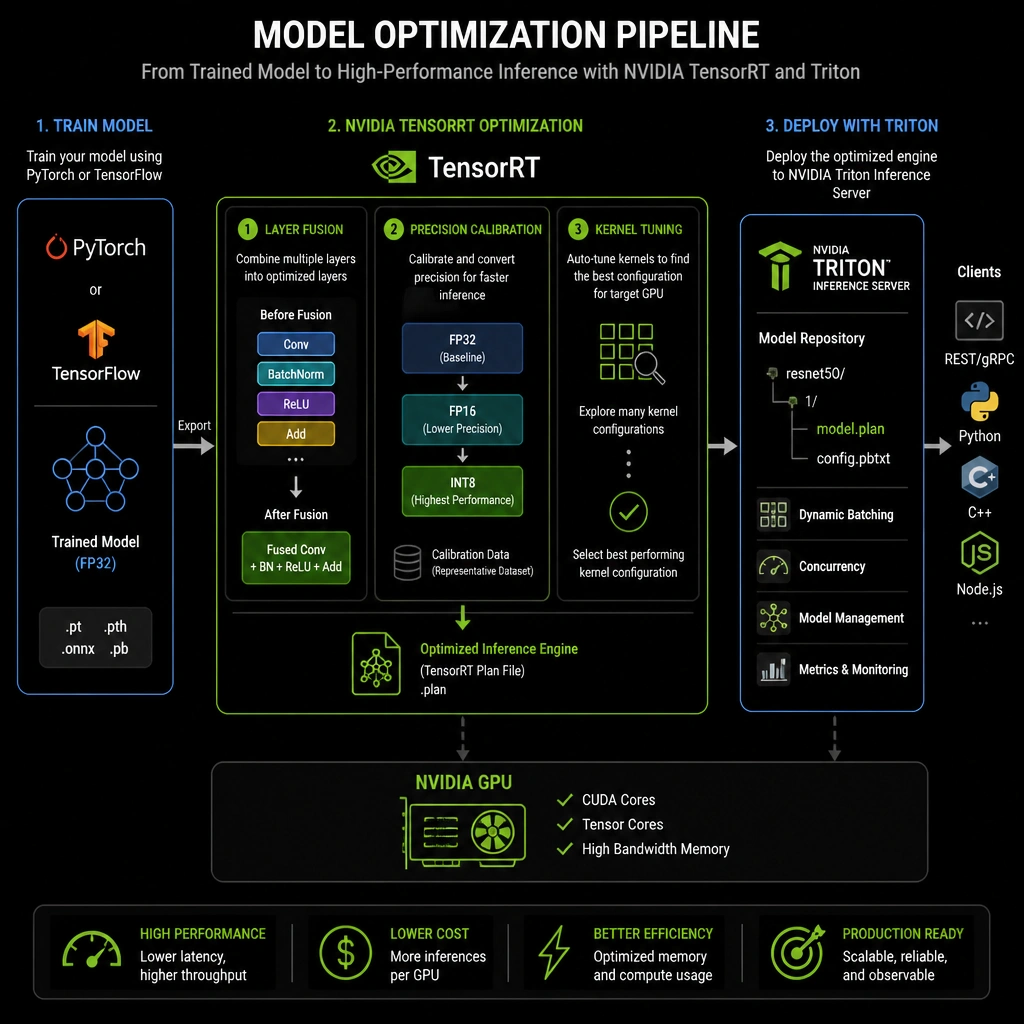
Here is the deal: once you've trained your model in PyTorch or TensorFlow, it's not ready for prime-time deployment yet. If you put it straight into production, it'll eat up too much memory and run slower than it needs to. You need to run it through NVIDIA TensorRT. This SDK takes your trained neural network, analyzes its structure, fuses layers together, and optimizes the memory usage—sometimes even converting it to lower precision like FP16 or INT8. What you get is a blazing-fast runtime engine tuned specifically for the GPU you're running on. CUDA and cuDNN are critical foundational tools, but TensorRT is the optimizer for inference deployment.
Full explanation below image
Full Explanation
NVIDIA TensorRT is a software development kit (SDK) designed for high-performance deep learning inference. It includes a deep learning inference optimizer and runtime that delivers low latency and high throughput for production deployments. TensorRT optimizes trained models (which can be imported from frameworks like PyTorch, TensorFlow, or ONNX format) by performing several structural modifications: 1. Layer and Tensor Fusion: Fusing adjacent layers (e.g., Convolution, Bias, and ReLU) into single kernels to reduce memory transfers and kernel launch overhead. 2. Weight and Precision Calibration: Quantizing the model weights to lower-precision formats like FP16 or INT8 while minimizing accuracy loss, which significantly accelerates execution speed on Tensor Cores. 3. Kernel Auto-Tuning: Selecting the most efficient algorithms and kernels for the target GPU architecture (e.g., A100 vs. L4). 4. Dynamic Tensor Memory: Reclaiming memory space allocated for intermediate tensors to reduce footprint. - Option A is incorrect because cuDNN (CUDA Deep Neural Network library) provides GPU-accelerated primitives for deep learning frameworks (primarily used during the training phase), but it does not perform compiler-level model optimization or build standalone runtime inference engines. - Option B is incorrect because RAPIDS is a suite of software libraries designed for accelerating data science, machine learning, and data analytics pipelines (like pandas and scikit-learn replacements), not deep learning inference compilation. - Option D is incorrect because CUDA is the foundational parallel computing platform and programming model that allows developers to write code for GPUs. It is not a specialized deep learning inference optimizer.