
When transferring large datasets to the cloud to train deep learning models, which verification strategy best ensures that the datasets maintain both technical integrity and mathematical quality for model training?
Select an answer to reveal the explanation.
Short Explanation and Infographic
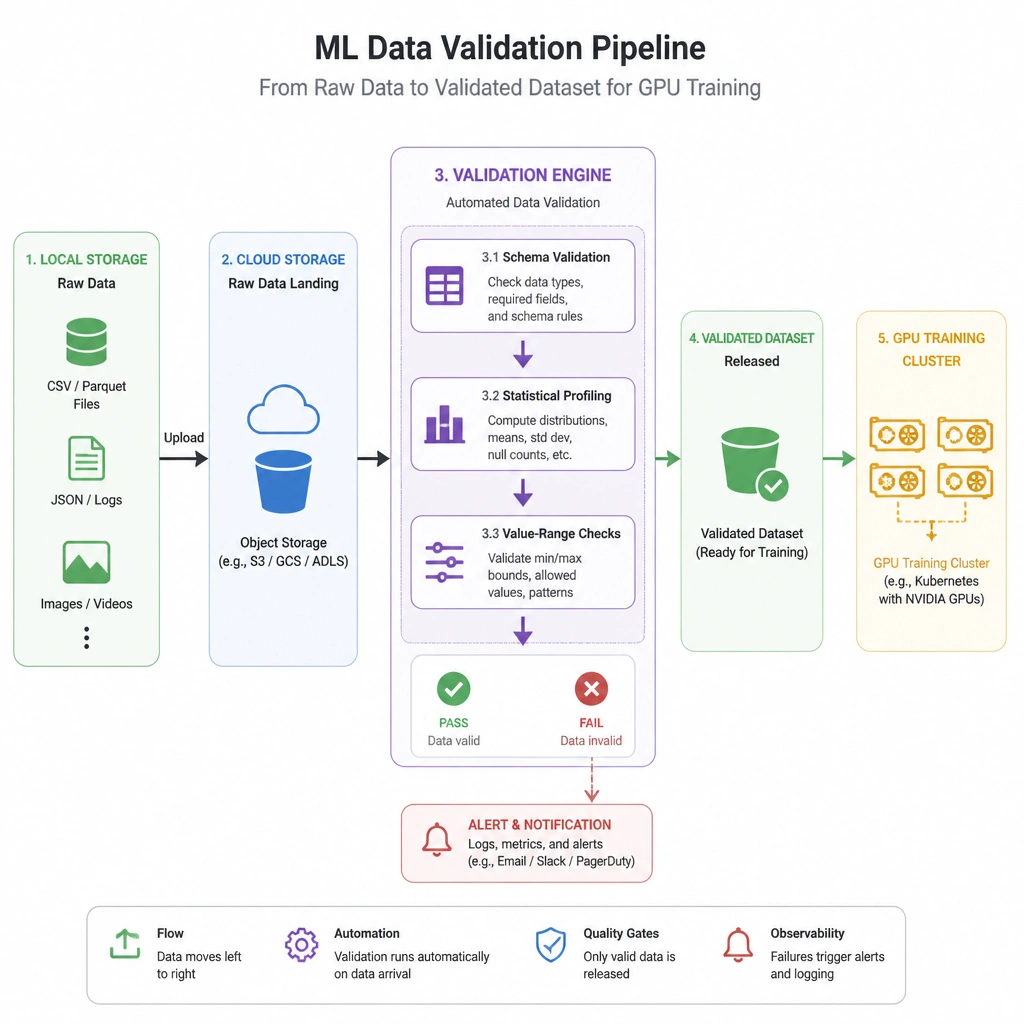
If you migrate a dataset for machine learning and some columns get corrupted or change types, your model training will fail, or worse, train on garbage data. Basic file counts or cloud storage SLAs won't tell you if your floating-point labels got truncated. You need automated checks that look at the structure and statistical profile of your data. Think of it like this: you need to verify that your schemas are identical, your statistical distributions (like mean and standard deviation of features) haven't drifted, and there are no null values where they shouldn't be. That's how you guarantee high-quality data for training!
Full explanation below image
Full Explanation
In machine learning, model performance is directly dependent on data quality. When migrating large training datasets (such as image datasets, text corpora, or structured tables) to cloud storage, data corruption or transformation errors can cause training failures or silent model degradation. Standard storage validations (like file size checks or hardware durability SLAs) only ensure that bytes were written to disk, not that the data is statistically valid. A comprehensive validation pipeline for machine learning data must evaluate: 1. Schema Validation: Confirming that columns, data types, and formatting (e.g., float32 precision, label indices) match the source schema exactly. 2. Statistical Profiling: Analyzing key statistics (such as min, max, mean, standard deviation, and null value percentages) of the dataset features. Any major shift in these statistics between source and target suggests data corruption or incomplete transfers. 3. Consistency Verification: Ensuring that relationship mappings, file labels, or tokenized representations remain intact. - Option A is incorrect because storage-level durability and replication check for drive failures and transfer errors at the hardware block level, but they do not detect software-level format or encoding issues. - Option B is incorrect because simple file audits only confirm file presence, not whether the contents of those files are valid or corrupted. - Option D is incorrect because manual spot checks are slow, error-prone, and cannot realistically identify statistical anomalies or schema inconsistencies across millions of rows or files.