
When designing data center infrastructure to support artificial intelligence, how do the computational profiles of model training and model inference differ?
Select an answer to reveal the explanation.
Short Explanation and Infographic
Think of training a model like studying for a medical license exam—it takes months of intense reading, practice, and correction (that's your backpropagation). On the other hand, inference is like a doctor answering a quick question in the clinic—they just use what they already know to give an answer (that's the forward pass). Training requires massive GPU clusters working for days to adjust model weights. Inference doesn't change the weights; it just runs the input through the existing network. That's why training needs high-end, interconnected GPUs, while inference can run on smaller, cheaper accelerators.
Full explanation below image
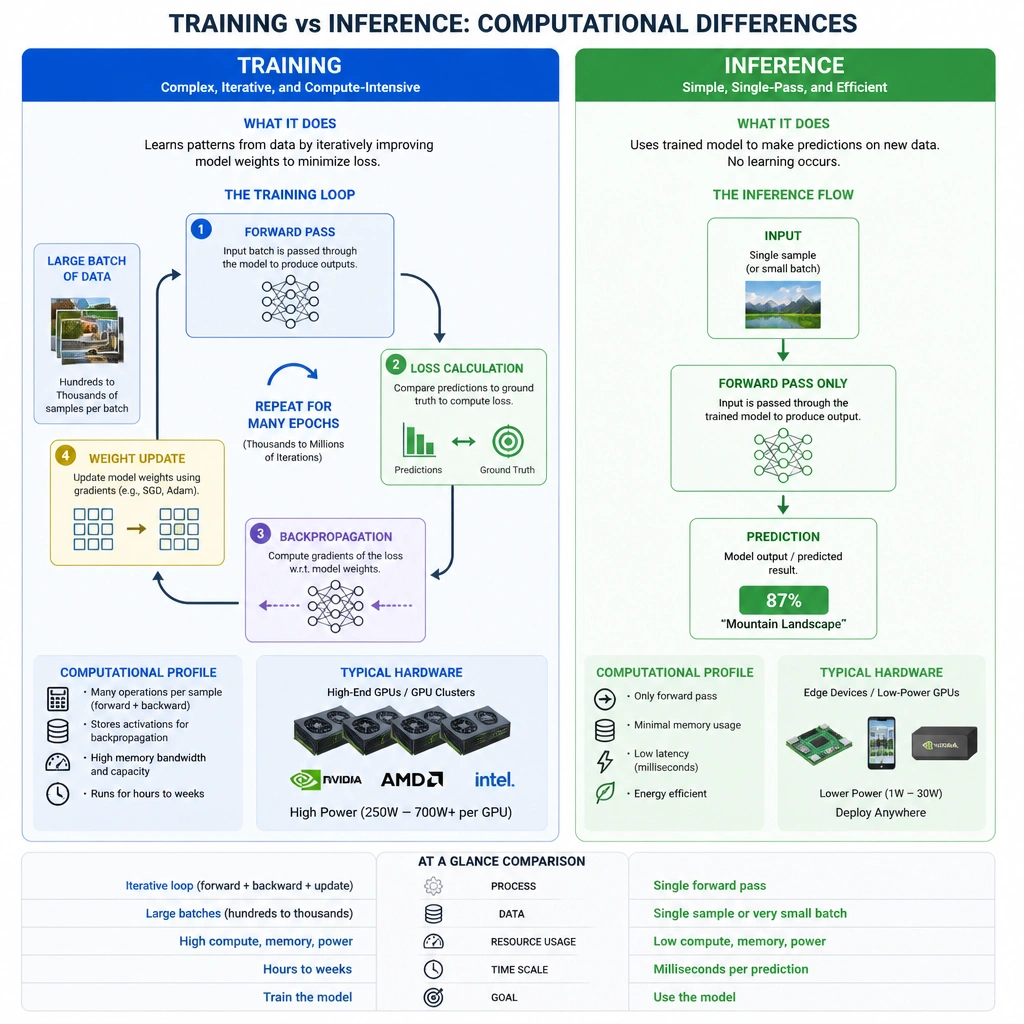
Full Explanation
In deep learning, training and inference represent two distinct phases of a model's lifecycle, each with vastly different hardware and resource demands. 1. Model Training: This is an optimization problem where a neural network learns patterns from data. It involves running inputs through the network (forward propagation) to generate a prediction, calculating the error (loss) against a target label, and then calculating gradients (backpropagation) to update the model's weights using optimization algorithms like stochastic gradient descent. Because it processes huge batches of data across many iterations (epochs) and must store all intermediate layer activations in memory for backpropagation, training is extremely compute- and memory-intensive, requiring high-performance GPUs with large HBM capacity (e.g., NVIDIA H100 or A100) connected by high-speed interconnects (NVLink). 2. Model Inference: Once trained, the model is deployed to make predictions on new, unseen data. Inference involves only the forward pass. The input data is processed through the network using the static, pre-calculated weights to generate an output. There is no backpropagation, no weight updating, and no need to store intermediate gradients in memory. Consequently, inference requires significantly less computing power per request and can be run on smaller, lower-power accelerators (e.g., NVIDIA L4 or T4) or even edge CPUs. - Option A and D are incorrect because they reverse the roles of forward and backward propagation. Inference never performs backpropagation or updates model weights in production. - Option C is incorrect because training and inference have completely different mathematical profiles and hardware requirements.