
When evaluating the hardware architecture of the NVIDIA A100 Tensor Core GPU for AI acceleration, which of the following statements is false?
Select an answer to reveal the explanation.
Short Explanation and Infographic
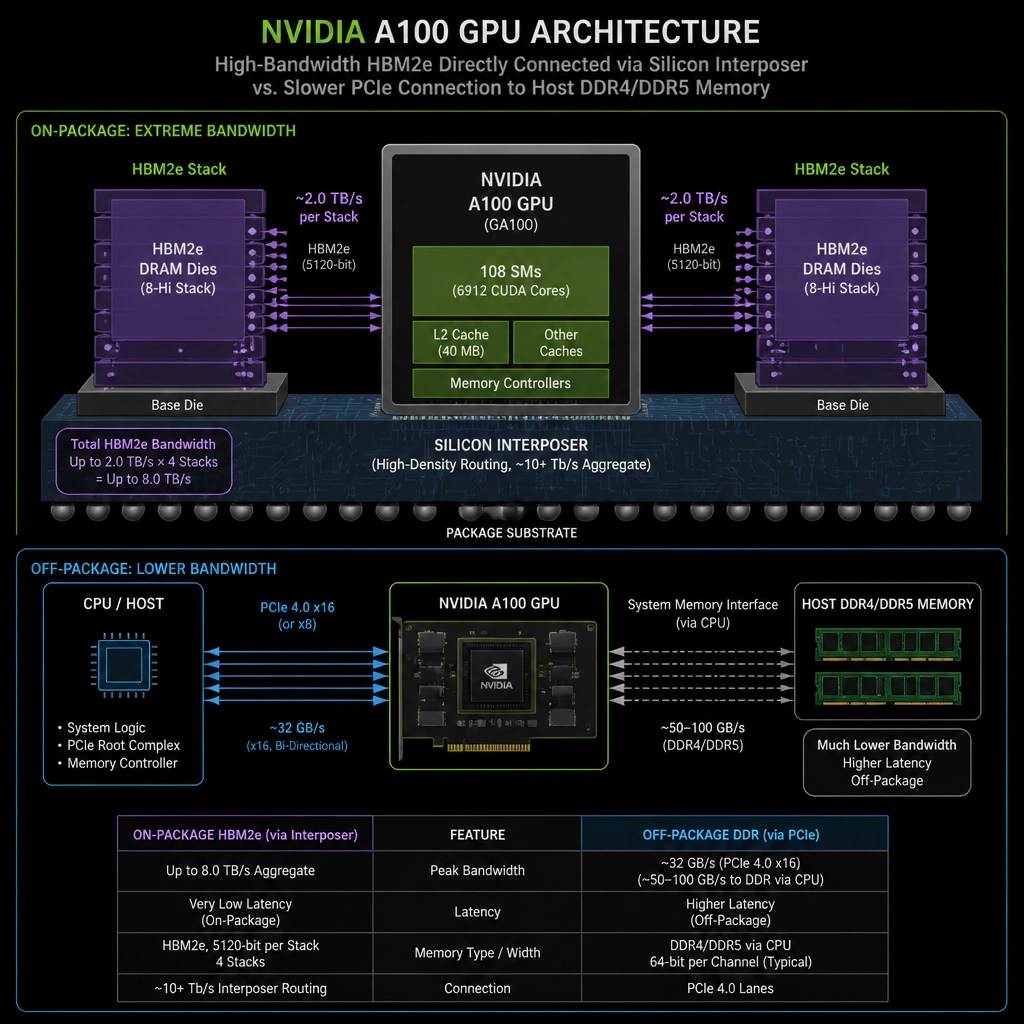
Here is the deal: GPUs are absolute beasts at processing parallel data, but they need an incredibly fast memory pipeline to keep those processing cores fed. If you hooked up an NVIDIA A100 to standard DDR4 system memory, the GPU would spend most of its time sitting around waiting for data—creating a massive bottleneck. That's why the A100 uses High Bandwidth Memory (HBM2e) stacked directly on the GPU silicon, achieving over 1.5 Terabytes per second of throughput. DDR4/DDR5 is for the CPU host, not the GPU core!
Full explanation below image
Full Explanation
The NVIDIA A100 Tensor Core GPU is designed for high-performance computing (HPC) and deep learning workloads. A critical aspect of its architecture is avoiding memory bottlenecks, which occur when compute cores starve for data. - Memory Interface (HBM2e vs. DDR): The A100 utilizes onboard High Bandwidth Memory (HBM2e), which is stacked vertically on the silicon substrate alongside the GPU die. This allows for a very wide memory bus and extremely high throughput (up to 1.55 TB/s or 2.0 TB/s depending on the variant). In contrast, DDR4 or DDR5 system memory is used by the host CPU and connects over much slower PCIe interfaces, making it completely inadequate for primary GPU calculations. Therefore, Option B is the incorrect statement (and thus the correct answer). - Multi-Instance GPU (MIG): This hardware-level virtualization feature allows a single physical A100 GPU to be partitioned into up to seven independent GPU instances. Each instance has its own dedicated SMs (Streaming Multiprocessors), memory controllers, and address space, providing hardware-level isolation for multi-tenant workloads. - Tensor Cores: The A100 features third-generation Tensor Cores, which introduce support for TF32 (TensorFloat-32), FP64, and BF16 formats, significantly boosting execution speeds for deep learning models compared to the Volta architecture.