
You are planning a major data migration project to transfer massive datasets to a cloud-based storage system for machine learning models. Which strategy provides the most reliable and thorough assurance that data has not been corrupted or lost during transit?
Select an answer to reveal the explanation.
Short Explanation and Infographic
Imagine moving all the contents of a giant library to a new building across town. If you just count the boxes, you might miss the fact that someone dropped a box in a puddle and ruined the books inside. That's why file sizes and file counts alone aren't enough when migrating datasets. You need a multi-layered approach. Use cryptographic checksums (like MD5 or SHA-256) to verify that every single bit matches exactly. Check the record counts, and run sample queries to make sure everything works on the new target system. Don't just trust the cloud provider's defaults!
Full explanation below image
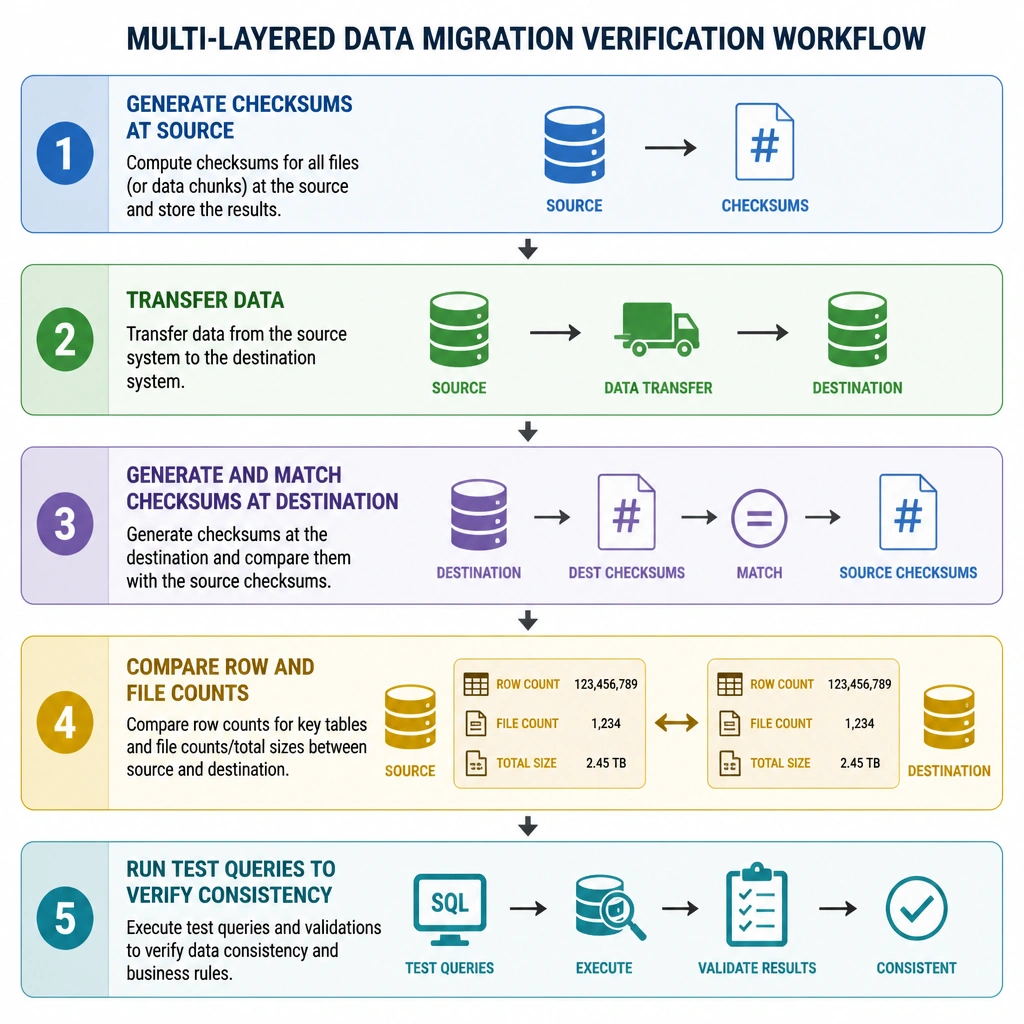
Full Explanation
In cloud migration projects involving high-value or large-scale datasets, ensuring data integrity is paramount. Simple validation methods, such as checking file sizes or relying on the transport layer's native transfer success codes, are insufficient because they can miss bit rot, payload truncation, or encoding errors. A comprehensive, multi-layered data validation approach consists of: 1. Cryptographic Checksum Verification: Generating hash values (e.g., MD5, SHA-256) on the source files and comparing them against hash values generated on the target files after transfer. If even a single bit changes, the checksums will not match. 2. Completeness Checks: Ensuring all records, files, or objects have been copied by comparing metadata databases (e.g., row counts, folder/directory structures). 3. Consistency and Quality Checks: Running validation queries or automated statistical profiling on the target system to confirm that data types, constraints, and relationships remain intact and operational. - Option A is incorrect because performing validation only after the entire migration is complete is a high-risk approach. If corruption occurs early in a multi-terabyte transfer, it can be extremely difficult and time-consuming to isolate and re-transmit only the affected data. - Option B is incorrect because comparing file counts and directory sizes can fail to detect internal data corruption where file sizes remain identical but the contents differ. - Option D is incorrect because cloud provider SLAs and hardware redundancy guarantee infrastructure availability and durability, but they do not protect against data corruption introduced during the upload process or application-level migration errors.