
Which of the following sets of infrastructure advancements represents the key pillars that have enabled the rapid scaling, high-performance training, and low-latency deployment of modern AI systems?
Select an answer to reveal the explanation.
Short Explanation and Infographic
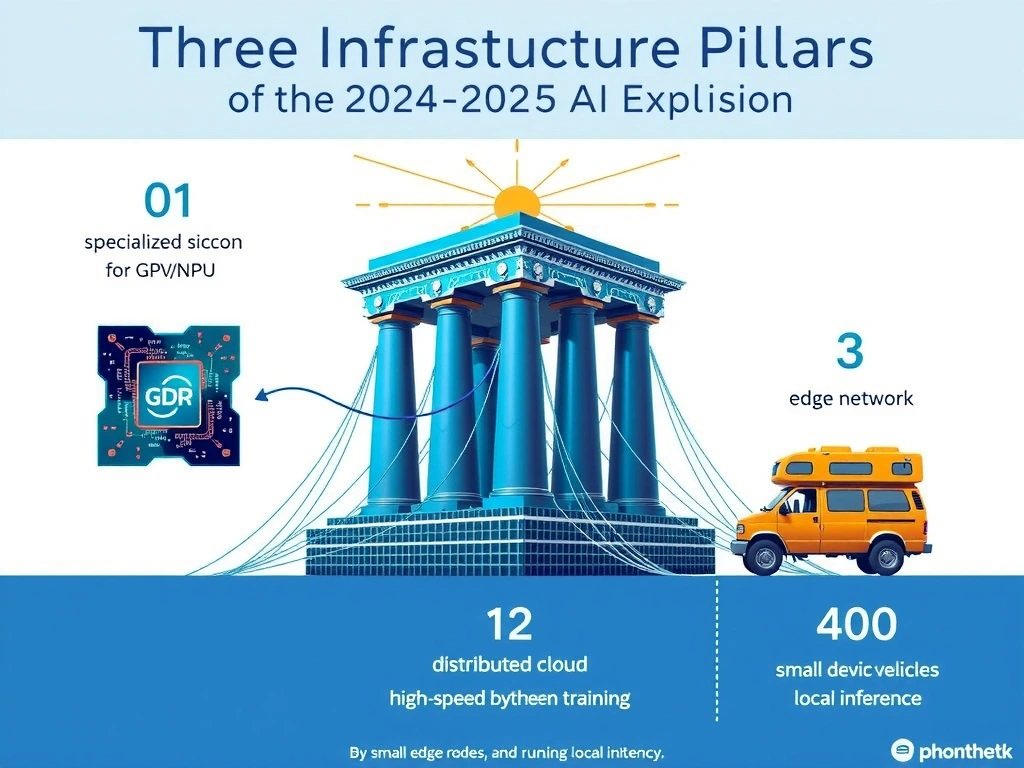
Think about how massive AI models are today. You can't train them on your old laptop! We've seen an explosion in AI capabilities because of three main hardware shifts. First, we have specialized AI chips like GPUs and ASICs designed specifically for matrix multiplication. Second, we pool these chips into massive cloud clusters using distributed computing to share the load. And third, we deploy the finished models out to the edge—closer to the users—so we don't have to wait for data to travel back and forth to a central server. That's the formula for modern AI success!
Full explanation below image
Full Explanation
The rapid advancement of AI and deep learning in recent years relies heavily on improvements in physical and cloud infrastructure. Three primary domains drive this enablement: 1. Specialized AI Accelerators: Standard CPUs are designed for general-purpose sequential tasks and struggle with the massive parallel matrix math required by neural networks. Specialized semiconductors, such as GPUs and TPUs (Tensor Processing Units), provide the parallel architecture needed to process training datasets efficiently. 2. Distributed Cloud Infrastructure: Training large language models (LLMs) requires clusters of thousands of accelerators working together. Distributed cloud environments provide the network fabric, storage throughput, and orchestration needed to partition datasets and models across nodes, enabling rapid scaling of training workloads. 3. Edge Computing Deployments: Running inference on remote central servers introduces network latency and bandwidth costs. Edge computing positions hardware closer to the end-users and data sources, enabling real-time, low-latency AI inference critical for applications like autonomous driving or real-time video analytics. - Option A is incorrect because legacy mainframes, tape drives, and VPNs are legacy technologies that do not provide the massive compute power or low latency required by modern AI. - Option C is incorrect because CPU-only compute and mechanical hard drives represent bottlenecks for high-throughput AI workloads. - Option D is incorrect because while neuromorphic computing is an active research area, it is not a primary driver of production AI scaling today, and standard RDBMS and security tools do not address the scaling of model workloads.