
When analyzing the dramatic performance scaling and widespread commercial adoption of AI systems in 2024–2025, which three infrastructure advancements have played the most critical role? (Select all that apply)
Select all correct answers, then click Submit.
Short Explanation and Infographic
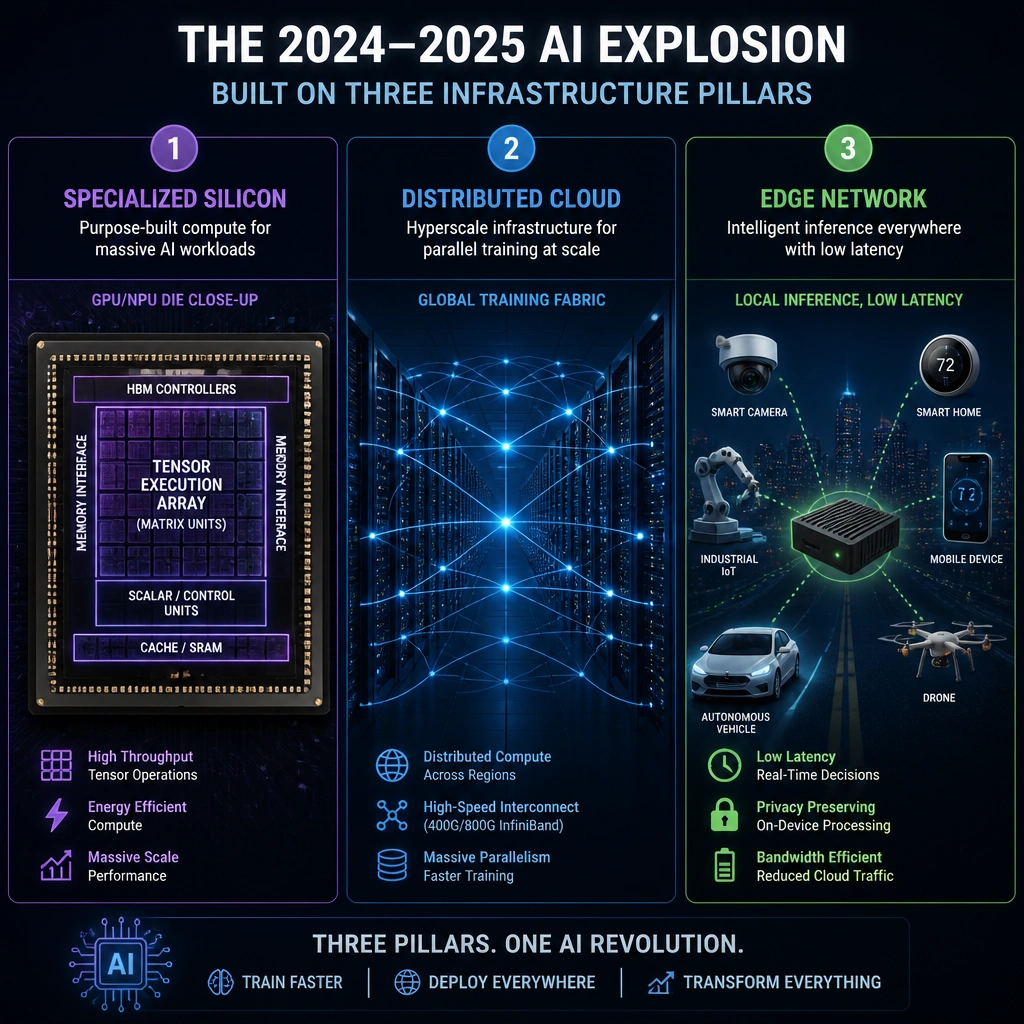
Here's the deal: AI didn't just explode in 2024 and 2025 because the math got better. The math has been around for decades! It exploded because the underlying infrastructure finally caught up. Think of it like trying to run a formula one race with a lawnmower engine—it just isn't going to happen. First, we got application-specific AI semiconductors like GPUs with Tensor Cores and dedicated NPUs. These chips are built to do one thing incredibly fast: matrix multiplication. Second, cloud infrastructure went hyper-scale. Now, you can spin up thousands of GPUs in a distributed cluster with a few clicks to train massive LLMs. Third, we pushed inference to the edge. By running models directly on local devices or edge nodes, we cut network latency to zero for real-time apps. Don't fall for the neuromorphic computing option—while it's cool science fiction, it's not what's driving today's AI boom. And legacy CPU-only setups? Forget about it. Got it? Sweet.
Full explanation below image
Full Explanation
The rapid scaling, training capability, and practical deployment of AI models in the 2024–2025 timeframe are directly tied to key developments in hardware and cloud infrastructure. The three most critical advancements include: 1. Application-Specific AI Semiconductors: Modern deep learning relies heavily on parallel matrix math. Traditional CPUs are general-purpose processors designed for sequential execution. The development of specialized AI chips—including GPUs equipped with Tensor Cores, Tensor Processing Units (TPUs), and Neural Processing Units (NPUs)—provides specialized hardware pipelines optimized specifically for low-precision tensor operations (like FP8, FP16, and INT8), yielding orders of magnitude improvement in performance-per-watt. 2. Distributed Cloud Infrastructure: Training state-of-the-art foundation models requires massive compute resources that exceed the memory and processing limits of any single physical server. Cloud providers have built highly optimized, elastic distributed computing infrastructure. By connecting thousands of GPUs over high-speed networks using protocols like InfiniBand or RoCE, these platforms enable data-parallel and model-parallel training at an unprecedented scale. 3. Edge Computing Deployment: For real-time applications like autonomous driving, robotics, and smart assistant devices, sending data back to a central cloud server introduces unacceptable latency. Edge computing brings trained model inference directly to localized hardware near the data source, optimizing response times and reducing network bandwidth consumption.
Let's address why the incorrect options are wrong: - Options A & B: Legacy on-premises hardware and CPU-only architectures lack the massive parallel processing power and specialized instructions required to train or run modern large-scale neural networks efficiently. - Option E: Neuromorphic computing, which mimics biological brain structures, remains largely experimental and has not yet contributed to the mainstream commercial AI systems scaled in 2024-2025.