
When deploying machine learning models in a production environment, why is containerization considered a crucial step for achieving horizontal scalability?
Select an answer to reveal the explanation.
Short Explanation and Infographic
Think of a container as a pre-packed suitcase. It has everything your model needs to run—dependencies, libraries, configuration files—all in one tight, isolated package. Because it's so lightweight, orchestration platforms like Kubernetes can spin up ten new copies in seconds when your traffic spikes, or tear them down when things quiet down. That's horizontal scaling in a nutshell! The container itself doesn't make your hardware faster or compress your files, but it makes deploying and scaling your app a breeze.
Full explanation below image
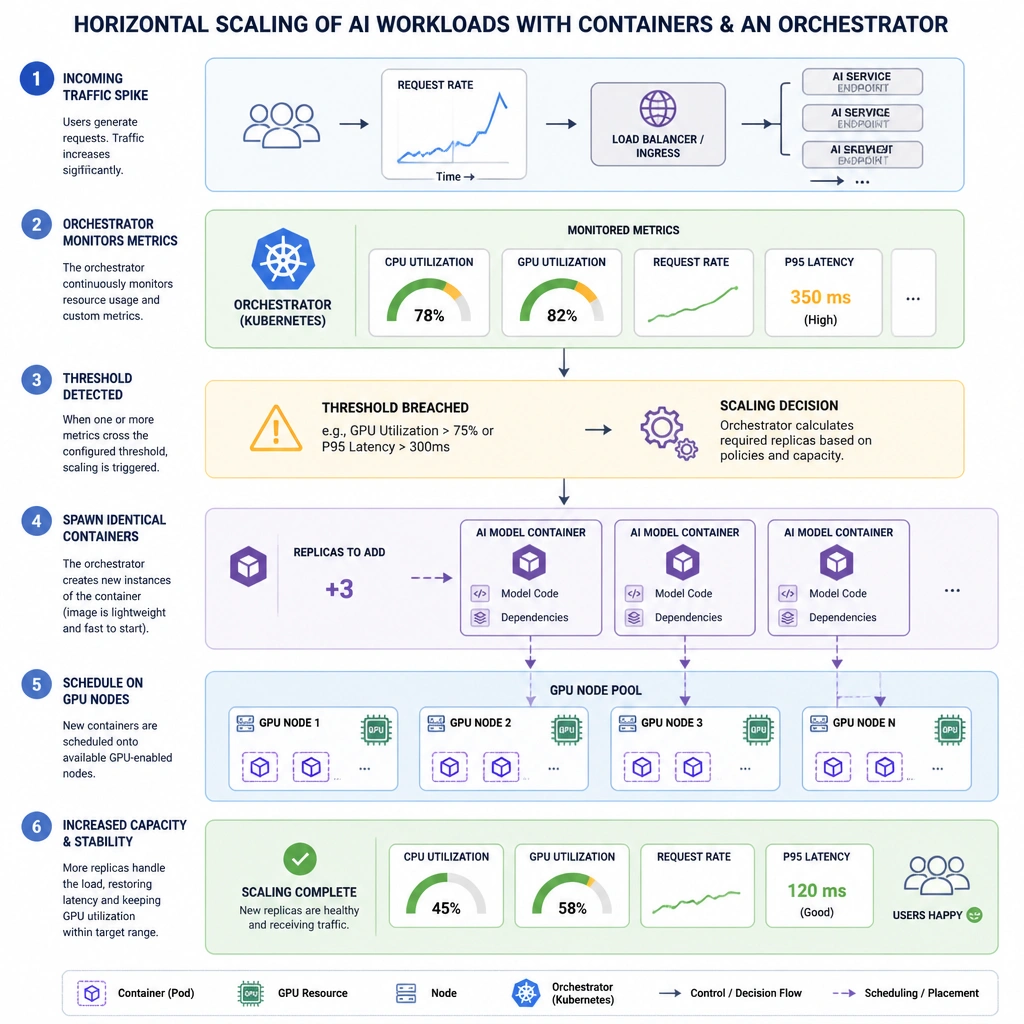
Full Explanation
In production machine learning deployments, scalability is achieved through horizontal scaling (adding more instances of an application) rather than vertical scaling (adding more resources to a single instance). Containers facilitate this process because they are lightweight, self-contained packages containing the application code, dependencies, and environment configurations. This isolation guarantees consistent behavior across different infrastructure nodes. Because containers share the host operating system's kernel, they start up in milliseconds, unlike traditional virtual machines. This rapid initialization allows orchestration engines like Kubernetes to dynamically scale containerized inference engines or worker nodes up or down in response to real-time traffic demand (e.g., CPU/GPU utilization or queue depth). - Option A is incorrect because containers do not modify GPU hardware configurations; hardware allocation is handled by the container runtime interface (like NVIDIA Container Toolkit) and the host driver. - Option B is incorrect because containers do not compress machine learning models; model compression techniques (like quantization or pruning) are separate software optimization steps. - Option C is incorrect because containers do not inherently provide cluster-wide network load balancing or dataset partitioning; these features are handled by external orchestration services, load balancers, and ML training frameworks (such as PyTorch DDP).