
An organization wants to dynamically allocate GPU accelerators, storage devices, and CPUs from a disaggregated pool to form custom compute nodes on demand. Which capability enabled by NVIDIA Base Command Manager combined with GigaIO FabreX allows this?
Select an answer to reveal the explanation.
Short Explanation and Infographic
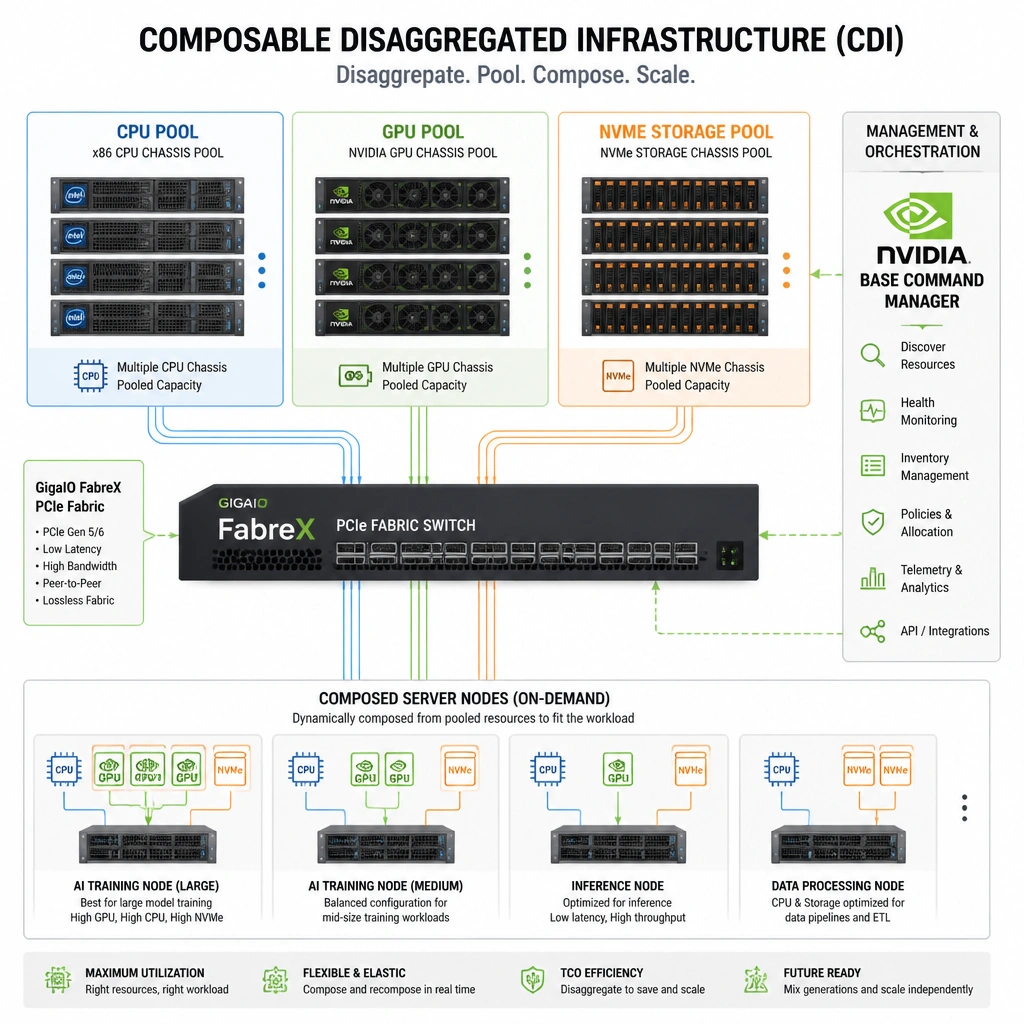
Here's the deal: in the old days, if you wanted to add two more GPUs to a server, you had to physically open the chassis and install them. Not very efficient! By integrating NVIDIA Base Command Manager with GigaIO FabreX, we get what's called composable disaggregated infrastructure. You pool all your CPUs, GPUs, and storage, and then use a software fabric to dynamically wire them together as if they were in the same box. It's like Lego bricks for data center hardware, all running over a high-speed PCIe fabric.
Full explanation below image
Full Explanation
In traditional data centers, servers are siloed resources where hardware ratios (such as CPU-to-GPU) are fixed at the time of purchase. When workloads change, some resources sit idle while others bottleneck. NVIDIA Base Command Manager's integration with GigaIO FabreX solves this by enabling Composable Disaggregated Infrastructure (CDI). FabreX is an enterprise-class PCIe resource fabric that connects CPUs, memory, storage (NVMe), and accelerators (GPUs) in separate chassis. The integration allows Base Command Manager to orchestrate these resources dynamically, assembling them into virtual "composable" servers on the fly based on the requirements of specific AI workloads. Once a task completes, the resources are released back into the pool. This allows on-premises data centers to achieve the agility of a public cloud with bare-metal performance. - Option A is incorrect because security group configuration and network partitioning are networking layers handled by SDN or cluster orchestrators, not CDI fabric orchestration. - Option B is incorrect because Base Command Manager and FabreX do not support cloud-to-cloud live virtual machine migrations. - Option C is correct because the key function of this integration is resource composition over a unified fabric. - Option D is incorrect because while Base Command Manager manages provisioning, the unique value of the GigaIO FabreX integration specifically is resource disaggregation and composability, not standard firmware updates.