
A data center manager needs to design an infrastructure that maximizes compute power per square foot while handling the intense thermal output of dense hardware configurations. Which set of technologies is critical to achieving this high-density computing environment?
Select an answer to reveal the explanation.
Short Explanation and Infographic
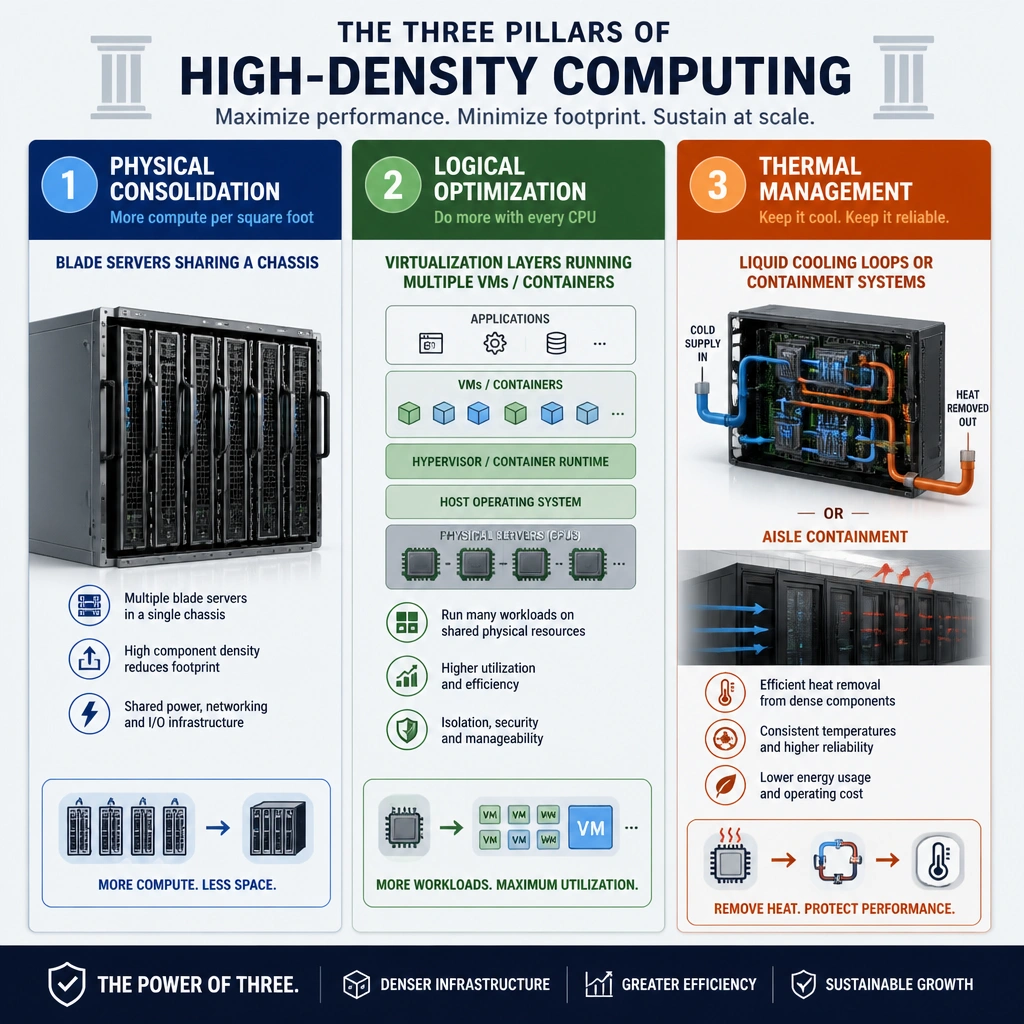
Here's the deal: if you want to squeeze as much horsepower as possible into your rack space, you've got to think about density, utilization, and temperature control. Blade servers let you pack a ton of CPUs into a single chassis. Virtualization makes sure you aren't wasting that hardware by letting multiple virtual machines share the same physical box. And trust me, all that computing power generates a massive amount of heat, so you absolutely need advanced cooling like liquid cooling or hot/cold aisle containment to keep from melting your gear. The other options are nice to have, but they don't solve the core hardware density and heat problem.
Full explanation below image
Full Explanation
High-density computing in modern data centers is defined by the concentration of computing power in a minimized physical footprint. To achieve this, three pillars are required: hardware consolidation, resource optimization, and thermal management. Blade servers address hardware consolidation by housing multiple modular server cards (blades) within a single chassis, sharing power, cooling, and networking components to drastically increase core density per rack unit. Virtualization addresses resource optimization by abstraction, allowing multiple operating systems and applications to run concurrently on the same physical hardware, thereby eliminating idle compute capacity and maximizing utilization. Advanced cooling systems, such as liquid-to-chip cooling or hot/cold aisle containment, are essential for thermal management; traditional air conditioning cannot efficiently dissipate the extreme heat generated by dense, multi-GPU or multi-core configurations. Incorrect options focus on different operational aspects: Option A relates to software performance and application routing. Option C concerns backup, monitoring, and security, which are operational and protective but do not build high-density compute. Option D focuses on data storage, network transport, and power redundancy, which support general operations but do not address compute density.