
When outlining a technology roadmap for enterprise cognitive computing, how should you define the hierarchical and nesting relationships between Artificial Intelligence (AI), Machine Learning (ML), Generative AI (GenAI), and Large Language Models (LLMs)?
Select an answer to reveal the explanation.
Short Explanation and Infographic
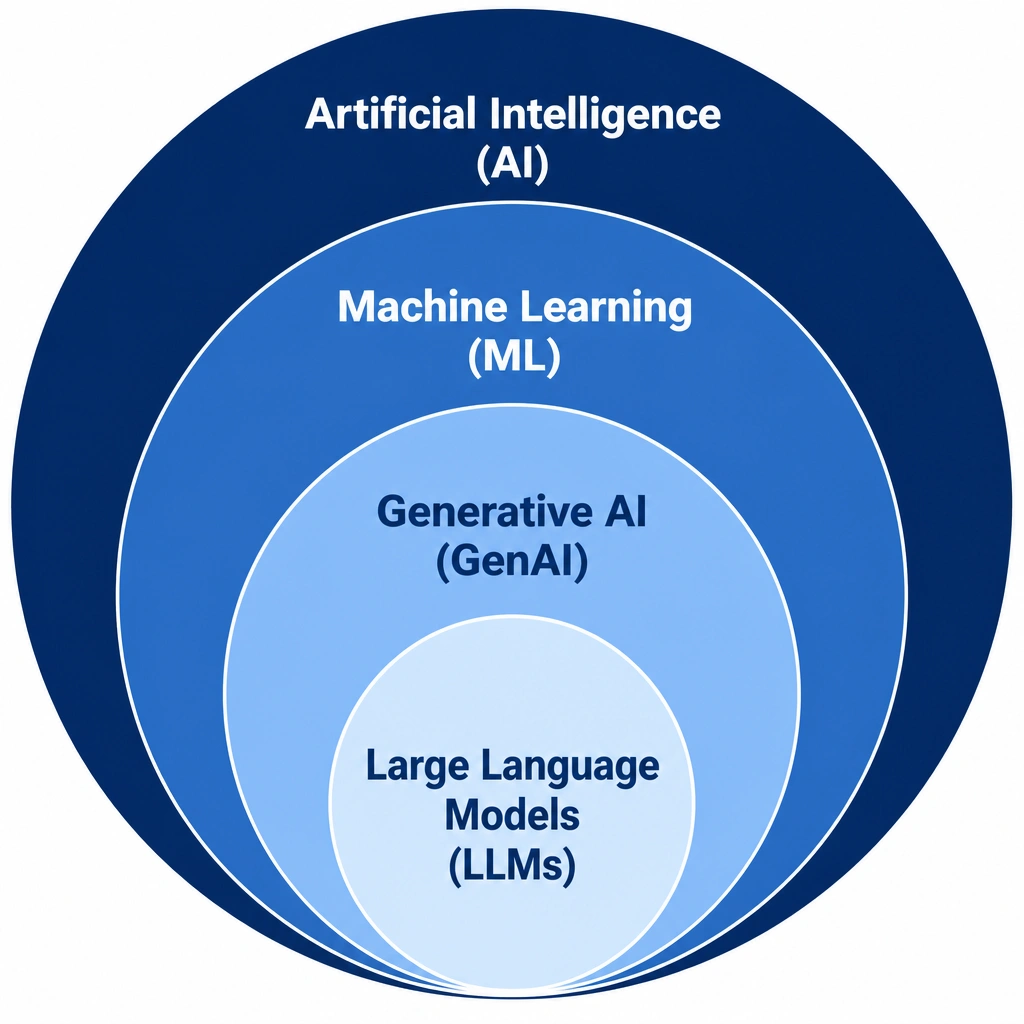
Check this out: people in the industry throw these terms around like they're interchangeable, but they definitely aren't. Think of it like nested Russian nesting dolls. The biggest, outermost doll is Artificial Intelligence—that's the broad dream of machines showing smart behavior. Open that up, and you find Machine Learning, which is all about learning from data. Open that one, and you get Generative AI, which is specialized in creating brand new stuff like text or images. Finally, the smallest doll inside that is Large Language Models—specifically designed for text and language. Keep this clean hierarchy in mind because it makes perfect sense once you visualize it, and you'll definitely see it on your test.
Full explanation below image
Full Explanation
In computer science taxonomy, the relationship between these concepts is strictly hierarchical and nested: 1. Artificial Intelligence (AI): The broadest category. It encompasses any system, whether rule-based, heuristic, or statistical, designed to simulate human-like cognitive functions. 2. Machine Learning (ML): A major subset of AI. It focuses on algorithms and statistical models that allow computers to learn patterns and make predictions from data without explicit, hard-coded rules. 3. Generative AI (GenAI): A specialized subset of ML. It refers to models designed to generate novel data instances (such as text, images, video, or audio) that resemble their training data, utilizing architectures like GANs, VAEs, or Transformers. 4. Large Language Models (LLMs): A subset of Generative AI. These are deep learning architectures (typically massive Transformer-based networks) trained specifically to process, understand, and generate natural language text. Therefore, LLMs reside inside GenAI, which resides inside ML, which resides inside AI. Understanding this nested relationship is critical for infrastructure planning. AI includes non-learning systems like classic chess engines or expert systems. ML introduces data-driven training, covering algorithms like support vector machines and random forests. GenAI introduces the creative aspect, where models generate new content rather than just classifying or predicting labels. Within GenAI, LLMs are a specific sub-discipline focused entirely on natural language text, character tokens, and semantic structures. Thus, every LLM is a Generative AI application, every Generative AI system is built using Machine Learning, and all Machine Learning is part of Artificial Intelligence. Options A, B, and D represent incorrect relationships or invert the direction of inheritance, which can lead to faulty system architectures and scoping errors.