
When building containerized infrastructure for AI workloads, which two capabilities represent the native, automated management features provided by Kubernetes? (Select two)
Select all correct answers, then click Submit.
Short Explanation and Infographic
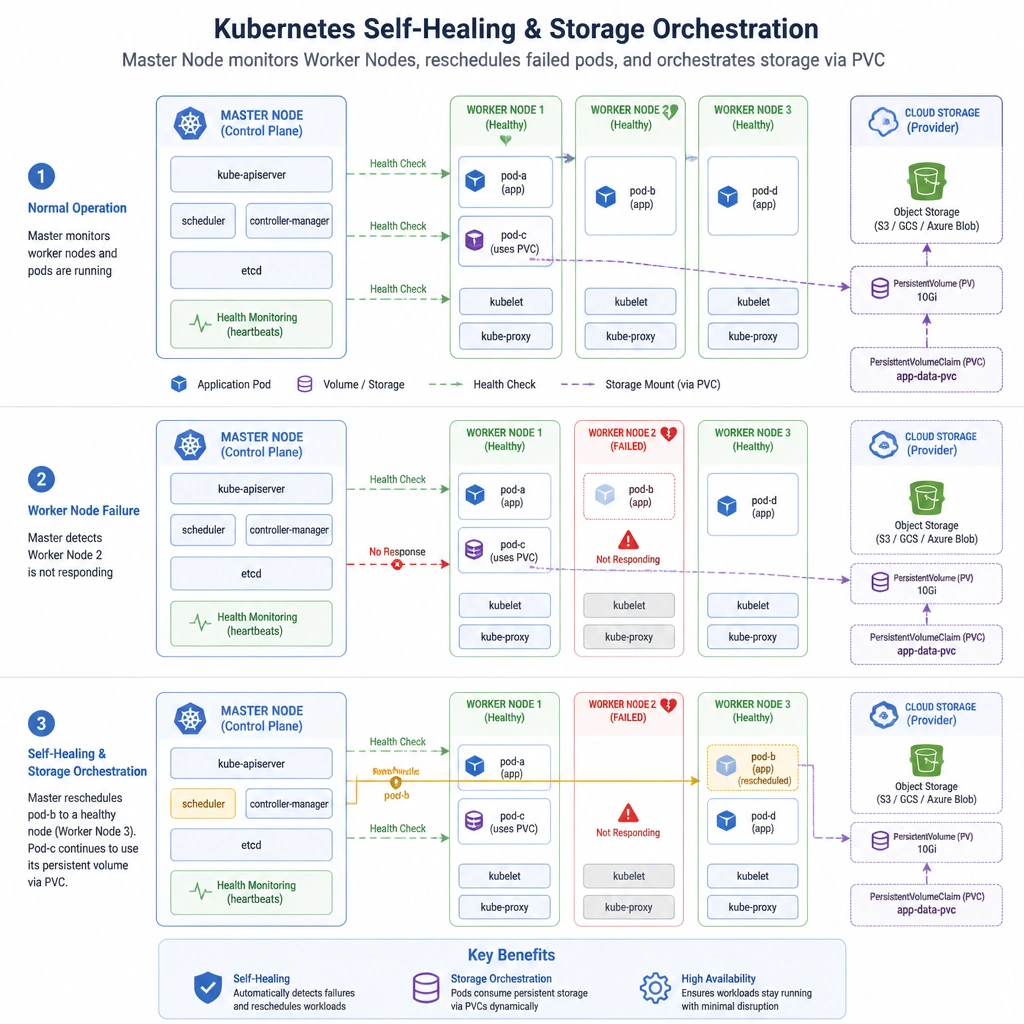
Alright, let's talk Kubernetes. If you're running AI models in production, you can't be babysitting containers all night. Imagine your boss walks in and asks what happens if a node crashes at 2 AM. With Kubernetes, you can tell him it's handled. Kubernetes has native self-healing: if a container dies, it restarts it. If a whole node goes down, it reschedules those workloads elsewhere. It also automates storage, meaning it can hook up local storage or public cloud drives automatically without you manually typing mount commands every time. That's why A and C are your answers. Remember, K8s is all about automation—so manual restarts or manual scaling requirements are not the correct answers.
Full explanation below image
Full Explanation
Kubernetes (K8s) is an open-source container orchestration platform designed to automate application deployment, scaling, and management. Two of its primary automated capabilities include: - Self-Healing (Option A): Kubernetes continuously monitors the health of containers (using readiness and liveness probes). If a container fails, Kubernetes restarts it automatically. If a node dies, Kubernetes immediately reschedules the affected pods onto other available, healthy nodes within the cluster. - Storage Orchestration (Option C): Kubernetes abstracts storage access, allowing containerized applications to request storage dynamically. It can automatically mount local drives, network storage (NFS, Ceph), or storage solutions from public cloud providers (like AWS, Azure, GCP) using Persistent Volumes (PVs) and Persistent Volume Claims (PVCs). These automated features are essential for running stateful AI workloads and training pipelines. In a cluster, if a GPU node hosting a training worker crashes, Kubernetes' self-healing capability automatically detects the failure and attempts to reschedule the workload onto an active node to resume training. Without automated storage orchestration, users would have to manually configure network storage attachments (like NFS or local SSD volumes) on every node. Option B is incorrect because manual intervention is not required; the main value proposition of Kubernetes is to automate recovery. Option D is incorrect because Kubernetes natively supports the Horizontal Pod Autoscaler (HPA), which automatically adjusts the number of replica pods running in a deployment based on CPU, memory, or custom Prometheus metrics.