
If you are building a scalable deep learning-based recommendation system using NVIDIA's specialized framework, which components form the core software suite for your data processing, training, and deployment pipeline? (Select all that apply)
Select all correct answers, then click Submit.
Short Explanation and Infographic
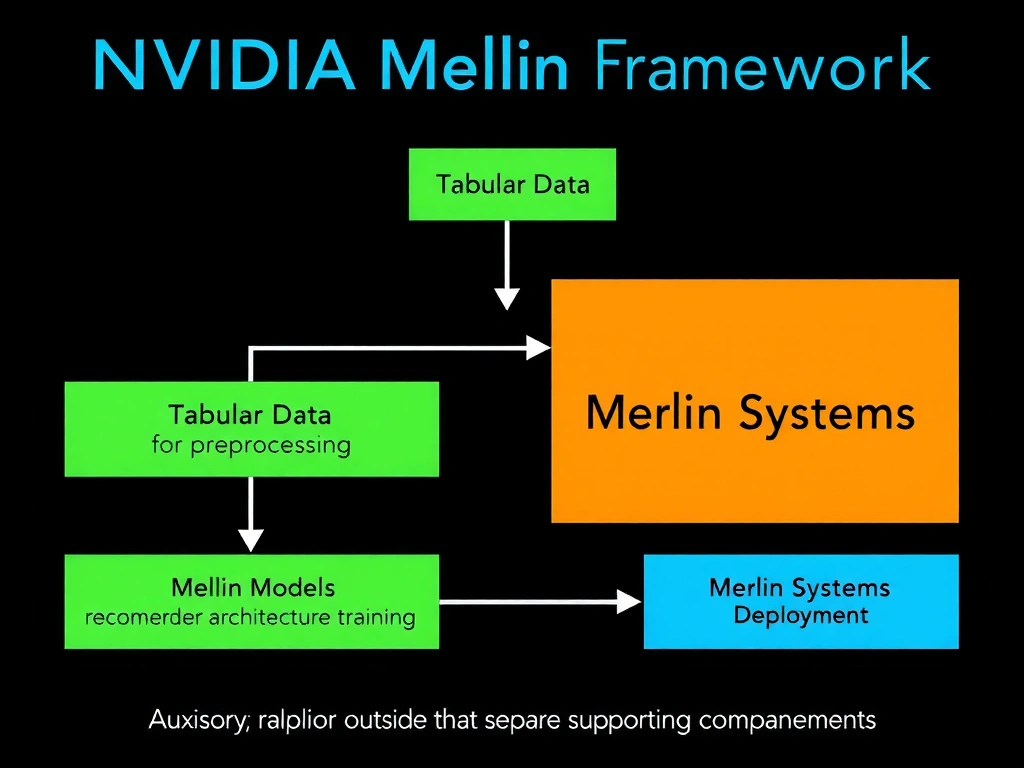
Here's the deal: if you want to build a recommender system that actually scales to millions of users, you can't just throw standard deep learning libraries at it and hope for the best. Recommendation pipelines are notoriously data-heavy, and the bottleneck is almost always data loading and feature engineering. That's why NVIDIA built the Merlin framework. It's a suite of tools that work together to solve this exact problem. The core trio consists of NVTabular, Merlin Models, and Merlin Systems. Think of NVTabular as your fast data preprocessor, Merlin Models as your architecture factory, and Merlin Systems as your production delivery vehicle. The other tools like RAPIDS, TensorRT, and CUDA are awesome, but they aren't part of the core Merlin suite. Make sure you don't get tripped up on this on the exam!
Full explanation below image
Full Explanation
The NVIDIA Merlin framework is an open-source library designed to accelerate all stages of recommender system development, from preprocessing to training and inference. Recommender systems handle massive sparse datasets, which require specialized operations. - NVTabular (Option F) is a core component dedicated to feature engineering and preprocessing. It accelerates tabular data preparation on GPUs, significantly reducing training time. - Merlin Models (Option C) provides high-quality, GPU-accelerated implementations of common recommender architectures (such as DLRM, DLRM-v2, DeepFM, etc.), making it easy to build and train models. - Merlin Systems (Option B) acts as the bridge to production, assisting in compiling the preprocessing pipeline and the trained model into an ensemble for deployment on Triton Inference Server. While RAPIDS cuDF (Option A) accelerates dataframe operations, TensorRT (Option D) optimizes deep learning inference, and the CUDA Toolkit (Option E) provides low-level GPU abstractions, these are separate libraries that Merlin leverages or runs alongside. They are not part of the core Merlin framework itself. Specifically, NVTabular addresses the main bottleneck in recommender systems, which is the ETL pipeline. It allows operators to manipulate billions of rows of tabular data using GPU memory. Merlin Models provides pre-built, production-tested deep learning recommender models (like DeepFM, DLRM, and Two-Tower) that are optimized for high GPU utilization. Merlin Systems orchestrates the transition between feature extraction and serving by creating Triton-compatible pipeline configurations, enabling low-latency inference. RAPIDS cuDF is a general dataframe library used for standard data tasks, but is not specifically optimized for the unique multi-hot encoding and embedding lookup pipelines that NVTabular manages. TensorRT optimizes neural network graphs but does not understand the business logic of recommender stages. The CUDA Toolkit is the foundational programming model used to write GPU kernels but is not a recommendation framework.