
An engineering team is designing a GPU-accelerated pipeline specifically for large-scale recommender systems using the NVIDIA Merlin framework. To achieve end-to-end efficiency, which three core libraries or components of the Merlin ecosystem should they implement to handle preprocessing, model training, and serving? (Select all that apply)
Select all correct answers, then click Submit.
Short Explanation and Infographic
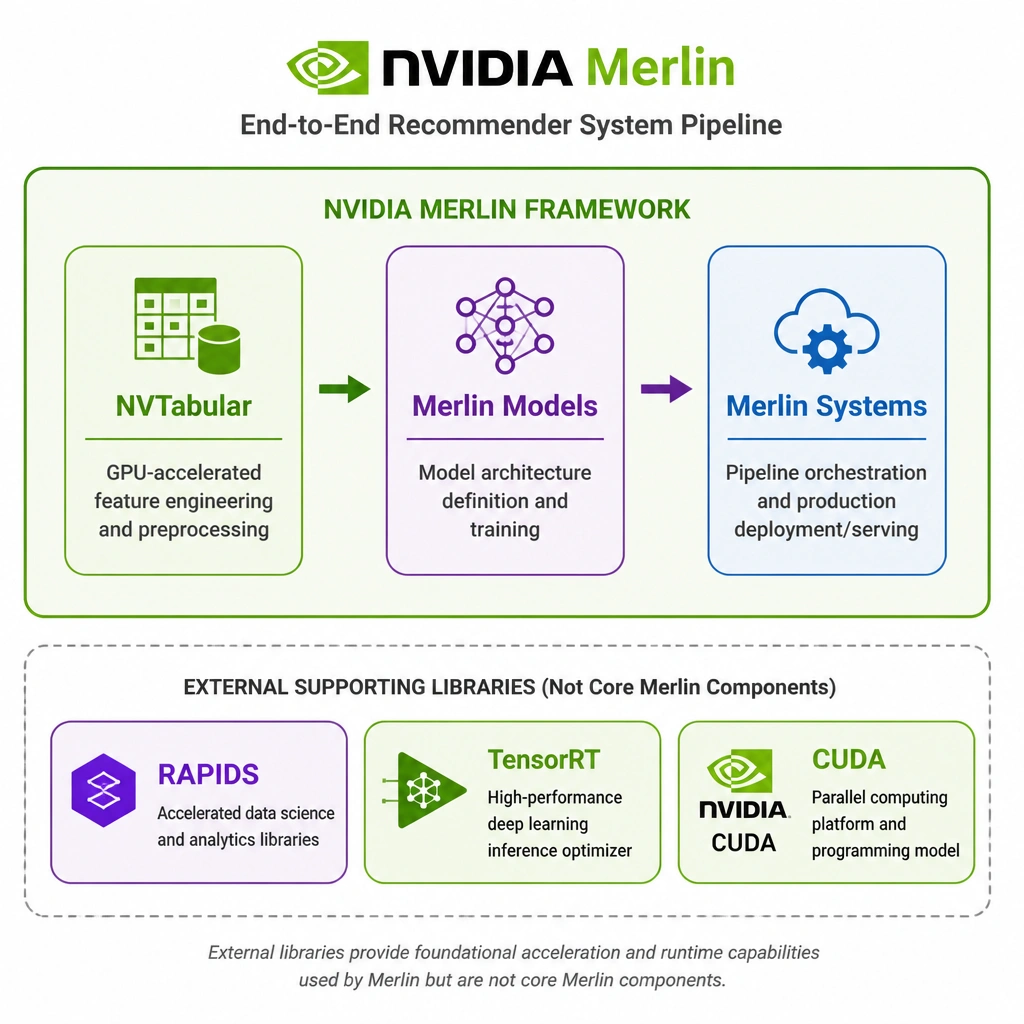
Here's the deal: recommendation systems are a beast of their own. You aren't just processing text or images—you're dealing with massive, sparse tabular datasets and multi-stage pipelines. To solve this, NVIDIA built Merlin. Now, if your boss walks in and asks what makes up this framework, you need to know the three pillars. First, NVTabular is your go-to for cleaning up massive datasets and engineering features directly on the GPU. Next, Merlin Models gives you the pre-built architectures and training loops designed specifically for recommenders. Finally, Merlin Systems wraps it all up to deploy your multi-stage pipeline into production. Don't fall for the trap of listing RAPIDS or TensorRT as core Merlin components—while Merlin uses them under the hood, they are separate NVIDIA tools! Got it? Sweet. Let's keep rolling.
Full explanation below image
Full Explanation
The NVIDIA Merlin framework is an open-source library designed to accelerate all stages of recommender system development, from data preprocessing to training and production deployment. The core of the Merlin ecosystem consists of three main components: 1. NVTabular: A GPU-accelerated data preprocessing and feature engineering library designed to handle massive tabular datasets that are characteristic of recommendation systems. It overcomes CPU bottlenecks by utilizing RAPIDS cuDF to accelerate feature engineering operations. 2. Merlin Models: A library that provides high-level APIs to easily build, evaluate, and train state-of-the-art recommendation system architectures (such as DLRM, DeepFM, and Two-Tower models) with TensorFlow, PyTorch, or JAX backends. 3. Merlin Systems: A component that simplifies the creation and deployment of multi-stage recommendation pipelines (e.g., retrieval, filtering, scoring, and ordering) to production environments like Triton Inference Server.
Let's analyze why the other options are incorrect: - Option A (RAPIDS cuML): While Merlin is built on top of RAPIDS libraries like cuDF for accelerated dataframe manipulation, RAPIDS cuML is a separate suite of GPU-accelerated machine learning algorithms (such as K-Means, XGBoost, and PCA) and is not a core component of the Merlin framework itself. - Option D (NVIDIA TensorRT): TensorRT is a highly optimized SDK for high-performance deep learning inference. While Merlin Systems can leverage TensorRT to optimize model execution, TensorRT is a general-purpose compiler and runtime that exists independently of the Merlin framework. - Option E (DeepStream SDK): DeepStream is NVIDIA's toolkit for building AI-powered video and audio analytics applications. It is completely unrelated to recommender systems and tabular data preprocessing.