
In the NVIDIA CUDA programming model, developers write parallel kernels executed by thousands of threads. If you need a group of threads to cooperate, share data locally with low latency, and synchronize their execution points using the __syncthreads() primitive, which CUDA organization unit must you use?
Select an answer to reveal the explanation.
Short Explanation and Infographic
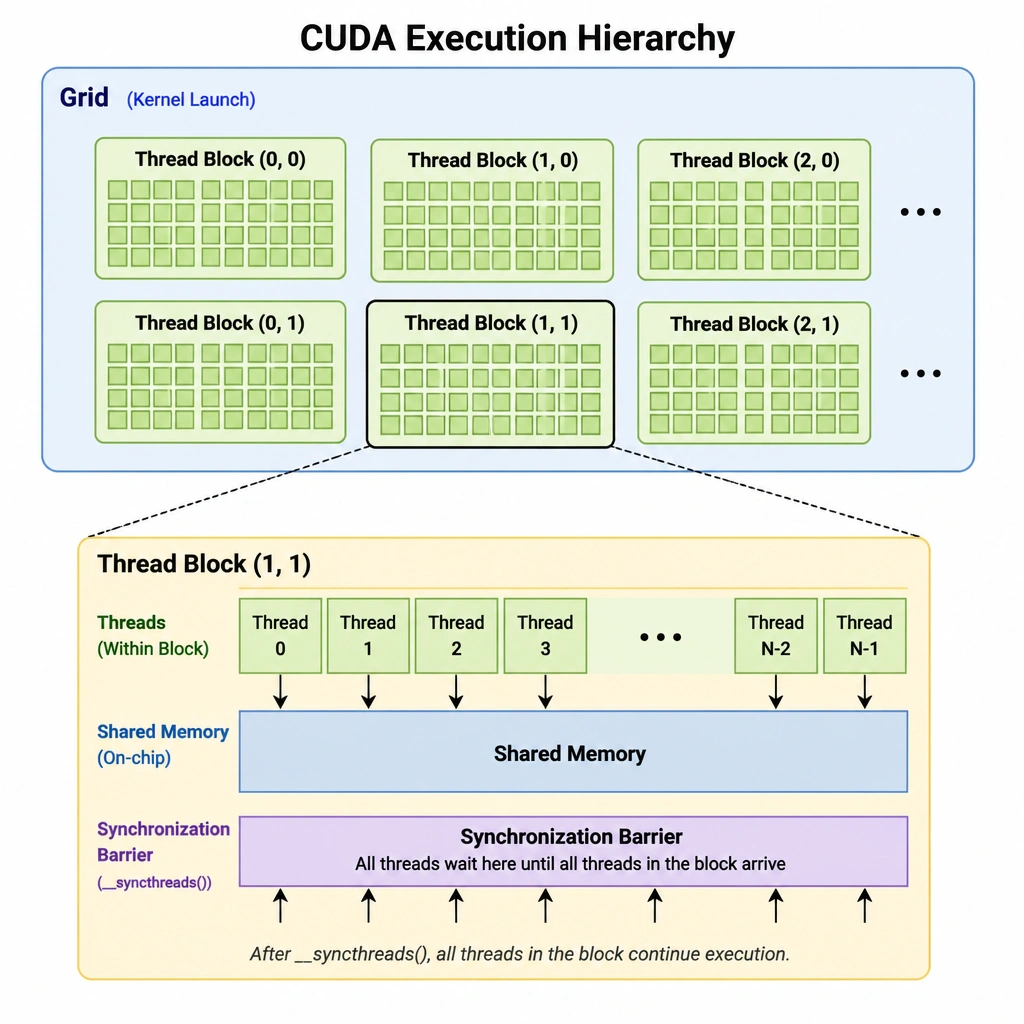
Check this out: in the CUDA world, understanding how threads talk to each other is key. You've got grids, blocks, and warps. If you want threads to synchronize their work using __syncthreads() and share data through fast on-chip shared memory, they must belong to the same Thread Block. Threads inside a block are guaranteed to run on the same Streaming Multiprocessor (SM), which is why they can share memory and sync up. Threads in different blocks can't do this easily. Got it? Sweet, let's keep rolling.
Full explanation below image
Full Explanation
The NVIDIA CUDA programming model uses a hierarchical execution structure to scale computations across varying GPU configurations. At the software level, a kernel launch defines a Grid, which contains multiple Thread Blocks, and each block contains multiple threads.
A Thread Block is a crucial logical unit because threads within the same block are guaranteed to execute on the same physical Streaming Multiprocessor (SM) of the GPU. Because they share the same SM, these threads can communicate using high-speed, on-chip shared memory and coordinate their execution using synchronization primitives like __syncthreads(). The __syncthreads() function acts as a barrier; no thread in the block can proceed past this point until all other threads in the block have reached it. This is vital to prevent race conditions when threads read and write to the same shared memory locations.
Let's analyze why the other options do not match this capability: - Grid (Option A): A Grid is the highest level of organization in a kernel launch, containing all the blocks. Grids are designed to execute independently, meaning there is no native hardware-supported synchronization or shared memory capability between different blocks within a grid. - Warp (Option B): A Warp is a hardware-level execution unit consisting of 32 threads. While warps execute in lock-step (Single Instruction, Multiple Data, or SIMD), the warp itself is a scheduling unit managed by the warp scheduler. The programming model uses Thread Blocks as the primary abstraction for developer-controlled shared memory and barrier synchronization. - CUDA Stream (Option D): A Stream is a queue of command sequences (kernels, memory copies) that execute in order on the GPU. While streams allow for concurrent kernel execution and asynchronous data transfers, they do not manage thread-level cooperation or shared memory synchronization.