
An enterprise is planning to migrate its deep learning training workloads from a cloud-based service to an on-premises high-density computing deployment. What are the primary physical infrastructure and facilities challenges they must address during this transition?
Select an answer to reveal the explanation.
Short Explanation and Infographic
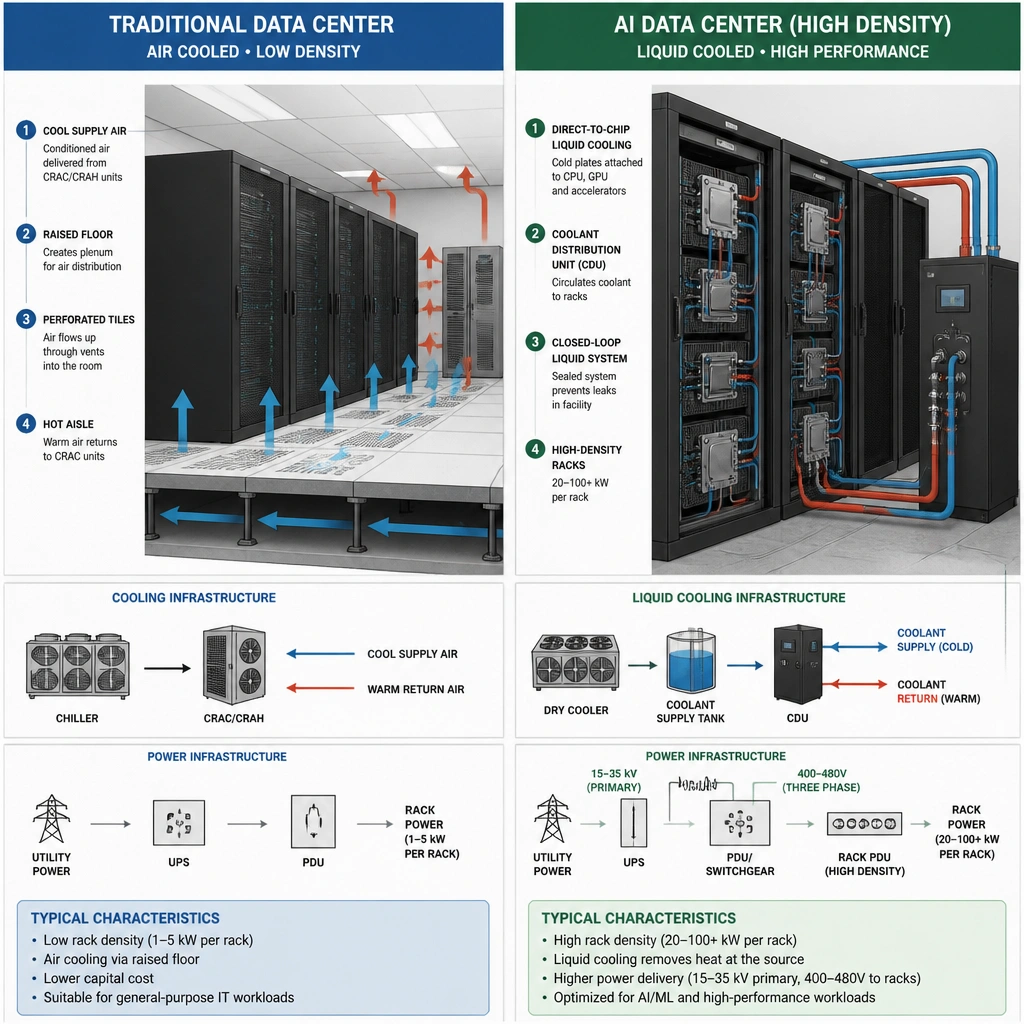
Listen, transitioning to on-premises high-density hardware for AI is a huge physical challenge. Traditional IT gear runs relatively cool, but GPU servers are basically space heaters on steroids. If you try to stack them in standard racks, your power grids will trip, and your air conditioning will completely give up. You have to upgrade your power infrastructure to deliver massive wattage, figure out how to direct that power to the racks, and deploy advanced cooling—like liquid cooling—to pull that intense heat away from the chips. Trust me, if you don't plan for the thermal and power demands first, your AI project is dead in the water.
Full explanation below image
Full Explanation
Migrating artificial intelligence (AI) and high-performance computing (HPC) workloads to on-premises deployments requires a fundamental overhaul of physical data center facilities. Standard enterprise data centers are typically built to support low-to-medium density racks, drawing between 5 kW and 10 kW of power. These environments rely on traditional forced-air cooling systems, which circulate chilled air through raised floors or containment aisles to keep hardware within safe operational temperatures.
GPU-accelerated servers used for AI models demand significantly more electrical power and generate extreme thermal loads. Racks containing multiple GPU systems frequently exceed 35 kW to 45 kW of power consumption. The primary technical challenges associated with this transition involve: 1. Power Infrastructure: Upgrading utility feeds, uninterruptible power supplies (UPS), power distribution units (PDUs), and backup generators to handle the increased load. 2. Thermal Management and Cooling: Traditional air cooling is physically unable to dissipate the heat generated by high-density racks. Facilities must implement advanced cooling technologies, such as rear-door heat exchangers (RDHx) or direct-to-chip liquid cooling loops (which use liquid coolant circulated directly over the GPU cold plates).
Let's review why the other options represent secondary concerns rather than primary facility challenges: - Option A (Software, training, migration): These are operational and software engineering tasks. While important for application deployment, they do not address the physical facility constraints that prevent AI hardware from operating safely. - Option C (Contracts, schedules, budgeting): These are project management and business administration responsibilities, not physical or technical infrastructure challenges. - Option D (Security, compliance, disaster recovery): These focus on governance, security policy, and business continuity. They remain constant requirements across all IT environments and are not unique physical scaling obstacles created by high-density GPU computing.