
When designing memory subsystems for AI computing clusters, it is crucial to understand how CPUs and GPUs handle memory. Which of the following statements accurately describes the primary differences in memory design between these two processing architectures?
Select an answer to reveal the explanation.
Short Explanation and Infographic
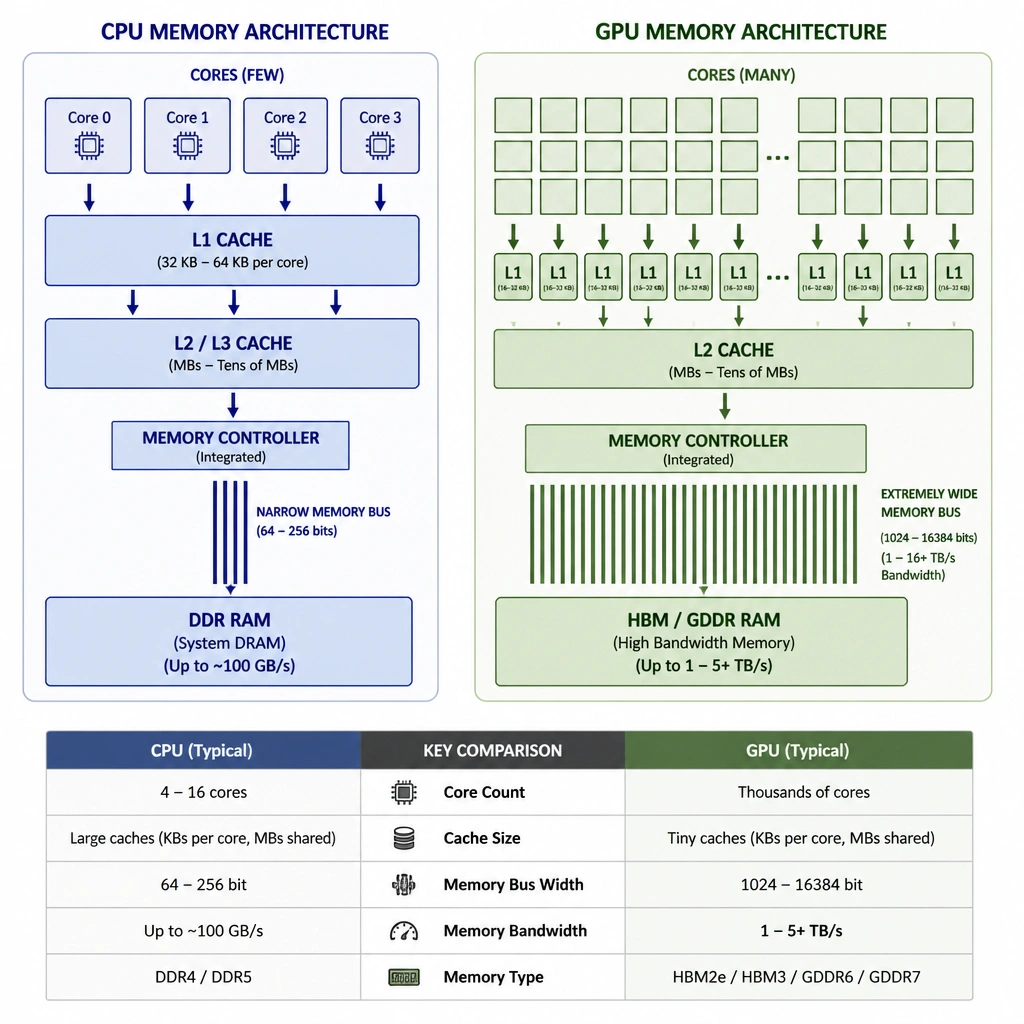
Here's the deal: CPUs and GPUs are built with completely different design goals. A CPU is like a Ferrari—it's designed to get a single task done as fast as possible. To do that, it needs low-latency memory access, using high-speed, multi-level caches and a narrower bus (usually 64 to 192 bits). A GPU, though, is like a massive freight train. It doesn't care about a tiny bit of latency; it cares about moving massive amounts of cargo all at once. So, GPUs use extremely wide memory buses (often 256 to 512 bits or more with HBM) to achieve insane memory bandwidth. When you are processing millions of parameters in an AI model, that high bandwidth is exactly what you need.
Full explanation below image
Full Explanation
The fundamental architectural differences between CPUs and GPUs extend directly to their memory subsystems. CPUs are latency-optimized processors. They are designed to execute sequential threads of instructions as quickly as possible. To minimize the time a CPU core spends waiting for data, CPU architectures dedicate significant chip area to complex cache hierarchies (L1, L2, L3) and utilize sophisticated branch prediction. Their physical memory buses are narrow, typically ranging from 64-bit to 192-bit interfaces, which focus on rapid, low-latency access to system memory (DDR4/DDR5).
GPUs are throughput-optimized processors designed for massive parallelism. Since they execute thousands of threads concurrently, they must stream huge volumes of data to their execution units. To achieve this, GPUs rely on high memory bandwidth rather than low latency. They employ very wide memory interfaces (typically 256-bit to 512-bit for standard GDDR, or up to 4096-bit and wider when using High Bandwidth Memory, or HBM) combined with high-frequency clock rates. This design allows GPUs to sustain bandwidths measured in terabytes per second, which is essential for deep learning workloads where huge arrays of weights must be continuously loaded.
Let's evaluate the incorrect choices: - Option A (Identical memory widths and clock rates): This is false. CPUs and GPUs use different physical bus widths and memory technologies (DDR vs. GDDR or HBM), resulting in vastly different memory performance characteristics. - Option C (CPUs outperforming GPUs in both latency and bandwidth): While CPUs have lower latency due to their advanced caching, they cannot match the massive memory bandwidth of GPUs, which is crucial for deep learning throughput. - Option D (Equal use of memory coalescing): Memory coalescing is a specific hardware optimization technique used by GPUs. It groups global memory accesses by threads in a warp into single, consolidated memory transactions. Because CPUs do not execute threads in warps with wide parallel memory buses in this manner, memory coalescing is not used or structured the same way in CPU architectures.