
When transitioning an AI project from development to production, an infrastructure architect decides to deploy the machine learning models on a Kubernetes cluster. What is the principal operational benefit of using Kubernetes for these production AI workloads?
Select an answer to reveal the explanation.
Short Explanation and Infographic
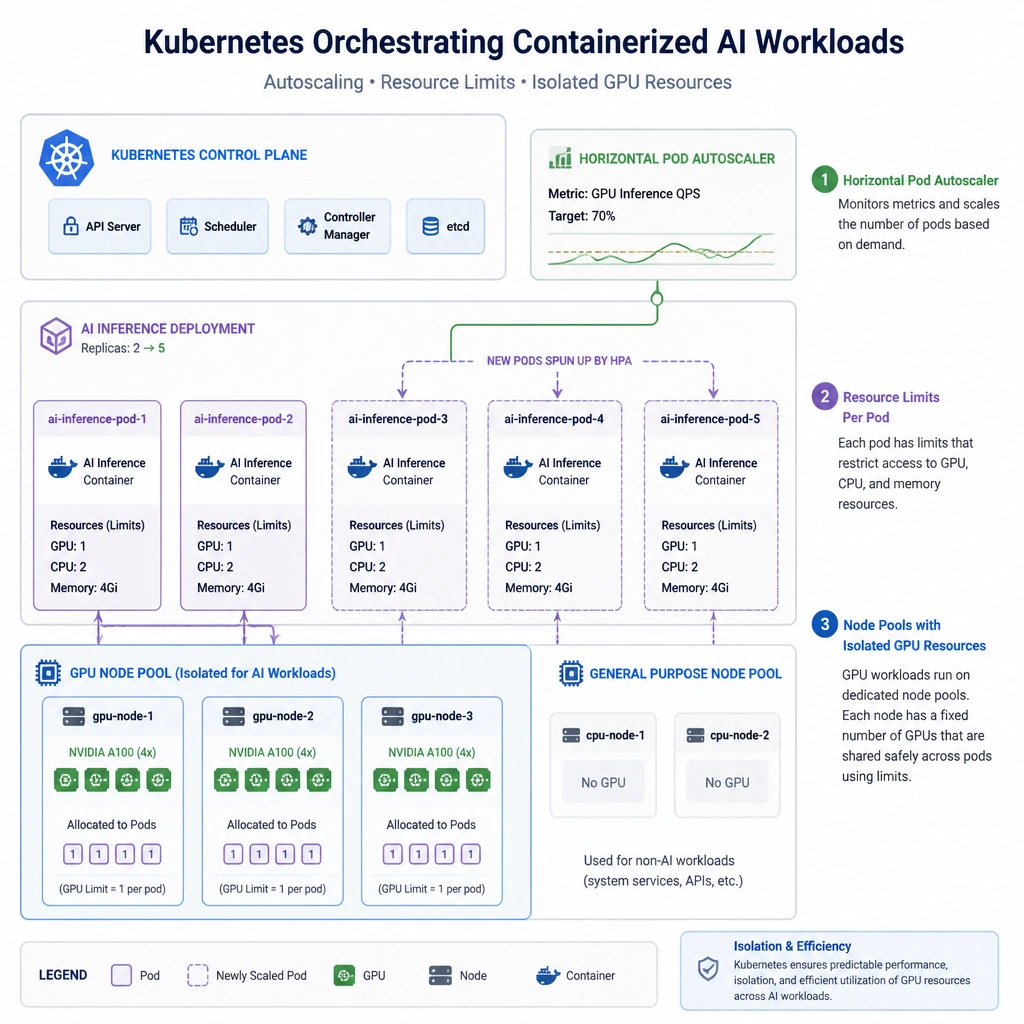
Let's talk about Kubernetes. Some people think it's a magic wand that makes their AI models run faster or trains them in half the time. It's not. What Kubernetes actually does—and it does this incredibly well—is manage your containerized workloads. It handles the orchestrating, scaling, and isolation. If you get a sudden spike in inference requests, Kubernetes can spin up new containers automatically. If a container crashes, it replaces it. It makes sure your containers get the CPU and GPU resources they need without stepping on each other's toes. That's the real win here.
Full explanation below image
Full Explanation
Kubernetes is a container orchestration platform designed to automate the deployment, scaling, and management of containerized applications. When deployed in production environments for artificial intelligence and machine learning workloads, its primary value lies in its operational management capabilities.
Kubernetes coordinates the scheduling of containerized model servers across a cluster of physical or virtual machines. It monitors resource usage and can dynamically scale the number of model replicas (horizontal pod autoscaling) to meet fluctuating traffic demands. By using namespaces, resource quotas, and limit ranges, Kubernetes ensures proper isolation between different workloads (e.g., separating development, testing, and production models) and prevents one runaway container from exhausting cluster-wide GPU or CPU resources.
Let's examine why the other choices are incorrect: - Option A (GPU hardware register and memory optimization): Optimization of GPU registers, memory access, and mathematical operations is handled at the driver and library level by software such as NVIDIA CUDA, cuDNN, and TensorRT, not by Kubernetes. - Option C (NCCL-based distributed training communications): High-speed, multi-node communication is managed by runtime libraries like the NVIDIA Collective Communications Library (NCCL) and message passing interfaces (MPI), which operate within the containers rather than being native functions of Kubernetes. - Option D (Model compilation and inference speed acceleration): Model optimization, pruning, quantization, and compilation are functions of specialized inference engines and frameworks (like NVIDIA Triton Inference Server, ONNX Runtime, or TensorRT), not the orchestration layer.