
You are designing the power and cooling infrastructure for a data center expansion that will house several racks of GPU servers dedicated to large language model training. How does the expected power density per cabinet for these modern AI workloads compare to the power density of traditional enterprise IT racks?
Select an answer to reveal the explanation.
Short Explanation and Infographic
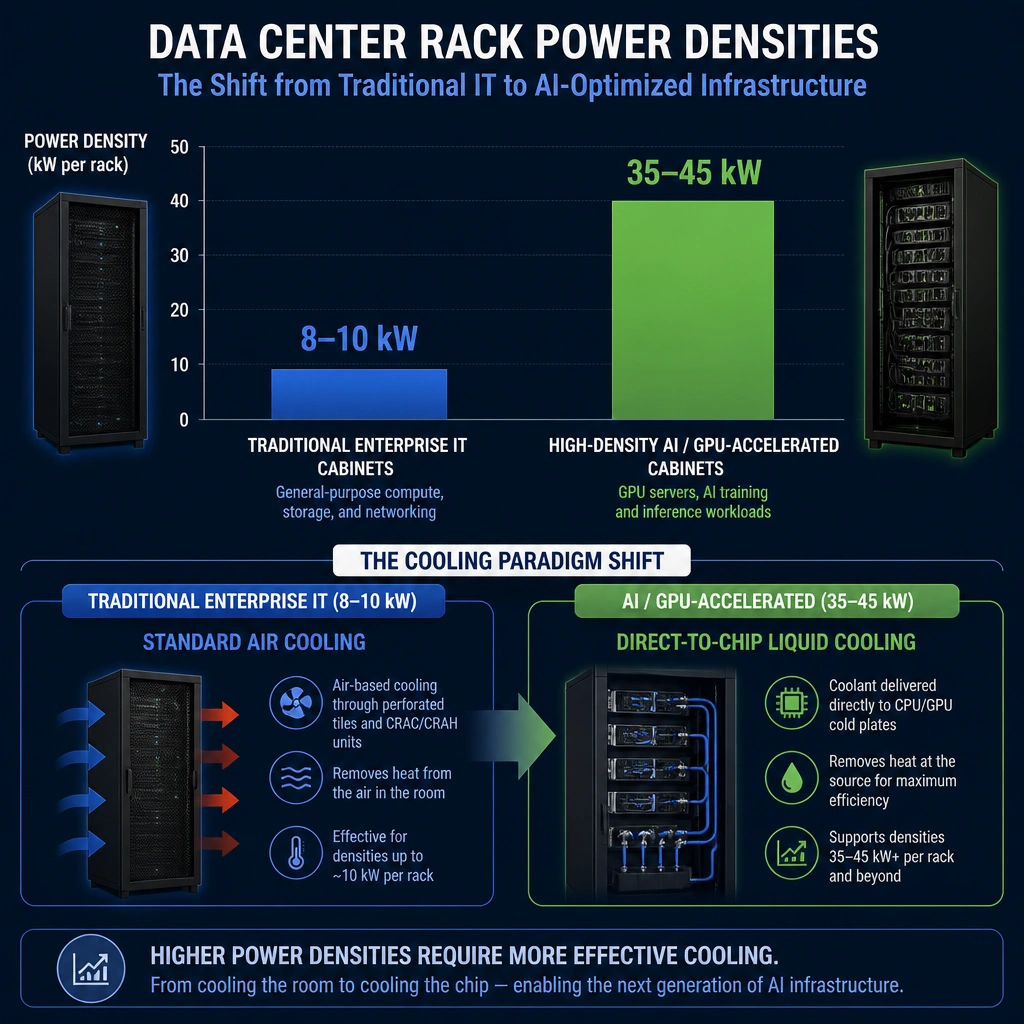
If you've been working in traditional enterprise data centers, you're probably used to engineering racks for about 8 to 10 kilowatts. That's standard stuff. But pay close attention here: when you drop GPU-heavy AI servers into the mix, those numbers skyrocket. We are talking 35 to 45 kilowatts per cabinet! And honestly, some of the newest liquid-cooled systems push way past that. If you try to run these high-density AI rigs on a traditional power grid with basic air cooling, you will melt something. Make sure your power and cooling designs are ready for this massive jump.
Full explanation below image
Full Explanation
Power density in data centers has risen exponentially with the adoption of high-performance computing (HPC) and artificial intelligence workloads. Traditional enterprise IT cabinets, hosting typical application servers, databases, and network switches, operate at a relatively low power density, averaging between 8 and 10 kW per cabinet. These systems can usually be cooled effectively using conventional raised-floor air distribution systems, such as hot/cold aisle containment.
In contrast, modern AI workloads utilize dense configurations of graphics processing units (GPUs) and specialized accelerators (such as NVIDIA DGX systems). A single 8-GPU server can draw upwards of 10.2 kW of power. When multiple of these high-performance nodes are stacked in a single rack along with network switches and storage interfaces, the power requirement easily climbs to the 35 to 45 kW range per cabinet. In many state-of-the-art AI deployments, rack densities can even exceed 70 to 100 kW, necessitating a transition from traditional air cooling to advanced liquid-to-air or direct-to-chip liquid cooling systems.
Let's look at why the other options are incorrect: - Option A (15-20 kW vs. 5-6 kW): While 15-20 kW is common for high-performance blade servers or dense virtualization clusters, it underestimates the power draw of multi-GPU accelerated racks used for deep learning. - Option C (5-8 kW vs. 1-3 kW): These values represent older, low-density data center architectures from a decade ago. Standard enterprise workloads have progressed beyond 1-3 kW, and AI workloads cannot operate within a 5-8 kW limit. - Option D (100-150 kW vs. 25-30 kW): These numbers are too high for standard AI and traditional baselines. Although some ultra-dense liquid-cooled supercomputers approach these limits, 100-150 kW is not the typical or standard operational range for most modern AI GPU racks, and 25-30 kW is far too high for average traditional enterprise IT cabinets.