
Your team is sizing storage arrays and caching strategies for a new machine learning project. During the critical data preparation and preprocessing phase—where raw datasets are ingested, cleaned, transformed, and saved for training—what storage I/O profile (read-to-write ratio) should you expect?
Select an answer to reveal the explanation.
Short Explanation and Infographic
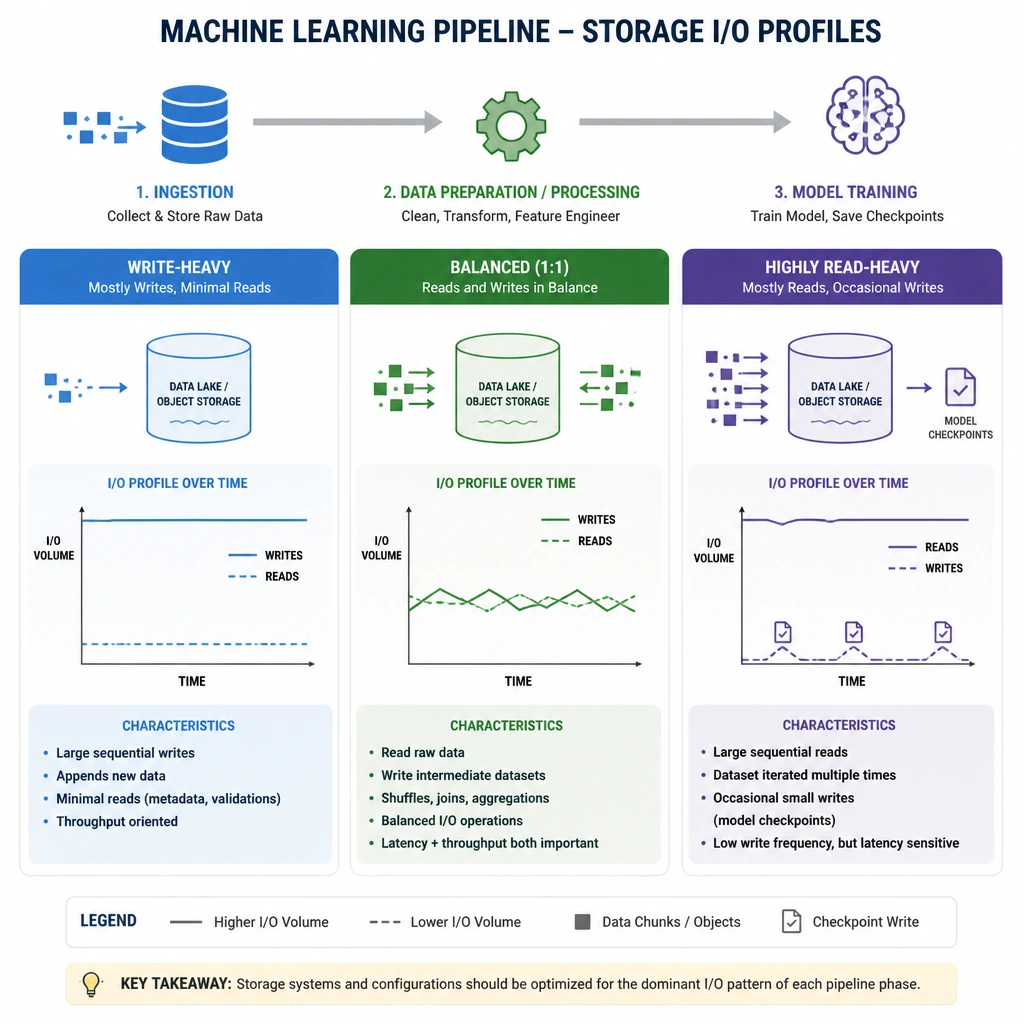
Here's the deal with the data prep phase of your machine learning pipeline: it's a two-way street for storage. Think about it—you have to read the raw, messy data first, run your transformation and cleaning scripts on it, and then write those cleaned datasets back to your storage system so the training cluster can access them. That means your reads and writes are pretty much neck-and-neck, giving you a balanced 1:1 ratio. I've seen folks build storage architectures assuming it's all read-heavy from day one, only to watch their systems choke during prep because they didn't plan for the heavy write traffic. Don't make that mistake!
Full explanation below image
Full Explanation
In machine learning pipelines, storage input/output (I/O) requirements shift dramatically depending on the specific phase of execution. During the initial data processing and preparation stage, the workload is characterized by a balanced read-to-write ratio, typically 1:1.
This phase is where raw data is ingested from data lakes or databases, parsed, cleaned, normalized, and transformed (e.g., tokenization, image resizing, feature engineering). To do this, the system must continuously read raw data, manipulate it in memory, and immediately write the transformed output back to storage as structured training files (such as TFRecord or Parquet formats). Consequently, storage systems supporting this phase must deliver high performance in both read throughput and write throughput, and caching systems must handle active write-back processes.
Let's review why the other options do not fit: - Highly read-heavy (roughly 10:1 or higher) (Option A): This is the characteristic storage pattern of the model training phase or the model inference/serving phase. During training, the GPU nodes repeatedly read the same prepared dataset in batches (epochs) while writing only occasional checkpoints. In inference, the system reads model parameters and incoming requests, returning small outputs, making it almost exclusively read-driven. - Write-only or write-intensive (roughly 0:1 to 1:10) (Option B and Option D): A write-heavy profile is typical of the raw data collection or ingestion phase, where IoT devices, logs, or sensors stream data directly into storage without any immediate read or transformation. It is not characteristic of the processing phase, which requires reading the source files before any transformation can occur.