
When setting up high-performance systems with NVIDIA Hopper or Ampere GPUs, you need to configure deep learning frameworks to leverage the hardware block specifically dedicated to running mixed-precision matrix multiplies and accelerating tensor-based mathematical operations. Which hardware component should you target?
Select an answer to reveal the explanation.
Short Explanation and Infographic
Check this out: if you are running deep learning workloads on modern NVIDIA GPUs like Ampere or Hopper, you want to make sure you're using Tensor Cores. Why? Because they are specialized, purpose-built engines designed specifically to crunch mixed-precision matrix multiplication—the exact math that powers neural networks. Standard CUDA Cores are great for general-purpose parallel math, but Tensor Cores do the heavy lifting for AI. If you're not using them, you're leaving a massive amount of performance on the table. Trust me on this, configure your framework for mixed-precision and let the Tensor Cores do their magic!
Full explanation below image
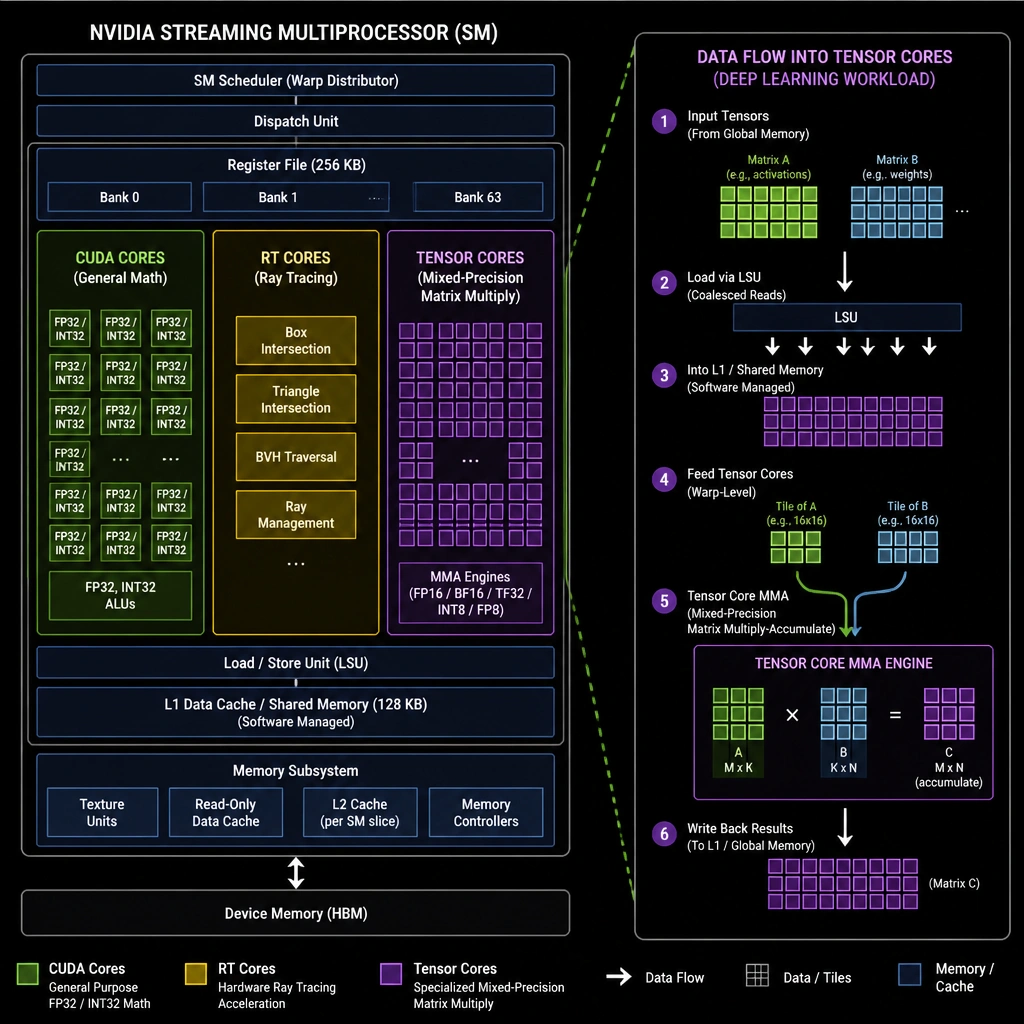
Full Explanation
Deep learning and neural network architectures rely heavily on matrix multiplication and accumulation operations (specifically, fused multiply-add operations). To accelerate these mathematical computations, NVIDIA introduced Tensor Cores starting with the Volta architecture, and significantly enhanced them in the Ampere and Hopper generations.
Tensor Cores are specialized hardware units within the GPU designed to perform mixed-precision calculations, such as multiplying two FP16 or BF16 matrices and adding the result to an FP32 matrix in a single clock cycle. This mixed-precision approach provides massive speedups for training and inference workloads while maintaining the accuracy of the neural network model. In the Hopper architecture, DPX instructions and fourth-generation Tensor Cores add support for FP8, doubling the throughput compared to previous generations.
Let's analyze why the other components are incorrect: - CUDA Cores (Option A): These are the general-purpose floating-point and integer processing units on the GPU. While they run general graphics pipelines and parallel mathematical equations, they do not have the specialized hardwired matrix-multiplication pipelines that Tensor Cores possess. Using them for deep learning matrix math is much slower. - Ray Tracing (RT) Cores (Option C): These hardware blocks are specifically designed to accelerate bounding volume hierarchy (BVH) traversals and ray-triangle intersection testing. They are used for rendering realistic lighting, shadows, and reflections in real-time graphics and gaming workloads, not for accelerating deep learning tensor operations. - Streaming Multiprocessors (SM) (Option D): An SM is a high-level organizational hardware unit on the GPU that contains CUDA Cores, Tensor Cores, RT Cores, register files, and shared memory. The SM itself is not the specific sub-component designed for matrix acceleration, but rather the container that houses these execution units.