
Distributed deep learning training requires tight coordination, as model gradients must be synchronized across hundreds of GPUs during backpropagation. If some processes start late or fail to initialize in sync, the entire training run can stall. Which core capability of the Slurm workload manager directly prevents this synchronization failure?
Select an answer to reveal the explanation.
Short Explanation and Infographic
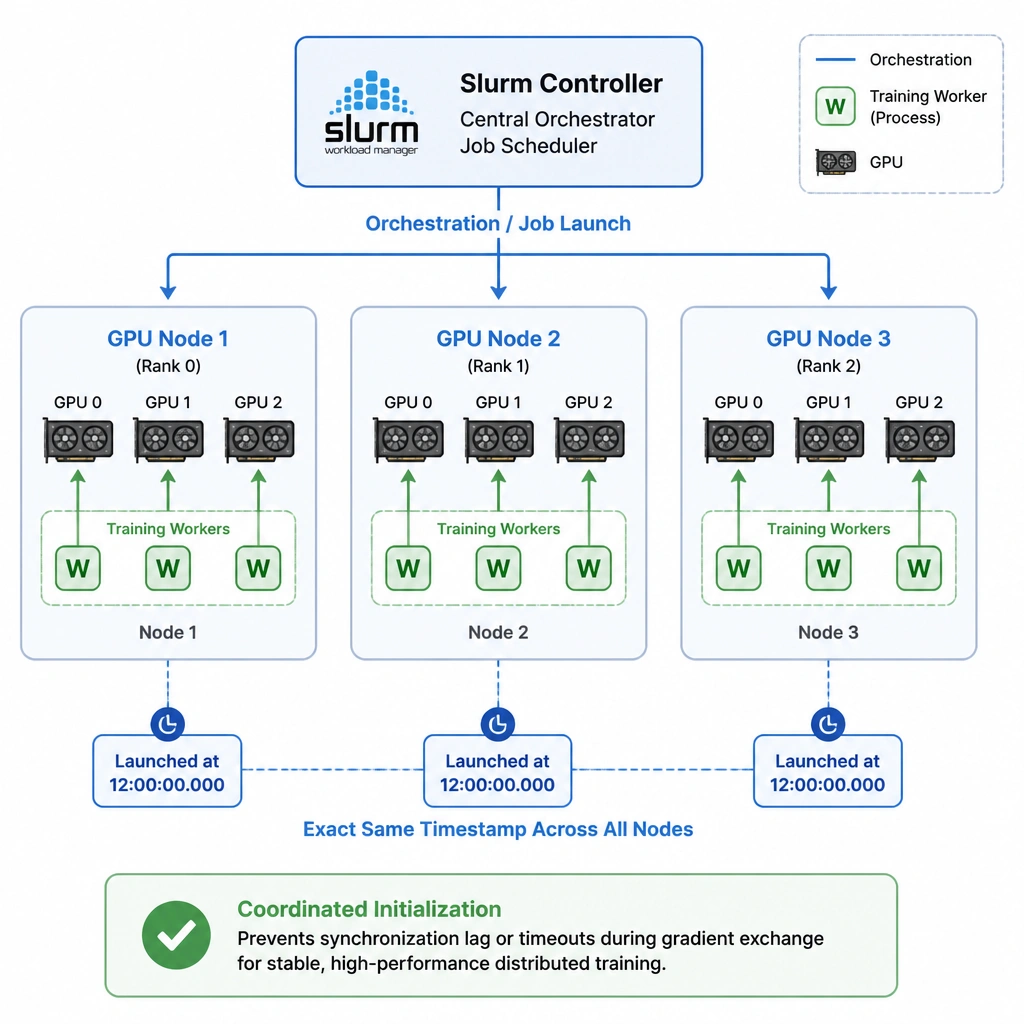
Think of distributed AI training like a rowing team. If some rowers start paddling five minutes after everyone else, the boat is just going to spin in circles. When you're training a model across multiple GPU nodes, all the training processes must launch at the exact same moment. If they don't, the nodes that started first will sit there blocked, waiting for the others, leading to a complete deadlock. Slurm solves this using its launcher capabilities (like srun) to spin up all the distributed tasks across all nodes simultaneously. Remember, Slurm doesn't know anything about your neural network's layers or your data cleaning scripts—its job is pure coordination and orchestration of the execution run.
Full explanation below image
Full Explanation
Distributed model training using frameworks like PyTorch (via DistributedDataParallel) or Horovod relies on synchronous communication libraries (such as NCCL). During training, all GPU workers compute gradients on their local data shards and then perform an AllReduce operation to synchronize and average the gradients before updating the model weights. If workers do not initialize and begin execution simultaneously, the early-starting nodes will hang while waiting to establish communication with the late-starting nodes, leading to timeouts and failed jobs. Slurm addresses this by providing coordinated process launching capabilities through utilities like srun. The Slurm controller coordinates with the launch daemons on all allocated compute nodes to ensure that all tasks are spawned simultaneously, with the correct environment variables (such as rank and world size) automatically injected.
Let's look at why the other options are incorrect: Option A is incorrect because Slurm is a cluster resource manager and job scheduler. It does not have built-in awareness of neural network architectures, layer optimization, or model compiling. Option B is incorrect because data preprocessing and feature extraction are managed within the machine learning application stack (using libraries like Pandas, TensorFlow Data, or custom PyTorch Datasets) and are not handled by the Slurm scheduling system. Option D is incorrect because hyperparameter optimization (like adjusting learning rates or batch sizes) is managed by dedicated software frameworks running inside the user's application space, not by the cluster's workload manager.