
An autonomous manufacturing facility requires real-time computer vision processing to detect assembly-line defects on the factory floor with sub-millisecond response times. Why is an on-premises GPU deployment preferable to a public cloud GPU service for this application?
Select an answer to reveal the explanation.
Short Explanation and Infographic
Imagine you're running a high-speed assembly line, and you need to stop a robotic arm the split second a defect is detected. If you send that video feed up to the cloud, wait for it to process, and wait for the signal to come back down, you've just crashed your production line! Latency kills. That's why on-premises GPUs are the way to go here. By keeping the hardware right next to the factory floor, you eliminate that long trip over the internet. You get predictable, ultra-low latency, and you don't have to worry about your internet connection dropping. Sure, the cloud is great for scaling, but for real-time edge operations, on-prem rules!
Full explanation below image
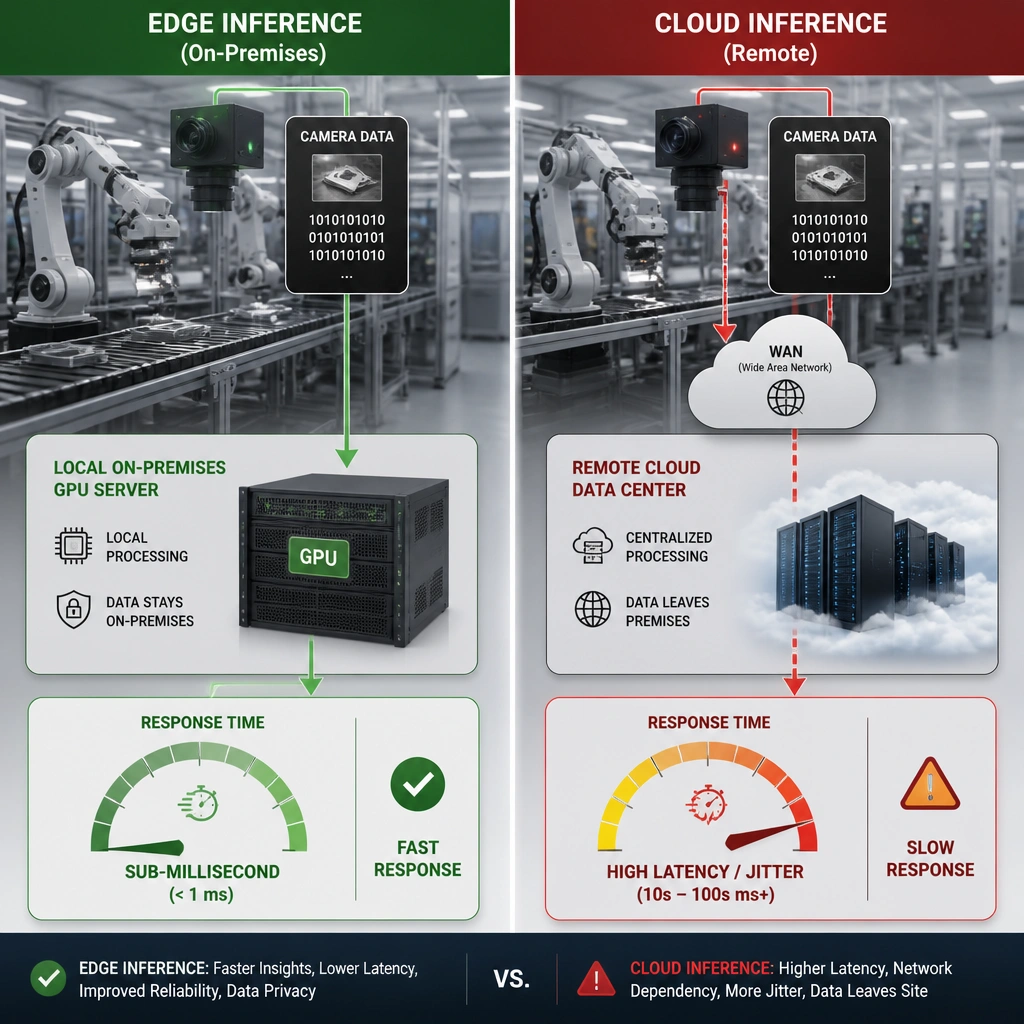
Full Explanation
While cloud GPU infrastructure offers unmatched scalability and elasticity, on-premises GPU deployments are highly advantageous for edge applications and real-time processing environments. The primary technical driver in these scenarios is the reduction of network latency. In a cloud model, data must travel from the local devices (like high-speed factory cameras or medical imaging equipment) over a wide area network (WAN) to the cloud provider's data center, undergo inference processing, and then return. This round-trip time introduces unpredictable network jitter and latency overhead that is unacceptable for time-critical, closed-loop control systems. Local, on-premises GPU installations eliminate WAN traversal entirely, delivering deterministic, sub-millisecond processing speeds and ensuring operational continuity even in the event of an external network outage.
Let's look at why the other options are incorrect: Option A is incorrect because temporary, experimental, or prototyping workloads are ideal candidates for the cloud. Renting cloud GPUs for a few days avoids the heavy initial capital investment required to purchase physical GPU nodes. Option C is incorrect because scaling physical GPU hardware on-premises requires a lengthy process of purchasing, shipping, mounting, and configuring servers. It does not scale dynamically in the way cloud virtual instances do. Option D is incorrect because buying and hosting your own GPU hardware represents a capital expense (CapEx) model. Cloud computing utilizes an operational expense (OpEx) model, allowing businesses to pay only for the resources they consume rather than investing upfront in depreciating physical assets.