
Storage infrastructure in AI pipelines must be designed for varying access patterns. During which stage of the machine learning lifecycle is the storage system subjected to a "Write Once, Read Rarely" (WORR) pattern?
Select an answer to reveal the explanation.
Short Explanation and Infographic
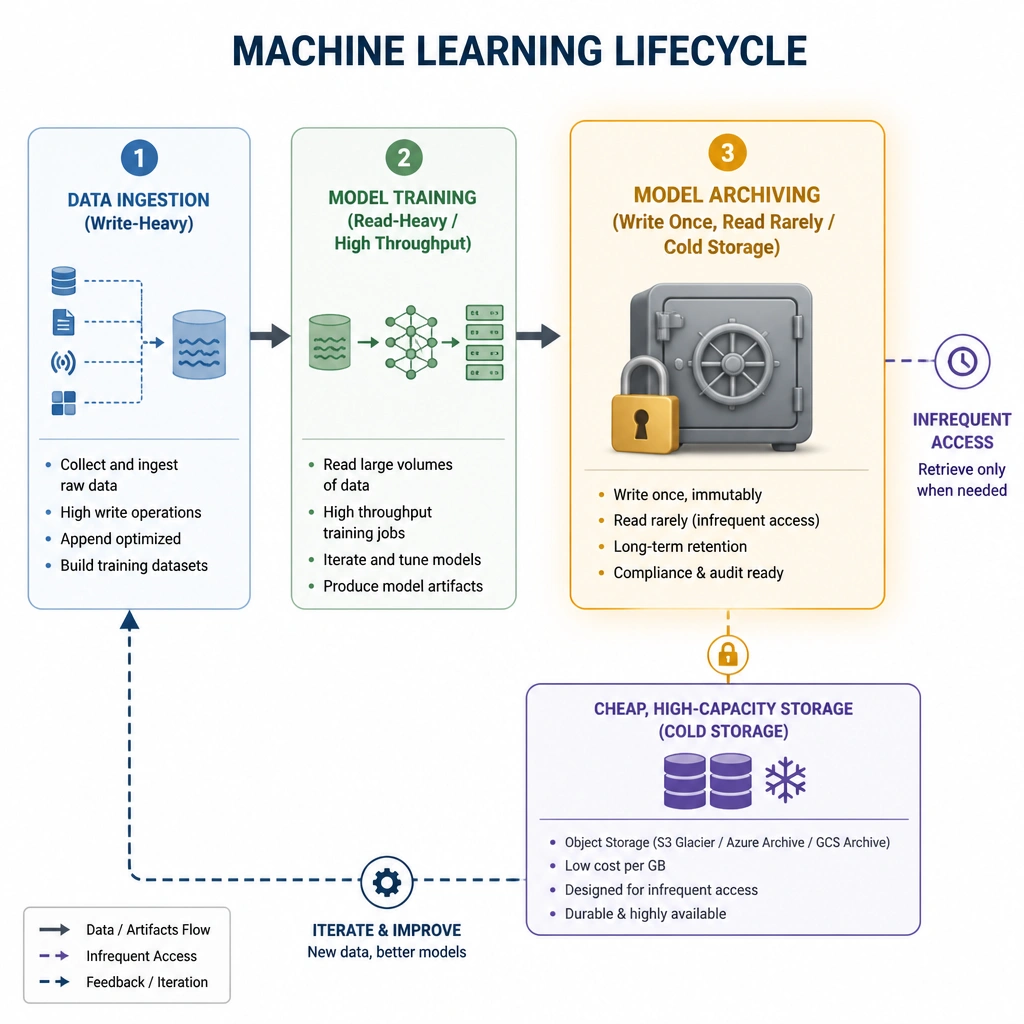
Here's the deal: different parts of your AI pipeline treat storage very differently. Think of it like this: when you're training a model, the GPU is constantly reading the same training images over and over again for every epoch—that's "read-heavy." But what happens when you've finished training and need to store the historical datasets, logs, and model checkpoints for compliance or backup? You write those files once, and hopefully, you never have to look at them again unless there's a system crash or an audit. That's your "Write Once, Read Rarely" (WORR) pattern, and it belongs right in the model archiving and backup phase. Using high-performance NVMe storage for archiving is just wasting money!
Full explanation below image
Full Explanation
Understanding storage access patterns is crucial for optimizing cost and performance in machine learning infrastructure. A "Write Once, Read Rarely" (WORR) pattern—often referred to as cold storage—occurs when data is written to a storage medium and is infrequently accessed thereafter. In the machine learning lifecycle, this pattern is characteristic of the model archiving and backup phase. During this phase, completed model checkpoints, historical training logs, raw datasets used for specific compliance-regulated runs, and metadata are saved to ensure reproducibility and disaster recovery. Because these files are rarely retrieved, organizations typically store them on high-capacity, lower-cost storage tiers (such as object storage or tape libraries) rather than expensive high-speed NVMe drives.
Let's look at why the other options are incorrect: Option A is incorrect because the model training phase exhibits a highly repetitive read-heavy pattern. The GPU cluster reads the same training datasets repeatedly across multiple epochs, requiring high-throughput, low-latency storage (like distributed parallel file systems or local NVMe caching) to avoid starving the GPUs. Option C is incorrect because the data ingestion phase is highly write-intensive. Raw data from IoT sensors, user logs, or external APIs is constantly being stream-written to a landing zone or data lake. Option D is incorrect because feature engineering and extraction are read-write intensive. Raw data is read, processed through various mathematical transformations, and the resulting features are written back to a database or feature store for model consumption.